Nina Varsava1*
Abstract
This Article presents original results from a large-scale empirical study of the relationship between opinion publication and judge demographics at the federal courts of appeals, focusing on gender and race. Opinion publication is significant because published federal appellate opinions, in contrast to unpublished ones, represent binding precedent and so shape the law. I find that, in the aggregate and holding other factors constant, opinions authored by men are more likely to be published than those by women, and opinions by white judges more likely to be published than those by Black judges. I find further that opinions by women and by Black judges receive fewer citations. If we control for publication status, however, we no longer see this citation disadvantage, which suggests that the publication disparities may be responsible for it. My results indicate that judges from historically marginalized groups may have less opportunity than others to influence the law through published opinions. While the conversation around representation on the courts has revolved around the numbers of women and people of color on the bench, my study suggests that increasing these numbers may be insufficient for ensuring that these groups have equal opportunities to exercise voice and influence in the legal system. I discuss how gender- and race-based biases and power dynamics, together with the informal, non-transparent, and discretionary character of publication decisions, could lead to disparities in publication rates. This discussion raises pressing questions about the legitimacy of the opinion publication system in its current form. I then propose reforms that would mitigate the kind of disparities identified and would make for a more intelligible and better justified system of publication and precedent.
Introduction
The federal courts of appeals have a two-tier system of judicial opinions: “published” and “unpublished.” Published judicial opinions represent binding precedent, whereas unpublished ones do not.2 Published opinions, then, have much greater legal force just by virtue of their publication status, and the assignment of publication status to opinions is a critical part of judicial administration at the federal courts of appeals.
The judges responsible for deciding a case determine whether the decision will be published and mark it accordingly as “for publication” or not, but beyond this little is known about how publication status is assigned. Courts do not give reasons to explain their publication decisions, nor are those decisions subject to other sorts of accountability or transparency mechanisms. Each of the federal courts of appeals does have a set of official guidelines describing qualities of publishable versus unpublishable decisions, but the guidelines are vague and open-ended, relying on subjective criteria like “importance” and “significance,” and would seem to leave judges and their staff a great deal of discretion.3 Given this discretion, we might expect an opinion’s publication status to depend on legally irrelevant factors, including the characteristics of the authoring judge.
This Article explores the relationship between authoring judge characteristics on the one side and opinion publication status on the other. I present original results from a large-scale empirical study of judicial decisions across the United States federal courts of appeals from 2005 through 2017.4 Using quantitative empirical methods, I test whether and to what extent the publication rates of judicial opinions are associated with authoring judge attributes, focusing on gender and race. Because only half of the circuits issue substantial portions of both signed published and signed unpublished decisions, I focus on these circuits in my main analyses.
My findings suggest that, in the aggregate and holding other relevant factors constant, opinions by men are more likely to be published than those by women and opinions by white judges are more likely to be published than those by Black judges. Further, opinions by judges who received their law degree from a school ranked in the top fourteen are more likely to be published than others, and this factor makes a bigger positive difference for women than it does for men. Other judge characteristics are also significantly associated with publication rates. In general, judges from more historically privileged groups seem to be more likely than other judges to author opinions that are officially published—the kind of opinions that set precedent.
To further explore the relationship between judge attributes and legal impact, I test whether attributes of an opinion’s author are associated with the citations it receives in subsequent cases. Here I find, again in the aggregate and holding other factors constant, that both opinions by men and by white judges do better in terms of citations than others. However, if publication status is controlled for, opinions by women and by Black judges no longer have lower citation scores. This suggests that gender- and race-based disparities in publication may explain the citation disadvantage of women and of Black judges. Other judge attributes, such as law school rank, are also significantly associated with citations.
As of 2022, about thirty percent of sitting U.S. Article III federal judges were women.5 About twenty-two percent were people of color.6 President Biden’s judicial appointments have served to decrease the representation gaps on the federal bench.7 Although women and people of color now comprise a substantial proportion of federal appellate judges, historically the numbers were much lower.8 Judging in the United States has long been a male- and white-dominated field. And even when women and people of color make it onto the bench, their professional realities might look different from those of white men, who fit the traditional mold of the judge. Judges from historically underrepresented groups might have to work harder to prove their capability for the role; they might be expected to perform different kinds of tasks than other judges, and in particular lower-profile or lower-status work; and their contributions might be discounted compared to other judges.9
What do gender and racial biases in the judiciary and legal profession more broadly have to do with opinion publication? Published opinions are understood to be more important and authoritative than unpublished ones. If gender and race stereotypes and biases affect judicial administration, then—given the informal, non-transparent, and discretionary character of publication decisions—we might expect to see disparities in publication rates such that opinions by women and by people of color are less likely to be published than others.10 If judges perceive women and people of color as somehow inferior qua judges, then those judges might receive less important opinion assignments or their opinions might be perceived as less valuable, leading to lower publication rates. Given the lack of transparency around publication decisions and seemingly broad discretion that judges have in making these decisions, it would not be surprising if biases operate undetected in this area of judicial administration.
Published opinions represent the primary platform from which appellate judges exercise and accumulate power in the legal system. We shouldn’t assume that judges from all backgrounds will have the same access to this platform. The relationships I uncover between opinion author demographics and publication rates may reveal one of the subtler ways in which traditional power dynamics continue to affect the judicial process and profession, and the legal system more broadly. My findings also raise concerns about the legitimacy of the opinion publication system in its current form.
Further, the study shows how merely increasing the numbers of women and people of color on the bench may be insufficient for ensuring that these groups have equal opportunities to exercise voice and influence in the legal system. As Rachael Hinkle observes, “[a] seat at the table matters. But making sure everyone at the table has an equal voice matters too”; we should therefore “look not only at the representation of women and minorities in policymaking positions, but also at how institutional rules and task distribution shape the power they exert.”11
The observational nature of case data prevents us from drawing any definitive conclusions about the cause of inter-judge disparities in opinion publication. Regardless of the causal mechanism behind these disparities, however, if we care about gender and racial equality in the judiciary and legal system, we should be concerned about publication disparities that track gender and race, since they may be indicative of disparities in the extent to which judges set precedent and thus shape the law. Nevertheless, the present study should be taken as exploratory and as a first-cut attempt to examine the relationship between opinion authorship and publication status and to shed light on patterns in judicial administration that may be indiscernible without bringing quantitative methods to bare on large corpora of decisions.
In Part I, I review the publication system at the federal courts of appeals, discussing the rules and practices surrounding publication and explaining the significance of opinion publication status. In Part II, I describe my empirical strategy and present the results. Next, in Part III, I explore possible explanations for gender- and race-based differences in publication rates, drawing on related theoretical and empirical literature. In Part IV, I discuss normative implications of my findings and propose reforms to judicial administration designed to mitigate publication disparities and to make for a more intelligible and better justified publication system. Finally, in the Conclusion, I summarize the study’s contribution to the related empirical and normative literature and propose directions for future research.12
I. Judicial Administration and the Publication System
This Part begins with a description of the hierarchical relationship between published and unpublished opinions, explaining why the distinction exists and why it matters. I then turn to a discussion of the rules and practices surrounding opinion publication to offer a sense of how publication decisions are made and why we might expect to see variation in publication rates across judges.
A. The Opinion Hierarchy
Precedential status is the main legal difference between published and unpublished decisions. Published decisions constitute binding precedent within a circuit; unpublished ones do not.13 As Norman Williams puts it, we have “two categories of decisions”: “one, superior category containing published decisions, which are afforded full precedential status, and a second, inferior category containing unpublished decisions, which have no or limited precedential status.”14 Whereas unpublished decisions historically were made available only to the parties to the case, they now appear in legal research databases and they also appeared in West’s Federal Appendix until it was discontinued in 2021.15 And so the term unpublished is a bit of a misnomer.16 It refers to the fact that the court designated the decision as not for publication and that the decision accordingly does not appear in the Federal Reporter.17
Other scholars have observed that regrettably little is known about the relationship between the characteristics of opinion authors and publication status, and that it would be interesting to explore this relationship—but scholars have assumed that such studies would be infeasible because unpublished opinions tend to be unsigned (meaning that no authoring judge is named in the decision).18 That assumption is mistaken though. In some circuits (the First, Second, Seventh, Eighth, Ninth, and D.C.), unpublished decisions are never or rarely signed. But the other circuits issue substantial numbers of signed, unpublished opinions.19 Accordingly, the characteristics of the authoring judges of unpublished opinions are readily ascertainable in half the circuits. This fact is important for the purposes of my empirical study: since I examine the relationship between publication status and authoring judge attributes, in my main analyses I focus on the six circuits that have nontrivial numbers of signed, unpublished opinions.
The concept of unpublished opinions gained traction in the federal courts of appeals in the 1960s, when the Judicial Conference of the United States resolved that federal appellate judges need publish “only those opinions which are of general precedential value.”20 By the end of the 1970s, each of the courts of appeals had adopted “limited publication plans” in accord with the Judicial Conference’s mandate.21 The primary purpose of limiting publication was to save judicial resources, which seemed necessary given rapidly rising caseloads.22 Judges and scholars alike still cite judicial efficiency as the primary reason for having this two-tier system of opinions.23
Unpublished opinions are seen as inferior to—both less important and lower quality than—published ones.24 The predominant view is that unpublished opinions do not “need to satisfy a critical audience” and that judges accordingly spend little time and effort on them.25 Compared to a published opinion, an unpublished opinion’s “[p]rose need not be as polished, nor [its] scholarship as thorough.”26 As Deborah Merritt and James Brudney put it, “cases decided by unpublished disposition” have a “second-class status” in the legal world.27 Regardless of the actual content of an unpublished opinion, then, the legal community will likely discount its importance and quality just by virtue of its publication status.28
Historically, the courts of appeals disfavored or even outright prohibited parties from citing unpublished opinions. In the early 2000s, five federal courts of appeals forbade litigants from citing them.29 And the courts that did not forbid citation nevertheless disfavored it.30 In 2007, the Federal Rules of Appellate Procedure were revised to compel all federal courts to permit citation to any unpublished federal judicial opinion issued after 2006.31 Rule 32.1, though, “is extremely limited”: “[i]t does not dictate the circumstances under which a court may choose to designate an opinion as ‘unpublished,’ or specify the procedure that a court must follow in making that determination”; and it “says nothing about what effect a court must give to . . . unpublished opinions.”32 The courts of appeals now generally permit citation of unpublished decisions, but some still have rules that “disfavor” or even prohibit citation to unpublished opinions issued before 2007.33 Courts are not bound to follow unpublished decisions, and litigants do better to find published decisions to support their arguments rather than relying on unpublished ones.
As Jonathan Kastellec notes, “because only published decisions are fully precedential, they are the vehicle through which the Courts of Appeals set legal policy.”34 Given the discretion that judges have over publication decisions, we might expect that some judges, and perhaps some groups of judges, will have greater influence over the course of the law than others. As I show in Part III below, my empirical study of publication rates across judges suggests that, holding other relevant factors constant, men’s opinions are more likely to be published than women’s, and opinions by white judges are more likely to be published than those by Black judges. The data indicate that male judges and white ones might wield a disproportionately large share of judicial power, even if we set aside the issue of unbalanced demographic representation in the judiciary.
B. Publication Criteria
The Federal Rules of Appellate Procedure do not delineate publication criteria, but the federal courts of appeals have their own internal publication rules. These rules are similar and overlapping across the circuits. For example, the Fourth Circuit’s publication rules, which are typical, provide that an opinion is not to be published unless it “establishes, alters, modifies, clarifies, or explains a rule of law within th[e] Circuit,” “involves a legal issue of continuing public interest,” “criticizes existing law,” “contains a historical review of a legal rule that is not duplicative,” “resolves a conflict between panels [within the] Court, or creates a conflict with a decision in another circuit.”35
A common theme of the provisions regarding publication is that panels should publish only opinions that are likely to be of interest and importance beyond the specific dispute and parties involved.36 For example, the Fifth Circuit’s rules provide that opinions “that may in any way interest persons other than the parties to a case should be published.”37 According to the Ninth Circuit’s rules, an opinion is to be published if it “[i]nvolves a legal or factual issue of unique interest or substantial public importance.”38 The First Circuit prohibits publication of opinions that are unlikely “to break new legal ground or contribute otherwise to legal development.”39 Similarly, under the Eleventh Circuit’s rules, if the judges on the decision panel believe that an opinion has “no precedential value,” then it shall not be published.40 Across the circuits, the rules governing publication reflect the idea that a decision “is worthy of publication if it will be a guide to future litigants or contribute to legal jurisprudence generally.”41 Although the circuits have similar and overlapping publication rules, given the generality of the rules and the subjectivity of the criteria, we should not be surprised to see considerable variation in publication practices across the circuits and also across judges within them.
Further, circuit rules leave considerable discretion to the judges assigned to a case (the “panel”) to determine whether an opinion warrants publication, with some circuits giving special latitude to the authoring judge. The Fourth Circuit’s rules provide that, “[o]pinions . . . will be published if the author or a majority of the joining judges believe the opinion satisfies one or more of the standards of publication.”42 The First Circuit invites the opinion writer to “recommend[] that the opinion not be published,” but also permits any judge on the panel to veto that determination.43 On the Fifth Circuit, opinions are to be published unless all panel members agree that publication is not justified under the delineated criteria for publication,44 whereas on the Eleventh Circuit an opinion is not to be published “unless a majority of the panel decides to publish it.”45 Some circuits allow any panel member to “request that a decision be published.”46 And some permit any judge on the court to request review of a decision not to publish an opinion.47
Informal norms also guide publication decisions. It’s difficult to gain a complete sense of these norms from the outside, but some anecdotal information is available. As David Law notes, federal appellate judges have reported that, regardless of the official rules, “it is often the author of the opinion who decides whether to publish—an understandable courtesy in light of the fact that the author is responsible for the effort of preparing an opinion for publication.”48 Moreover, the formal rules generally do not specify at what point in the adjudicative process publication decisions are to be made or finalized. According to some accounts, judges make an initial publication decision during “conference,” when they meet to discuss the case and voice their preliminary votes on the merits, but the publication decision may be revisited later.49 Some accounts indicate that the panel decides whether an opinion will be published after the opinion is completed.50
Some commentators suggest that publication assessments are relatively easy to make and that judges generally apply publication criteria consistently and objectively. Judge Boyce Martin claims that judges “seldom make mistakes in dividing up the cases between published and unpublished.”51 He suggests that if judges are capable of deciding cases and trusted to do so, then surely they are capable of deciding which cases warrant publication and should be trusted to make those decisions as well.52
Others, however, observe that individual judges seem to have different ideas about what warrants publication, and that existing publication practices are questionable and are inconsistent across judges. Former federal appellate judge Richard Posner, for example, maintains that “criteria for when to publish an opinion are . . . imprecise and nondirective,” that “they amount to little more than saying that an opinion should not be published unless it is likely to have value as a precedent,” and that “[j]udges often will not know whether an opinion is likely to have such value.”53 Some scholars have expressed skepticism about the existence of “a clear distinction between opinions that deserve publication and those that do not” and whether “judges can and do make that distinction consistently and faithfully,” especially when they are deciding on the importance of their own work products.54 Ryan Copus observes that the publication rules are “essentially tautological” and “wildly overbroad” and that there are “no uniformly enforced or practiced guidelines for making the publication decision.”55 He questions the ability of judges to identify the cases that have the most precedential potential and therefore warrant publication.56
Previous empirical research indicates that publication rates vary across the circuits and also within circuits based on which individual judges are on the decision panel, which suggests that judges do not apply the publication criteria consistently.57 Merritt and Brudney identify correlations between characteristics of panel members and publication.58 And Keith Carlson, Michael Livermore, and Daniel Rockmore likewise find evidence to suggest that publication status is a function not only of case characteristics, but also of panel characteristics and in particular the ideological makeup of decision panels.59 Based on interviews with federal courts of appeals judges, Jennifer Bowie, Donald Songer, and John Szmer conclude that official publication criteria “take different concrete meanings in the minds of different judges and[,] . . . as a result, which decisions are actually published depends a lot on which judge wrote the opinion.”60
Given the combination of judicial discretion and non-transparency in the publication decision, we might expect an opinion’s publication status to depend to some extent on legally irrelevant factors, including judge characteristics, and perhaps especially on attributes of the authoring judge. In the only existing study that I am aware of on the relationship between opinion author attributes and publication status, Elizabeth Tillman and Rachael Hinkle examine how the attributes of opinion assignors and authors relate to publication.61 They test whether an assignor is more likely to assign a published opinion to a judge who shares the assignor’s gender and race. They find that “White and male judges [are] more likely to author published opinions and less likely to author unpublished opinions,” but that the “difference is only statistically significant when the opinion assignor is male or White”: “[b]oth male and White assignors are significantly more likely to assign unpublished than published opinions to judges who do not share their relevant demographic characteristic.”62 While the authors study a somewhat different question than mine and use a different empirical approach and dataset, my findings of gender and race imbalances in opinion publication are broadly consistent with theirs and raise overlapping concerns.63
C. Case and Opinion Assignment
At the federal courts of appeals, cases are typically assigned to panels composed of three judges, and for each case one of those judges is assigned to write the majority opinion. Both points of assignment could potentially lead to disparities in publication rates across judges, even if publication criteria are applied uniformly across cases.
First, on case assignment, if publication-worthy cases are more likely to be assigned to some judges than others, then publication rates might end up varying with judge characteristics for that reason. Most of the federal appellate courts, however, have rules that provide for the random assignment of judges to panels and panels to cases. For example, the Fourth Circuit’s internal operating procedures indicate that the Clerk of Court merges a list of cases with “a list of three-judge panels provided by a computer program designed to achieve total random selection.”64 And scholars generally take panel and case assignment to be random.65 As Edward Cheng writes, “well-established rules and norms within the courts of general jurisdiction require the random assignment of cases [to judges].”66 Empirical studies investigating the matter of randomization in panel and case assignment have found that such assignment is more or less random, with some exceptions.67
Second, on opinion assignment, even if publication decisions are made objectively based on case characteristics like the importance or novelty of the facts, publication rates might become associated with judge demographics if opinion writing assignments are not randomly distributed across demographic groups. As Bowie, Songer, and Szmer observe, “[t]he selection of the judge to write the opinion of the court is arguably one of the most important decisions of the court, but the process has received virtually no previous scholarly attention” and “little is known about who writes for the court or what criteria are used in practice to make the assignment.”68
Across the circuits, the presiding judge of the decision panel is generally responsible for making opinion assignments.69 None of the circuits have rules requiring that writing assignments be randomized. Some of the circuits’ rules do state that “[j]udges do not specialize” in issue areas and that “assignments are made so as to equalize the workload of the entire session.”70 In the Ninth Circuit, writing assignments apparently rotate among the judges on a panel.71 As other scholars have observed, however, given the random case assignment rules and the absence of such rules for opinion assignment, opinion writing is one of the few areas in which judges are able to specialize in terms of subject matter and “the assigning judge may distribute opinions based on the panel members’ special expertise or interest.”72 Empirical studies have uncovered evidence of this kind of specialization in opinion writing.73
In sum, then, there are multiple different points in the judicial administration pipeline that could lead to disparities in publication rates across judge characteristics: the assignment of cases to panels, the assignment of opinions to judges, and publication determinations made after opinions are assigned. Those publication decisions might be made before the opinion is drafted or during or after the drafting process. Given rules and norms of randomized case assignment, this part of judicial administration would not seem to leave much room for the creation of demographic disparities in publication rates. The lack of randomized opinion assignment, however, and the substantial judicial discretion around both opinion assignment and publication determinations, present substantial opportunity for demographic publication disparities to emerge.
D. Why Test Publication?
Much of the scholarly attention devoted to the topic of gender, race, and judging has focused on the question of whether judge gender or race makes a difference to case outcomes.74 Over a decade ago, Christina Boyd and coauthors noted that scholars had already “produced over [thirty] systematic, multivariate analyses of the extent to which female judges make decisions distinct from their male colleagues . . . or cause male judges to behave differently [in terms of the outcomes they vote for] than they otherwise would.”75 The results of these studies are mixed: some find no gender differences in case outcomes, whereas others find significant differences; the same is true for studies of judge race. Taken together, the literature suggests that when it comes to some legal issues—civil rights, for example—women decide cases differently than men, and likewise Black judges decide differently than white ones, but in other areas gender and race make little or no difference to outcomes.76
The idea that gender and race might affect case outcomes has also attracted the attention of the media and the public. Former Justice O’Connor’s position on judging and gender—that wise judges come to the same conclusions in cases regardless of their gender—was widely publicized.77 And so was now-Justice Sotomayor’s statement that she “would hope that a wise Latina woman with the richness of her experiences would more often than not reach a better conclusion than a white male who hasn’t lived that life.”78
But the demographic profile of judges might shape the adjudicative process in many ways besides affecting case outcomes.79 As Laura Moyer and coauthors point out, “[w]hile much of the extant work on gender and race in the judiciary focuses on the voting behavior of judges, another profitable avenue for inquiry” explores “ways in which actors and institutional rules or norms interact to shape expectations and how such interactions shape the distribution of power within an institution.”80 Opinion publication represents a major but understudied avenue through which power is distributed across judges. By exploring the relationships between judge attributes and metrics like publication rates, we can shed light on the relationship between gender and race on the one side and judicial process and administration on the other. If the opinions of some judges are less likely to be published than those of their peers, then the former judges will likely have comparatively less visibility and legal impact.
My empirical findings raise questions and concerns about gender and racial inequality and power dynamics on courts, as well as about the legitimacy of the publication system in its current form. In the next Part (II), I describe my data and methodology and present my empirical results in detail.
II. Empirical Study
My empirical study primarily addresses how the publication status of judicial opinions differs depending on the gender, race, and other characteristics of the authoring judge. Secondarily, my study addresses how the citations (in terms of quantity and importance) that an opinion receives differ depending on authoring judge characteristics. My analysis should be taken as exploratory and descriptive—a first step at illuminating patterns in publication rates according to authoring judge attributes in the federal courts of appeals.
A. Data and Methods
My final dataset for analysis includes all available majority (or lead) opinions with a reported author, both published and unpublished, for all United States federal courts of appeals except the Federal Circuit, for the period of January 1, 2005, to December 31, 2017.81 I selected this time range because even though the Federal Appendix came into being in 2001, unpublished decisions from some courts did not consistently appear in it until 2005, and because my source for the case data had comprehensive coverage only through 2017 at the time of data collection.82 By “unpublished” decisions, I mean decisions that the issuing court has labelled as “not for publication” or something to that effect, but that nevertheless appear in the Appendix of the Federal Reporter.83 Published decisions are included in the main volume of the Federal Reporter—given my timeline, this is the Federal Reporter, Third Series. Since I am interested in authoring judge characteristics, I exclude all unsigned opinions.84
I control for multiple factors at the case and judge levels that we might expect to vary with gender or race on the one hand and publication status or citations on the other. The case-based covariates include year, circuit, topic, and unanimity (whether a separate opinion was issued in the decision). The authoring judge covariates include experience or tenure (years served in current appointment), race, ideology, chief judge status (whether the judge is the issuing court’s chief judge), senior status, visiting status (whether the judge is visiting from another court), presiding judge status (whether the judge is the presiding judge), and law school tier (whether the judge’s primary law degree is from a “top-fourteen” law school).85 I group judge race into three categories: Black; white; and Hispanic, Asian, Pacific Islander, Hispanic/white, or Pacific Islander/white (“other” in the regression tables).86 I combine the latter racial groups because of the low numbers of judges in any one of them. I use the party of the judge’s appointing president as a proxy for ideology.87
To create my dataset, I merged data from three databases. I collected the decisions from the Caselaw Access Project (CAP)—a database of cases produced by Harvard Law School, which includes the full text of decisions reported in the Federal Reporter Third and Federal Appendix.88 CAP provides various metadata about the opinions, including opinion type (majority, dissent, etc.) and author name. I retrieved judge demographic data from the Federal Judicial Center (FJC)’s judge database, which contains biographical information on federal judges from 1789 to the present.89 I matched the opinion data to the judge data using judge names. In addition to demographic attributes, I collected career data such as appointment dates and senior status dates.
To generate topics for the cases, I relied on the FJC’s Integrated Database (IDB).90 I merged the CAP decisions to the IDB using case docket number, decision date, and court.91 The IDB provides nature of suit (NOS) and appeal type (APPTYPE) codes, which can be used to identify case subject matter.92 Using these codes and following the topic construction procedure that Rachael Hinkle delineates in recent work, I assigned the following (mutually exclusive topics) to the cases: Criminal, Civil, Civil Rights, Administrative, Prisoner Petitions, Bankruptcy, and Original Jurisdiction.93 Because relatively few cases belong to each of the Bankruptcy and Original Jurisdiction categories, I combined these into a category designated “Other.” Figure 1 illustrates the distribution of cases by topic.94
Figure 1: Case Topics
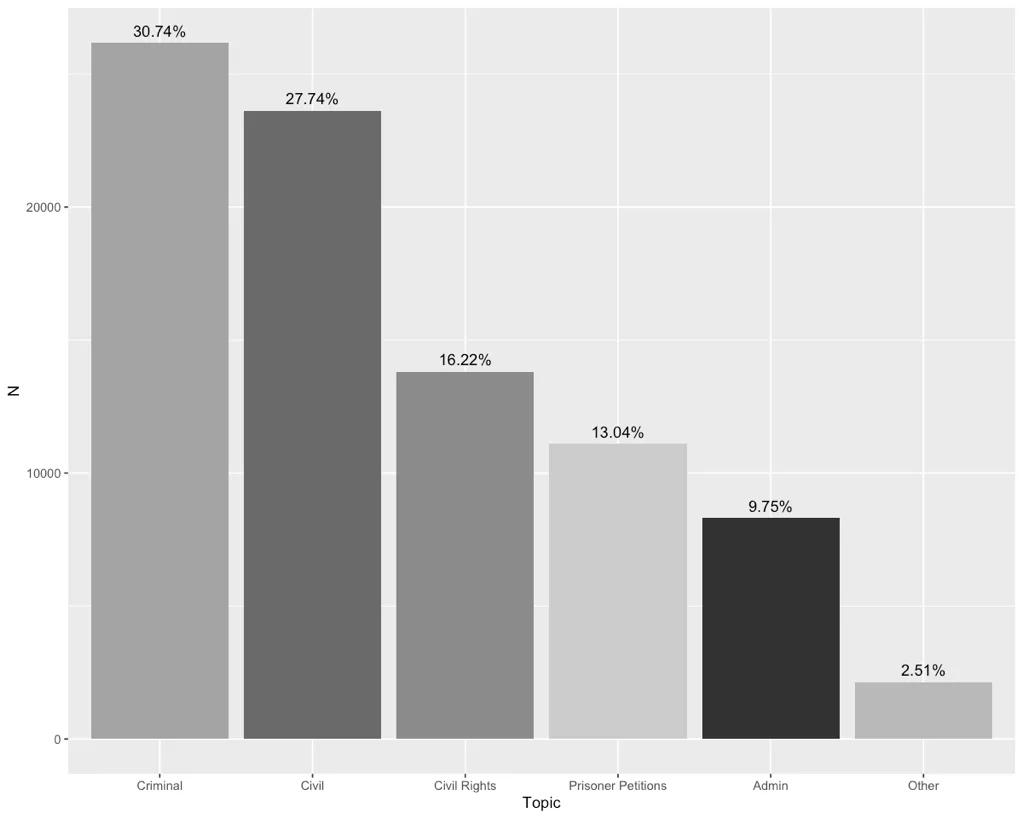
Table 1 lists the numbers of judges corresponding to each demographic group who appear as opinion authors in the dataset.95
Table 1: Judge Demographics96
|
Judge Attribute |
N Judges |
Percent |
|
Gender – woman Gender – man |
225 720 |
23.83 76.17 |
|
Race – Black97 Race – white Race – other98 |
73 799 73 |
7.72 84.55 7.72 |
|
Appointing party – Democrat Appointing party – Republican |
449 497 |
47.46 52.54 |
|
Law school – top 14 Law school – other |
385 560 |
40.74 59.26 |
|
TOTAL |
945 |
100.00 |
For a sense of the intersectional representation, the data includes only twenty-nine Black women judges and twenty-one women in the other judges of color group (fifteen of whom are Hispanic and six of whom are Asian). My full dataset for analysis includes a total of 85,175 opinions, which are distributed across the twelve geographical federal circuits as shown in Figure 2.99
Figure 2: Number of Signed Opinions by Court and Publication Status
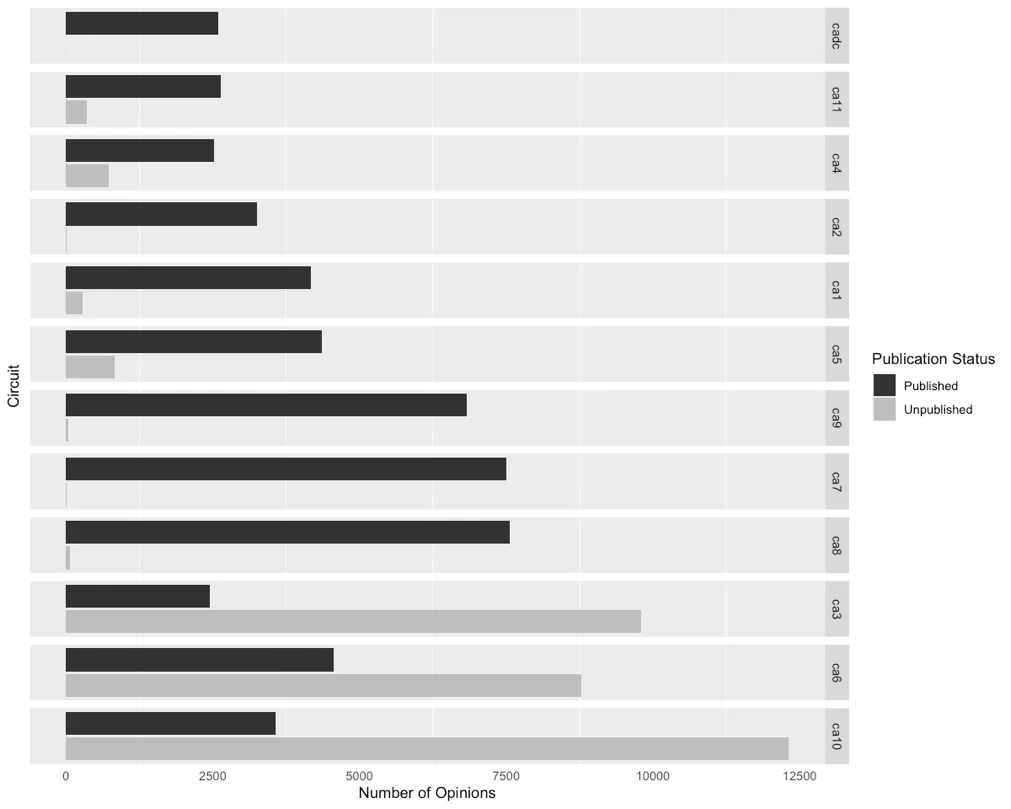
Notes: Courts are ordered from top to bottom by smallest to largest total number of signed opinions.
Overall, 61% of the opinions in my dataset are published. This proportion does not vary much across the thirteen years of study,100 but the proportion of published opinions does vary considerably across circuits. Note that half of the circuits (the First, Second, Seventh, Eighth, Ninth, and D.C. Circuits) never or only rarely issue signed opinions that are unpublished.101 This is why my data includes very few unpublished opinions for these circuits. Half of the circuits (the Third, Fourth, Fifth, Sixth, Tenth, and Eleventh), however, issue substantial proportions (10% or more) of opinions that are both unpublished and signed. I take advantage of this fact to test for relationships between author characteristics and publication status. Because I am primarily interested in the relationship between author attributes and publication status, and we can expect to gain traction on this question only for courts that issue substantial proportions of both published and unpublished opinions that are signed, my main analysis focuses on the six circuits for which this is true.102 This key subset of the data consists of 52,885 opinions, 38% of which are published.
The most common measure of or proxy for opinion importance or precedential value is citation counts, and in particular the number of subsequent decisions in which the opinion is cited. The more cases that an opinion is cited in, the greater its supposed precedential value.103 For my citation analysis, I use case PageRank percentile scores, generated by CAP.104 PageRank is an algorithm originally created by Larry Page and Sergey Brin to measure the significance of web pages according to both the quantity and quality of links from other web pages to the page of interest.105 CAP has applied the PageRank algorithm to judicial decisions to estimate their significance.106 This would seem to provide a more informative measure of legal impact than citation counts alone, since the algorithm takes into account both the number of cases that cite a case and the importance of each citing case (measured by the number of cases that cite it). In the citation analysis, I control for the same case and judge characteristics that are included in the publication regression models.
To test for gender- and race-based differences in publication status, I use linear probability models with publication status (published versus unpublished) as the outcome variable; these models reveal the difference in probability of an opinion being published if it were written by a judge of one group compared to another.107 To test for gender differences in citations, I use ordinary least squares linear models, since the dependent variable (PageRank percentile) is continuous. In all regressions, I cluster standard errors at the judge level.108
B. Results
1. Publication Status
First, looking at gender, the data suggest that in the aggregate across circuits and years, and conditioning on other relevant factors, men’s opinions are more likely to be published than women’s. Table 2 presents results from eight regression models.
Table 2: OLS Linear Regression of Opinion Publication (Target Courts)
|
Model A |
Model B |
Model C |
Model D |
Model E |
Model F |
Model G |
Model H |
|
|
Gender (?) |
-0.016** |
-0.029*** |
-0.035*** |
-0.037*** |
-0.041*** |
-0.042*** |
-0.062*** |
|
|
(0.006) |
(0.007) |
(0.008) |
(0.007) |
(0.008) |
(0.008) |
(0.010) |
||
|
Race (Black) |
-0.048*** |
-0.073*** |
-0.078*** |
-0.081*** |
-0.084*** |
-0.084*** |
-0.068*** |
|
|
(0.012) |
(0.014) |
(0.014) |
(0.014) |
(0.013) |
(0.014) |
(0.019) |
||
|
Race (Other) |
-0.002 |
-0.010 |
-0.016 |
-0.014 |
-0.010 |
-0.011 |
-0.006 |
|
|
(0.009) |
(0.012) |
(0.012) |
(0.013) |
(0.013) |
(0.012) |
(0.012) |
||
|
Party (Rep.) |
-0.046*** |
-0.042*** |
-0.043*** |
-0.044*** |
-0.044*** |
-0.045*** |
||
|
(0.008) |
(0.008) |
(0.009) |
(0.009) |
(0.008) |
(0.009) |
|||
|
T-14 School (1) |
0.048*** |
0.046*** |
0.047*** |
0.043*** |
0.043*** |
0.037*** |
||
|
(0.009) |
(0.008) |
(0.008) |
(0.008) |
(0.009) |
(0.011) |
|||
|
Senior (1) |
-0.063*** |
-0.057*** |
-0.045*** |
-0.028** |
-0.027** |
|||
|
(0.010) |
(0.010) |
(0.009) |
(0.009) |
(0.009) |
||||
|
Chief (1) |
0.049*** |
0.046*** |
0.038*** |
0.041*** |
||||
|
(0.012) |
(0.011) |
(0.011) |
(0.012) |
|||||
|
Visiting (1) |
-0.107*** |
-0.102*** |
-0.099*** |
|||||
|
(0.012) |
(0.013) |
(0.013) |
||||||
|
Presiding (1) |
0.021*** |
0.022** |
||||||
|
(0.006) |
(0.007) |
|||||||
|
Tenure (years) |
0.00004 |
0.002*** |
0.001** |
0.001*** |
0.001* |
0.001 |
||
|
(0.0003) |
(0.0004) |
(0.0005) |
(0.0004) |
(0.0004) |
(0.0004) |
|||
|
Unanimous (1) |
-0.257*** (0.020) |
-0.257*** (0.019) |
-0.256*** (0.020) |
-0.254*** (0.019) |
-0.254*** (0.020) |
-0.254*** (0.020) |
||
|
Gender(?)* T-14 |
0.043*** |
|||||||
|
(0.013) |
||||||||
|
Black * T-14 |
-0.029† |
|||||||
|
(0.016) |
||||||||
|
Other * T-14 |
-0.087* |
|||||||
|
(0.037) |
||||||||
|
Court*Year |
X |
X |
X |
X |
X |
X |
X |
X |
|
Topic |
X |
X |
X |
X |
X |
X |
||
|
n |
52885 |
52885 |
52879 |
52879 |
52879 |
52879 |
52879 |
52879 |
|
R2 |
0.260 |
0.260 |
0.298 |
0.300 |
0.300 |
0.303 |
0.304 |
0.304 |
Notes: Robust standard errors clustered by judge in parentheses. Reference category for gender is male. Reference category for race is white. ***p < 0.001; **p < 0.01; *p < 0.05; †p < 0.10.
I will focus my interpretation on Model G, which includes all controls but not the interaction effects.109 The coefficient for authoring judge gender (woman) is about -0.04 (p < 0.001). This means that, in the aggregate and holding all other factors constant, if an opinion is written by a woman instead of a man it is about four percentage points less likely to be published. This effect represents 11.1% of the baseline publication rate. (Overall, 38.0% of signed opinions from the target circuits are published.)
Second, looking at race, the results suggest that an opinion by a Black judge is less likely to be published than one by a white judge. In the aggregate and holding all covariates equal, opinions by Black judges are about eight percentage points less likely to be published than opinions by white ones (p < 0.001) (Model G). This represents 22.1% of the baseline publication rate. Black judges are the least likely of the racial groups to have their opinions published. There is no statistically significant difference in publication between white judges and judges in the other racial group.
The covariate of opinion unanimity may be problematic because of endogeneity: the concern is that unanimity itself affects publication (making a decision less likely to be published) and judge attributes may affect unanimity. To explore how unanimity may be affecting the results in the main model, I ran the regression reported in Model G without the unanimity variable. Both the gender and race coefficients increased slightly in magnitude (and the p-values did not change), suggesting that unanimity is not driving the judge-attribute effects.
One might wonder if there is a gender-race interaction effect such that gender has a different effect for judges in the different racial groups. To explore this possibility, I ran the full regression with all covariates plus a gender-race interaction term; the interaction coefficients were very small and not statistically significant, and the independent gender and race effects remained relatively unchanged in this specification.110
One possible explanation for the gender- and race-based differences in publication is that female judges and Black judges are more likely to write separate opinions in cases and so to be unavailable to author majority opinions. Decisions with separate opinions are much more likely to be published than unanimous ones, so the publication disparities could be a product of disparities in writing separately. To explore this possibility, I tested whether women are more likely than men to write separately, and likewise judges of color compared to white judges. Controlling for the full set of variables (the same as in Model G reported above, except decision unanimity), the relationship between female authorship and non-majority opinion is positive (0.008) but not statistically significant. The relationship between Black authorship (compared to white) and non-majority opinion is positive and statistically significant (0.014, p < 0.05).111 Since these results suggest that women may be slightly more likely to write separately than men and the same for Black judges compared to white ones, I ran the main publication regression with all non-unanimous decisions omitted to see if the results hold in that subset. The results were not substantially different from those of the main analysis.112
Third, let us look at the other judge attributes. Opinions by judges with law degrees from top-fourteen schools are more likely to be published than other judges’ opinions. Motivated by recent findings from Tracey E. George, Albert Yoon, and Mitu Gulati, I tested for interaction effects between the main judge attributes of interest and law school.113 George, Gulati, and Yoon found that women in corporate law benefit more than men from “elite” law school credentials; specifically, they found that having a J.D. from Harvard or Stanford is positively associated with leading merger and acquisitions deals and that the effect is greater for women than men.114 Accordingly, I wondered whether law school would have a more positive effect on opinion publication for women than for men. The interaction effect between gender (woman) and top-fourteen law degree is positive and statistically significant, which indicates that law school rank is associated with a greater positive difference in publication rates for women than for men, such that women get a greater publication boost—by about four percentage points (p < 0.001)—from attending a top law school (Model H). Another way to put the point is that being a woman is not as bad for a judge’s publication rate if the judge went to a top law school. It may be that women depend more on the law school credential for perceived credibility or authority than men do. In contrast, the interaction effects for top-fourteen law school and both non-white racial groups are negative (for the Black group, statistically significant at the 0.10 level and for the other racial group significant at the 0.05 level). These results suggest that having a law degree from a top school has less of a positive association with publication rates for Black judges and other judges of color than it does for white ones.
Judges appointed by Republican presidents are less likely to have their opinions published than appointees of Democrats. Opinions are also less likely to be published if they are written by a senior status judge or visiting judge, whereas they are more likely to be published if written by a chief judge. Opinions are also more likely to be published if the author is the presiding judge, meaning that the opinion is self-assigned.115
The models reported in Table 2 might mask heterogeneity across circuits, time periods, and topics. To explore such possible heterogeneity, I ran regressions using subsets of the data separated into courts, topics, and time periods. The full results are reported in Appendix Tables A.6–A.8. The most striking finding from these analyses is the inter-circuit variation: the Sixth Circuit has the starkest gender and race disparities; in that circuit, an opinion by a woman is about 12 percentage points less likely to be published than one by a man (p < 0.001), and an opinion by a Black judge is about 20 percentage points less likely to be published than one by a white judge (p < 0.001) (Table A.6). In contrast, the gender effect runs in the opposite direction in the Fifth Circuit; the results indicate that there an opinion by a woman is about 6 percentage points more likely to be published than one by a man (p < 0.001) (Table A.6).116
In sum, I found that, in the aggregate across the six circuits studied and controlling for covarying factors, majority opinions written by men are more likely to be published than those by women, and majority opinions by white judges are more likely to be published than those by their Black peers.
2. Citations
Here I examine the relationship between citations to an opinion and opinion author attributes, to see if judges from some groups do better in terms of citations than others.117 If publication disparities exist along the lines of gender or race, we might expect to see disparities in citations as well, since all else equal we should expect a published opinion to get more citations than an unpublished one (if for no other reason than that published opinions are precedential). If publication status is responsible for between-group differences in citations, then once we control for publication status those citation disparities should disappear.
The first set of citation models (Table 3) includes the same subset of courts included in the publication models (i.e., the Third, Fourth, Fifth, Sixth, Tenth, and Eleventh Circuits, each of which issues substantial proportions of both published and unpublished signed opinions).
Table 3: OLS Linear Regression of PageRank Percentile Scores (Target Courts)
|
Model A |
Model B |
Model C |
Model D |
Model E |
Model F |
Model G |
Model H |
|
|
Gender (?) |
-0.005 |
-0.009** |
-0.011*** |
-0.012*** |
-0.014*** |
-0.014*** |
0.003 |
|
|
(0.003) |
(0.003) |
(0.003) |
(0.003) |
(0.003) |
(0.003) |
(0.002) |
||
|
Race (Black) |
-0.007 |
-0.024*** |
-0.025*** |
-0.027*** |
-0.028*** |
-0.028*** |
0.007** |
|
|
(0.006) |
(0.006) |
(0.007) |
(0.006) |
(0.006) |
(0.006) |
(0.003) |
||
|
Race (Other) |
0.010* |
0.005 |
0.003 |
0.005 |
0.006 |
0.006 |
0.010*** |
|
|
(0.005) |
(0.006) |
(0.006) |
(0.005) |
(0.006) |
(0.006) |
(0.003) |
||
|
Party (Rep.) |
-0.025*** |
-0.024*** |
-0.024*** |
-0.025*** |
-0.025*** |
-0.006** |
||
|
(0.004) |
(0.004) |
(0.004) |
(0.005) |
(0.004) |
(0.002) |
|||
|
T-14 School (1) |
0.029*** |
0.028*** |
0.029*** |
0.027*** |
0.027*** |
0.009*** |
||
|
(0.004) |
(0.004) |
(0.004) |
(0.004) |
(0.004) |
(0.002) |
|||
|
Senior (1) |
-0.022*** |
-0.018*** |
-0.013** |
-0.006 |
0.005* |
|||
|
(0.005) |
(0.004) |
(0.004) |
(0.004) |
(0.003) |
||||
|
Chief (1) |
0.027*** |
0.026*** |
0.023*** |
0.007 |
||||
|
(0.006) |
(0.007) |
(0.007) |
(0.004) |
|||||
|
Visiting (1) |
-0.049*** |
-0.047*** |
-0.004 |
|||||
|
(0.007) |
(0.007) |
(0.003) |
||||||
|
Presiding (1) |
0.008** |
-0.001 |
||||||
|
(0.003) |
(0.002) |
|||||||
|
Tenure (years) |
-0.001*** |
-0.00002 |
-0.0002 |
-0.0002 |
-0.0004** |
-0.001*** |
||
|
(0.0002) |
(0.0002) |
(0.0002) |
(0.0002) |
(0.0001) |
(0.0001) |
|||
|
Unanimous (1) |
-0.118*** |
-0.118*** |
-0.118*** |
-0.117*** |
-0.117*** |
-0.011*** |
||
|
(0.009) |
(0.009) |
(0.008) |
(0.009) |
(0.009) |
(0.003) |
|||
|
Published (1) |
0.418*** |
|||||||
|
(0.011) |
||||||||
|
Court*Year |
X |
X |
X |
X |
X |
X |
X |
X |
|
Topic |
X |
X |
X |
X |
X |
X |
||
|
n |
52885 |
52885 |
52879 |
52879 |
52879 |
52879 |
52879 |
52879 |
|
R2 |
0.219 |
0.219 |
0.254 |
0.255 |
0.256 |
0.258 |
0.258 |
0.704 |
Notes: Robust standard errors clustered by judge in parentheses. Reference category for gender is male. Reference category for race is white. ***p < 0.001; **p < 0.01; *p < 0.05; †p < 0.10.
Models G and H, with all case- and judge-level controls, are the preferred models. Model H differs from G only in that it includes publication status as a covariate. Before controlling for publication, the coefficient for gender (woman) is -0.01 (p < 0.001) (Model G). Recall that the citation score is in PageRank percentile units, so this coefficient corresponds to a one percentage point difference in PageRank percentile score (for example, the difference between an opinion having a score of 0.30 and 0.31, which is equivalent to the 30th percentile and the 31st percentile respectively). This difference represents about 3% of the baseline mean percentile score of 0.48 and 5% of the baseline median of 0.31. The coefficient for judge race (Black compared to white) before controlling for publication status is -0.03 (p < 0.001), which represents about 6% of the baseline mean and 9% of the baseline median. The coefficient for the other racial group (compared to white) is not statistically significant.
It should not be surprising to find gender- and race-based differences in citations along these lines because we already know that women’s opinions are less likely to be published than men’s, and Black judges’ opinions less likely to be published than white judges’.118 And we should expect published opinions to be cited more than unpublished ones since the former have precedential status. Once we include publication status as a covariant, the gender effect disappears and the race (Black) coefficient flips to positive (b = 0.01, p < 0.01) (Model H). Together these results suggest that, in the aggregate in the target courts and controlling for other factors, opinions by women and by Black judges are disadvantaged in terms of citations (although the gender and race differences do appear to be small in magnitude), but that the disadvantages may be attributable to the gender- and race-based differences in publication rates.
Both before and after controlling for publication status, opinions by judges with top-fourteen law degrees have higher PageRank scores than others, but the coefficient decreases substantially once we control for publication, indicating that the citation differences here too may be largely attributable to differences in publication rates (Models G and H). As expected, the coefficient for publication status (published) is positive and very large (Model H).
According to some of the explanations for possible publication disparities that I explore below,119 the publication bar for men’s opinions would be effectively lower than for women’s and likewise for opinions by white judges compared to those by Black ones, meaning that all else equal the standards (of quality, importance, etc.) that an opinion by a male or white judge would have to meet to be published would be lower than for a female or Black judge.120 If this kind of explanation holds weight, then we might expect to see differences in the importance or value of opinions between groups within publication status. For example, women’s unpublished opinions would be more significant on average than men’s if women have a higher publication bar. Accordingly, I compare citations between the groups of judges within each opinion type (published and unpublished). I also test for interaction effects between gender and publication status, and race and publication status, to explore whether publication has a different effect depending on a judge’s gender and race. The results are reported in Table 4.
Table 4: OLS Linear Regression of PageRank Percentile Scores w/ Publication Status Subsets and Interactions (Target Courts)
|
Model A (published cases) |
Model B (unpublished cases) |
Model C (all cases) |
|
|
Gender (?) |
0.008* |
-0.0002 |
0.005* |
|
(0.004) |
(0.001) |
(0.002) |
|
|
Race (Black) |
0.024*** |
0.0001 |
0.001 |
|
(0.006) |
(0.001) |
(0.004) |
|
|
Race (Other) |
0.019** |
0.002† |
0.003 |
|
(0.006) |
(0.001) |
(0.003) |
|
|
Party (Rep.) |
-0.010** |
-0.0001 |
-0.007** |
|
(0.003) |
(0.001) |
(0.002) |
|
|
T-14 School (1) |
0.013*** |
0.001* |
0.009*** |
|
(0.004) |
(0.001) |
(0.002) |
|
|
Senior (1) |
0.014** |
-0.001 |
0.005* |
|
(0.005) |
(0.001) |
(0.002) |
|
|
Chief (1) |
0.024*** |
-0.003 |
0.006 |
|
(0.007) |
(0.002) |
(0.004) |
|
|
Visiting (1) |
-0.008 |
0.004*** |
-0.004 |
|
(0.007) |
(0.001) |
(0.003) |
|
|
Presiding (1) |
0.0002 |
-0.0003 |
-0.001 |
|
(0.004) |
(0.0004) |
(0.002) |
|
|
Tenure (years) |
-0.002*** |
-0.0001*** |
-0.001*** |
|
(0.0002) |
(0.00003) |
(0.0001) |
|
|
Unanimous (1) |
-0.012*** (0.003) |
-0.005*** (0.001) |
-0.011*** (0.003) |
|
Published (1) |
0.417*** |
||
|
(0.011) |
|||
|
Gender(?)*Pub |
-0.006 |
||
|
(0.006) |
|||
|
Race(Black)*Pub |
0.015† |
||
|
(0.008) |
|||
|
Race(Other)*Pub |
0.019** |
||
|
(0.007) |
|||
|
Court*Year |
X |
X |
X |
|
Topic |
X |
X |
X |
|
n |
20077 |
32802 |
52879 |
|
R2 |
0.392 |
0.025 |
0.705 |
Notes: Robust standard errors clustered by judge in parentheses. Reference category for gender is male. Reference category for race is white.
***p < 0.001; **p < 0.01; *p < 0.05; †p < 0.10.
Within published opinions, I find a small positive effect in citations for women judges (b = 0.01, p < 0.05), and a somewhat larger positive effect for Black judges (b = 0.02, p < 0.001) (Model A). Other judges of color also have higher scores than white judges (b = 0.02, p < 0.01). Within unpublished opinions, we see no statistically significant effect for women or Black judges, and a very small one for other judges of color (Model B). There is no statistically significant interaction effect for gender and publication, but we see a small positive interaction effect for race (Black) and publication (b = 0.01, p < 0.10) and for race (other) and publication
(b = 0.02, p < 0.01).
The results from Table 4 lend some, but limited, support to the theory that women’s opinions and opinions by judges of color are held to higher publication standards than other opinions. The higher citation scores of opinions by women and judges of color within published decisions may indicate that opinions by those judges face a higher publication bar.
We might also wonder how citation scores compare between judge groups across all the federal courts of appeals. Results from that analysis are reported in Table 5.
Table 5: OLS Linear Regression of PageRank Percentile Scores (All Courts)
|
Model A |
Model B |
Model C |
Model D |
Model E |
Model F |
Model G |
Model H |
|
|
Gender (?) |
0.001 |
-0.001 |
-0.002 |
-0.002 |
-0.004 |
-0.004 |
-0.006 |
|
|
(0.002) |
(0.002) |
(0.002) |
(0.002) |
(0.003) |
(0.003) |
(0.004) |
||
|
Race (Black) |
-0.003 |
-0.011* |
-0.011* |
-0.011** |
-0.012** |
-0.012** |
-0.009† |
|
|
(0.004) |
(0.004) |
(0.004) |
(0.004) |
(0.004) |
(0.005) |
(0.005) |
||
|
Race (Other) |
0.015*** |
0.013** |
0.012** |
0.012** |
0.012** |
0.012** |
0.015** |
|
|
(0.004) |
(0.004) |
(0.004) |
(0.004) |
(0.004) |
(0.004) |
(0.005) |
||
|
Party (Rep.) |
-0.014*** |
-0.014*** |
-0.014*** |
-0.015*** |
-0.015*** |
-0.015*** |
||
|
(0.003) |
(0.004) |
(0.003) |
(0.004) |
(0.004) |
(0.004) |
|||
|
T-14 School (1) |
0.015*** |
0.014*** |
0.014*** |
0.012*** |
0.012*** |
0.012*** |
||
|
(0.003) |
(0.003) |
(0.003) |
(0.003) |
(0.003) |
(0.004) |
|||
|
Senior (1) |
-0.009** |
-0.009** |
-0.004 |
-0.002 |
-0.002 |
|||
|
(0.003) |
(0.003) |
(0.003) |
(0.003) |
(0.003) |
||||
|
Chief (1) |
0.003 |
0.002 |
0.001 |
0.001 |
||||
|
(0.004) |
(0.005) |
(0.005) |
(0.005) |
|||||
|
Visiting (1) |
-0.043*** |
-0.042*** |
-0.042*** |
|||||
|
(0.005) |
(0.006) |
(0.005) |
||||||
|
Presiding (1) |
0.002 |
0.003 |
||||||
|
(0.002) |
(0.002) |
|||||||
|
Gender(?)* T-14 |
0.006 |
|||||||
|
(0.005) |
||||||||
|
Race(Black)* T-14 |
-0.007 (0.006) |
|||||||
|
Race(Other)* T-14 |
-0.013 |
|||||||
|
(0.009) |
||||||||
|
Tenure (years) |
-0.001*** |
-0.0003* |
-0.0003** |
-0.0004** |
-0.0005** |
0.0005*** |
||
|
(0.0001) |
(0.0001) |
(0.0001) |
(0.0001) |
(0.0001) |
(0.0001) |
|||
|
Unanimous (1) |
-0.069*** |
-0.069*** |
-0.069*** |
-0.068*** |
-0.068*** |
-0.068*** |
||
|
(0.008) |
(0.008) |
(0.008) |
(0.008) |
(0.007) |
(0.007) |
|||
|
Court*Year |
X |
X |
X |
X |
X |
X |
X |
X |
|
Topic |
X |
X |
X |
X |
X |
X |
||
|
n |
85175 |
85175 |
85169 |
85169 |
85169 |
85169 |
85169 |
85169 |
|
R2 |
0.362 |
0.362 |
0.389 |
0.389 |
0.389 |
0.390 |
0.390 |
0.390 |
Notes: Robust standard errors clustered by judge in parentheses. Reference category for gender is male. Reference category for race is white. ***p < 0.001; **p < 0.01; *p < 0.05; †p < 0.10.
In the preferred model with the full set of controls (Model G), the gender coefficient for woman author is not statistically significant. For race, the results indicate that we can expect an opinion by a Black judge to score about one percentage point lower than one by a white judge (b = -0.01, p < 0.01), whereas an opinion by a judge in the other racial category is expected to score about one point higher than one by a white judge (b = 0.01, p < 0.01). Note that, for an analysis including all courts, it is problematic to control for publication status, since that variable is almost perfectly collinear with half of the courts (those that rarely or never issue unpublished, signed opinions). Nevertheless, if we do control for publication, the gender (woman) coefficient and the coefficients for both non-white racial groups are positive and statistically significant (but small in magnitude).
Again motivated by recent findings of George, Yoon, and Gulati, I tested for interactions between gender and law degree and race and degree.121 I found no statistically significant interaction effects here (Model H). These findings suggest that the citation boost associated with having a law degree from a top-fourteen school does not affect judges differently depending on their gender or race.
Overall, my citation analysis suggests that, in the subset of courts with substantial proportions of signed, unpublished opinions, women’s opinions score lower on citations than men’s (Table 3, Model G). And opinions by Black judges score lower than those by white judges (Table 3, Model G). These findings suggest that, in the aggregate across these courts, opinions by women and by Black judges may have slightly less influence or precedential power than other opinions. The analyses also indicate that the differences in citations may be attributable to gender- and race-based disparities in publication rates. Once we control for publication, neither women’s opinions nor Black judges’ opinions are negatively associated with citation scores (Table 3, Model H).
In the next Part, I explore possible explanations for gender- and race-based differences in publication rates, drawing on related theoretical and empirical literature.
III. Gender, Race, and Judicial Power
This Part begins with a discussion of the ways in which gender and racial biases and power dynamics have been shown to affect the legal profession and the judiciary. I then discuss how these kinds of biases may affect judicial administration and in particular decisions about opinion assignment and publication status in a way that could create gender and race disparities in publication rates.
A. Gender and Racial Bias
As other scholars have observed, in professional settings and in particular those historically dominated by white men, women and people of color do not enjoy the presumption of competence that white men are afforded.122 Women and people of color may also be held to higher standards than others.123 Ronit Dinovitzer, Joyce Sperling, and Nancy Reichman find that women lawyers are undercompensated compared to men, and argue that “the mechanisms underlying gender inequity [in law firms] combine to generate a consistent devaluation of women.”124 Jordana Goodman finds that women patent attorneys and agents are systematically under-attributed “on both patent applications and office action responses relative to their representation” and accordingly suffer from “a gender gap in the attribution of authorship credit.”125 Multiple studies have found that women judges and judges of color receive lower scores on judicial performance evaluations than male judges and white judges, even after controlling for measures of judicial quality such as disciplinary history, experience, and reversal rates.126
Women and people of color who become judges may have to do more than their male and white counterparts to prove their expertise and competence, and accordingly may have to work harder to establish authority and credibility. Previous studies suggest that these judges “are likely to feel pressure to work harder than white men to explain and to justify their decisions to relevant audiences.”127 In a study of judicial opinion qualities, Moyer and coauthors find evidence to suggest that women and people of color “are more likely to overprepare in achievement-related tasks like writing majority opinions, spending more effort than their male colleagues to [persuade] key audiences . . . that their decision is legally correct.”128
Given the apparent biases against women and Black judges, it should not be surprising if judges from these groups believe that they must work harder than others to prove their professional competence. Women judges widely report that they feel the need to go out of their way to counteract gender stereotypes and to prove that they are capable of the occupation. As Rosemary Hunter observes, “[s]everal studies of women and other non-traditional judges have demonstrated their unwillingness to step out of line, and a feeling that they must distance themselves from any notion of difference in order to establish their judicial authority and to be taken seriously by their peers and the judicial hierarchy.”129
Former New York state Judge Kaye remarks that during her judicial career she continually avoided speaking openly on the issue of whether women decide cases differently than men, apparently in an effort not to draw attention to the possibility of gender differences in judicial decision-making.130 Other scholars have suggested that women as well as people of color are more likely than white men to be perceived as biased in favor of members of their identity groups, and their impartiality is more likely to be questioned.131 These perceptions might be a product, in part, of actual or imagined affirmative action practices.132 Further, women and people of color in the judiciary might be more likely than male and white judges to question or underestimate their own abilities and expertise. Gender and racial biases can contribute to inaccurately low self-assessments in professional settings, which can manifest in risk-averse behavior like over-preparing and delaying or even avoiding pursuit of selective positions.133
Other scholars have suggested that women judges and attorneys are subjected to higher standards of professionalism and formality than their male counterparts. For example, in a study of the U.S. Supreme Court, Tonja Jacobi and Dylan Schweers found that women justices interrupt their colleagues less often than men do; and, even though women justices speak less than their male counterparts, women justices are interrupted more often by both attorneys and their fellow justices.134 Jacobi and Schweers found further that it is not unusual for men attorneys practicing before the Supreme Court to interrupt the Justices, despite court rules prohibiting this behavior; women attorneys, in contrast, tend to play by the rules and not interrupt.135 The authors suggest that these gender differences in attorney and justice behavior offer “a glimpse into the nature of the legal profession and the expectations that apply differently to men and women,” with women expected to be more polite and deferential than men.136 These kinds of gender biases are not unique to the legal profession. Scholars have shown that in professions perceived as masculine, women are subject to a double-bind in the sense that “what might be a positive quality for a man could be a negative quality for women”: for example, confidence, independence, and aggressiveness.137
Deborah Rhode pointed out that “women experience greater dissatisfaction with key dimensions of practice, such as level of responsibility, recognition for work, and chances for advancement.”138 A survey study of Australian judges uncovered meaningful differences in how women and men experience the judicial occupation, finding that women judges relative to men were less satisfied with their level of professional autonomy or degree of control over their work and less satisfied with their relationships with colleagues.139 In a survey of U.S. immigration judges, women reported experiencing more symptoms of job-related stress and burnout than men.140 A possible explanation (although one not advanced by the authors) is that the judicial role takes a greater psychological toll on women because their colleagues perceive and treat them differently than men. If women judges have to contend with gender-based preconceptions that they are poorly suited for the judicial role, then we should expect women judges to experience greater job-related stress and dissatisfaction than their male counterparts. An empirical study of judicial administration in state supreme courts uncovered systematic relationships between race and gender on the one hand and the status of opinion assignments on the other, finding that Black judges and women judges were less likely to receive assignments in important cases.141 Similarly, an empirical study of Canadian Supreme Court decisions found that women justices write fewer opinions in important cases (but more opinions overall).142 These findings are consistent with previous studies across various professional settings showing that women tend to receive lower-status, more menial work assignments, and to be offered more limited opportunities for advancement.143
The findings are consistent with anecdotal accounts of women judges receiving less respect, and less interesting or important assignments, than their male colleagues. For example, former Supreme Court of Georgia Chief Justice Sears, a Black woman, wondered in an interview whether one has “to become chief justice to get the same respect as a first year white guy out of law school gets automatically.”144 And Burnita Matthews, the first woman U.S. federal trial judge, recounted that when she joined the D.C. District Court, her colleagues apparently “agreed among themselves to assign her all the ‘long motions,’ the most technical and least rewarding part of the court’s docket.”145 Although discriminatory assignment practices are unlikely to be so blatant today, they might persist in a subtler form.
In the nineties, several of the federal circuits created task forces to study gender and racial bias in the judicial system and legal profession, following a recommendation of the Judicial Conference of the United States.146 These task forces conducted survey studies of judicial employees, which showed that women judges and judges of color seem to be afforded less respect than their male counterparts and viewed as less competent and authoritative.147 As Vicki Jackson (who served as co-chair of the D.C. Circuit task force on gender) summarizes, “[s]ome task force reports suggest[ed] that colleagues and attorneys may evaluate female judges more harshly than male judges; in one study more than half of the female attorneys said they had heard colleagues question female judges’ competence to serve as judges.”148 In the Third Circuit, women respondents indicated “that they ‘over prepare’ because their competence has been questioned at every step” and “[w]omen of color felt that the ‘assumption of incompetence factor’ with which they often have to deal creates additional, unnecessary stress for them in their work.”149 Task force reports also indicated that women lawyers were more likely to be “passed over for promotion and for important case assignments in favor of men with equal qualifications [than vice versa].”150
Even though there are now substantial proportions of women and people of color in the legal profession and on the bench, judges from these groups may face distinct challenges resulting from persistent gender and race biases.
B. Publication Status
Published opinions are understood to be more important, authoritative, and valuable than unpublished ones.151 If the kinds of biases and power dynamics discussed in the previous Section affect judicial administration, then—given the informal, non-transparent, and discretionary character of publication decisions—we might expect to see disparities in publication rates such that opinions by women and by people of color are less likely to be published than others.152 In this Section, I examine three possible pathways informed by the theoretical and empirical literature discussed in the previous Section that could explain the gender- and race-based disparities we see in opinion publication.
First, if women and Black judges are less likely than their peers to be seen as competent, qualified, and credible, then they might be more likely to receive opinion assignments in lower-stakes or less important cases—cases that do not warrant published opinions.153 If judges are randomly assigned to panels, then judges should be equally likely to be assigned to a case that warrants a published decision.154 Even if panel assignment is random, though, writing assignment appears not to be.155 On some courts, women and Black judges might receive a smaller proportion of the more intellectually demanding and higher-stakes judicial tasks and a larger proportion of the more rote and trivial work associated with unpublished opinions.
To the extent that judges seek out opinion writing assignments, women and Black judges might be less likely to request assignments in high-status cases, perhaps because they feel less entitled or because they are more likely to meet resistance to such requests.156 Moreover, other scholars have found that women “are much more likely than men to underrate their competence, qualifications, and achievement.”157 Women judges, then, might be less likely to seek out high-profile writing assignments because they are more likely than men to doubt their abilities. As others have pointed out, given that judge preferences and expertise influence opinion writing assignments, we might see judges specializing in certain issue areas.158 But we might also see judges specializing in terms of case importance or salience.
Even in the absence of biases in opinion assignments, if the competence, expertise, authority, or neutrality of women and Black judges qua judges are more likely to be doubted, whether explicitly or only implicitly,159 then judges might be less likely to favor publication for an opinion by a judge from one of those groups. Likewise, women and Black judges might be less likely to advocate for the publication of their own opinions or to resist peer assessments of their opinions as unsuited for publication.160 Merritt and Brudney suggest that judges’ “sense of self-importance” might influence publication decisions; studying the relationship between attributes of the judges on a decision panel and publication status of the resulting decision, they found that panels with “more graduates of elite law schools were significantly more likely to publish their decisions . . . than were panels with graduates of less prestigious law schools.”161 Differences in sense of self-importance could also explain publication disparities across opinion authors.
Further, if the authority of women and Black judges is more likely to be questioned, and those judges are perceived as less deserving or qualified than others, then judges might be less comfortable with them setting precedent and driving the course of the law.162 Judges might be less likely to favor the publication of opinions by women and Black judges for that reason.
Because of their precedent-setting nature, published opinions have higher stakes than unpublished ones and tend to attract more attention for that reason.163 As William Reynolds and William Richman observe, “[u]npublished opinions . . . will generally not receive critical commentary from [other judges, lawyers, scholars, or the public] for the obvious reason that they will go unnoticed” and “there is relatively little incentive to comment upon an opinion that is not ‘law.’”164 Some judges might favor non-publication because they are risk averse or prefer not to draw attention to their opinions. Women judges and Black ones might be more averse to scrutiny because they tend to be judged more harshly or held to higher standards than their male and white counterparts.165 This might result in women and Black judges on some courts seeking out lower-profile, safer writing assignments, or disproportionately favoring non-publication of their own opinions.166
Further, if the views and work products of women and Black judges are subject to heightened scrutiny, then they might be inclined to approach their work more cautiously, carefully, or deferentially than others. This might make them more hesitant to depart from precedent and develop new legal doctrine, such that their opinions would be less likely to warrant publication. Indeed, other commentators have suggested that women judges exercise greater judicial restraint and deference, which might manifest in greater adherence to precedent.167 In this sense, the content of opinions by women and Black judges might make those opinions less likely to meet publication criteria.
Moreover, male judges and white ones might be more concerned with prestige, status, and credit than others, making them more likely to favor publication of their own opinions. Studies in other areas have found that men value public acknowledgement of their contributions more than women do.168 As others have pointed out, some judges probably publish opinions that do not warrant publication just to increase their own visibility and influence.169 At the same time, some opinions that warrant publication go unpublished.170
As other scholars have suggested, if judges are unhappy with an opinion, they might nevertheless agree to go along with it so long as it will not be published.171 If panelists tend to view opinions by women and Black judges more skeptically or critically than others, then judges of those groups might face disproportionate pressure not to publish their opinions. Some scholars have suggested that the high rates of unanimous opinions on the federal courts of appeals indicate that judges afford a lot of “deference to opinion authors.”172 However, the high rates of unanimity might also, or alternatively, suggest that judges put pressure on opinion authors to accept nonpublication and that authors often acquiesce, which mitigates the need for issuing separate opinions. Judges might be more likely to push back against an opinion by a woman or person of color and to threaten to write separately.
Some studies suggest that women are less comfortable with conflict than men.173 Women judges might accordingly be more willing to exchange non-publication for unanimity if a fellow panel member threatens to write a concurrence or dissent. Further, many commentators attribute the high rates of unanimity in federal appellate decisions to norms of collegiality and professionalism, and to a related judicial concern to maintain the perceived legitimacy of the courts.174 On some courts, women and Black judges may encounter heightened pressure to uphold these norms and may be more sensitive to calls to exhibit collegiality and maintain (or rebuild) the judiciary’s appearance of legitimacy.175 For the same kinds of reasons, those judges might be more likely to seek out opinion assignments in lower-stakes and less contentious cases that are unlikely to lead to conflict or to strategic bargaining around publication.176
Finally, women and Black judges might also be more likely to suffer adverse consequences for self-promotion and assertiveness in professional settings, and so these judges may face greater costs if they insist on the publication of their opinions.177 Accordingly, they might be less likely than others to push for the publication of their opinions or to try to persuade the rest of the panel that their opinions should be published.178
This Part of the Article has explored possible explanations for gender- and race-based disparities in opinion publication. In the next Part, I discuss normative implications of my empirical findings and propose possible reforms to judicial administration that would limit the opportunity for unjustified disparities in opinion publication to arise.
IV. Implications and Reform
A. Implications
1. Voice and Influence
There are two main lines of reasoning that have been used to support efforts to increase the representation of women and people of color on the bench. The first relies on the idea of substantive representation—that women and people of color judge differently from their male and white counterparts, and specifically that judges tend to “produce legal policy more advantageous” to the groups they identify with.179 If judges represent the perspectives and interests of their identity groups, then justice might demand that the judiciary be roughly representative of the population it serves. The second kind of argument appeals to the inherent fairness or legitimacy of proportional participation and influence.180 The idea seems to be that, even if women and people of color do not decide cases differently, there is inherent value in having roughly proportional representation of important identity groups in positions of power and prestige such as judgeships.181
As Sean Farhang and Gregory Wawro emphasize, “[t]o examine empirically the influence of race and gender on judicial decisions . . . does not mean to indulge the facile notion that women or racial minority judges are homogeneous in their politics or values.”182 But “in a society with a long history of race and gender discrimination, . . . the assumption that the race and gender of judges will have no bearing on the policy they make may be equally facile.”183 And it is likewise facile to assume that judge race and gender will not affect judicial administration in a way that might disadvantage or disempower women and people of color.
If we care about gender and racial equality on the bench, whether for reasons of substantive representation or the inherent value of equal participation, then we should be concerned about gender- and race-based power disparities across judges. Published opinions are the primary platform from which appellate judges exercise as well as accumulate power in the legal system. We should not assume that, on a given court, judges from all backgrounds will have the same access to this platform. My results suggest that, on some courts, judges from historically marginalized groups have less opportunity than others to exercise influence through published opinions.
As scholars studying other contexts have argued, the proportions of women or people of color in deliberating bodies may not matter much in itself. Christopher Karpowitz and Tali Mendelberg explain how “descriptive representation may not translate into . . . the actual expression and implementation of women’s preferences” or equal “rates of participation or influence”: “despite rising numbers, the institution often remains steeped in a masculine culture, and women fail to achieve the voice and authority predicted by theories of critical mass.”184 My empirical study shows how this phenomenon might manifest in the judicial context.
In addition to disparate influence in law development, judges who have lower rates of published opinions are likely to be less visible than other judges, all else equal, which might result in reduced access to other professional opportunities, such as visiting positions at other courts, invitations to deliver speeches, or appointments to serve on selective committees. Consistent with my findings, women judges and lawyers have reported in surveys that they feel they are “less visible than their male counterparts.”185 The survey results also indicated that women respondents believe that, because of their lower visibility, they are less likely than their male peers to be selected for desirable or prestigious roles.186
The relationships I uncover between opinion author demographics and publication rates may reveal one of the subtler ways in which traditional power dynamics continue to affect the judicial process and profession, and the legal system more broadly. My analysis shows how merely increasing the numbers of women and people of color on a court may be insufficient for ensuring that these groups have a fair opportunity to exercise voice and influence in the legal system.
2. Evaluations and Rankings
If women and Black judges on some courts have higher proportions of unpublished to published opinions than their male and white counterparts, then their contributions might be discounted just because of the labels attached to their opinions. Regardless of the actual content of an unpublished opinion, it is likely to be viewed as a less serious and less valuable work product than a published one.187 If judges from certain groups spend more of their time on work considered to be menial or insignificant, this might negatively affect how they are perceived and valued in the legal community.
Some scholars have even used publication rates to evaluate the performance of the federal courts, with higher publication rates taken as an indicator of better performance.188 If this criterion were extended to judges, then, on average, women and Black judges would get lower performance ratings than their male and white counterparts on this measure within some courts. A more intuitive measure of individual judge performance is quantity and type of citations received, which many scholars have used to comparatively evaluate judges. But unless both published and unpublished decisions are included in the analysis and publication status is controlled for—which is not the norm189—the results might be biased against judges with lower publication rates.
3. Discretion and Judicial Administration
My findings lend support to the idea that opinion publication decisions are subjective and publication criteria are applied inconsistently across judges.190 The systematic associations we see between judge characteristics and opinion publication suggest that judge proclivities may be driving, in part, publication decisions, as opposed to purely case-based factors like the novelty of the legal question presented. As former judge Martin suggests, judges “need to be able to distinguish those opinions worthy of publication, and of making a meaningful contribution to our body of precedent, from those that merely apply settled law to decide a dispute between parties.”191 The current form of the rules and procedures governing opinion publication allow for the probability of publication to vary according to judge attributes that are likely irrelevant to the legal significance, and so publication-worthiness, of an opinion.
4. Do These Differences Matter?
As others have pointed out, regardless of gender or race differences, judges often have remarkably similar backgrounds in terms of socioeconomic status, education, and career.192 Gender and race nevertheless seem to make a difference in judicial administration. That said, one might wonder if the differences I uncover are large enough to care about. While it is difficult to identify quantitatively just what sort of difference in outcomes like publication rates and citations would represent a reasonable cause for concern, it is worth noting that the gender and race differences I found between judges in both the publication and citation analyses are comparable to the ideological or political party differences between judges in terms of these outcomes.193 Tonja Jacobi and Dylan Schweers observe that, given the large body of literature showing that ideology affects judicial behavior in various ways and the relative paucity of similar research on judge gender, showing that the effect of gender on judicial behavior “is at least equivalent to ideology is a very powerful result.”194
While the gender and race differences that my main publication analysis reveals may appear to be small in terms of magnitude (about a 4% difference for gender and an 8% difference for race; see Table 2, Model G), given that federal judges often have very long careers and write hundreds or even thousands of opinions over the course of those careers, ultimately the differences in publication rates could add up to sizable gender and race differences in quantity of published, precedential opinions compared to unpublished ones. Further, if judges are comparatively evaluated or ranked according to numbers or proportions of published opinions, or quantity and quality of citations, then even differences of small magnitudes could have meaningful real-world impact.195 And, as others have pointed out, seemingly minor inequalities in visibility or influence can ultimately produce large disparities in reputation and power over time.196 Moreover, my analyses of disparities within circuits revealed substantial heterogeneity across circuits (which perhaps should not be surprising, as circuits differ considerably in terms of judicial administrative practices and norms, as well as demographic compositions).197 The analysis of overall publication disparities across the circuits masks the magnitude of the disparities within some circuits, which are as large as 12% between genders and 20% between races in the Sixth Circuit.198
In any event, the analyses presented here should be taken as a first-cut investigation into the relationship between judge attributes and publication status; further research is necessary to examine specific circuits in more depth, including using qualitative methods, so that we can better understand why judge-level disparities exist where they do. The results presented here could help guide that inquiry.
B. Reform
In this Section, I discuss some possible reforms to judicial administration and steps toward those reforms. The aim of my proposals here is two-fold: (1) to improve the opinion publication system, making it more transparent and better justified; and (2) to mitigate the possible influence and perpetuation of gender and racial biases in judicial administration. Given the critical difference between published and unpublished decisions—that the former represent federal law within a circuit and the latter do not—it is astounding how little effort has gone into ensuring that decisions are designated as published or unpublished according to legally relevant criteria as opposed to the personal predilections and preferences of judges. Studies such as the present one will hopefully bring awareness to the problem, and such awareness might itself help reduce any unjustified biases in opinion publication,199 but other remedies may be warranted.
1. Circuit-Based Research
It might be time for another round of circuit-based task forces on gender and racial inequality. The first and only systematic effort on the part of the circuits to study gender and racial biases in the judiciary was undertaken in the nineties.200 Since that time, the composition of the judiciary has changed substantially, becoming more diverse, and various empirical studies, including the present one, suggest that judicial administration might be affected by gender and racial biases in ways that the courts themselves do not appreciate. Further, in the original survey-based studies, respondents (court employees) indicated that they experienced bias in terms of a gendered division of labor.201 As far as I know, however, researchers have not followed up on that finding. My results are indicative of a kind of gender- and race-based division of labor within some courts that calls for further investigation.
Further, the task force survey studies were criticized for measuring perceptions of bias as opposed to actual bias, and for neglecting to present objective evidence of gender- or race-based inequalities. For example, the U.S. Government Accountability Office reported that the methodologies used by the Ninth and D.C. Circuit task forces were inappropriate for drawing any conclusions about the existence of biases; according to that Office, “[f]or such conclusions to be supportable, the methodologies would need to include . . . factual data, in addition to perceptual data, measuring court processes and operations.”202 To better motivate and support their inquiries, and to preempt this kind of criticism, task forces might do well to employ survey and interview methods as before but also rely on case data and quantitative methods like those used here.
2. Circuit Reporting
As part of circuit operating procedures, the courts of appeals should consider tracking the numbers and proportions of opinions written by judges according to demographic group. That way, courts can be aware of race- or gender-based disparities along important dimensions such as opinion publication and can address those disparities as they arise.203 As other commentators emphasize, metrics help identify where problematic patterns of disparities may exist, which is necessary for addressing them.204
3. Assignment and Publication Protocols
Because publication disparities of the type documented here can be a product of both how opinions are assigned and how publication determinations are made, reforms to both stages of judicial administration might be necessary to prevent unjustified disparities in publication rates across judges. Revisions to internal operating procedures governing assignment and publication decisions could occur at the circuit level, or through an amendment to the Federal Rules of Appellate Procedure. The latter might be preferable, since uniform publication criteria would make it easier for people to understand how the publication system is supposed to work. Currently, the standards governing publication are loose and vague, leaving considerable room for subjectivity and biased decision-making; they do not offer much reason for confidence that the difference between a published and unpublished decision will be the product of legally relevant factors and not of judge inclinations and preferences.205
Scholars examining another professional context—that of scientific research—have found that “rules governing . . . contributions [a]re often not codified, not understood by all members of the research team, or simply ignored” and that, accordingly, “the level of work deemed necessary to receive attribution can vary on the basis of the idiosyncratic personal preferences and a team member’s relationship with the principal investigator.”206 As a result, “women and other historically marginalized groups must often put in significantly more effort in order for their scientific contributions to be recognized.”207 The study suggests that transparent, codified, and mutually agreed upon rules for credit allocation may help counteract the gender disparities identified.208 The same kind of reform might help prevent unjustified disparities in opinion publication.
One possibility is a rule requiring that all signed opinions are to be published. As a matter of circuit practice, several circuits seem to already follow such a protocol.209 The problem with this approach, however, is that it might just push the problem under the rug, since some groups of judges might still write or be responsible for a disproportionate number of unpublished opinions (even if those opinions are unsigned, such that the author is invisible to the outside world).
A more promising possibility is to replace the current publication rules, which are vague and invite subjective evaluations, with more concrete and detailed provisions. For example, provisions that appeal to general “interest,” “significance,” “importance,” and “precedential value” should be scrapped entirely, as should language referring to a decision’s “contribution to the legal literature” or “jurisprudence,” or to whether it “breaks new legal ground.”210 These are all qualities that judges might be more likely to ascribe to opinions by judges of certain groups for reasons apart from opinion content and quality. Because the current rules are vague and revolve around abstract merit, they invite judges to make general value judgments about their own and one another’s work, without requiring evidence to support those assessments. Disparities in perceptions of whose opinions are important or novel, and so warrant publication, might be shaped by gender or racial biases.
Under the current system, details about publication decisions are not transparent and apparently not subject to oversight.211 As Joan Williams and Veta Richardson explain, “hidden bias[es] flourish[]” in systems with these qualities.212 More specific and clearly delineated decision rules help ensure that everyone has the means “to gain the knowledge necessary to understand,” navigate, and benefit from the system.213 Further, vague standards or criteria, like those we see in the current iteration of the publication rules, allow for private negotiations that might disadvantage women and people of color relative to others.214
More concrete rules would help ensure that publication determinations track consistent criteria regardless of the identity of the authoring judge and might also make the publication system come across as more legitimate. Revised rules might include, for example, that all nonunanimous decisions must be published, since those are less likely to concern well-settled points of law, and that all decisions applying a statutory or regulatory provision for the first time must be published, since they are likely to supply unique guidance value for future litigants and courts.215 The rules could also require all decisions that reverse lower court decisions to be published; reversal indicates that a case may be difficult and may set new precedent, and a decision reversing the lower court is likely to have guidance value going forward.216
Further, the publication rules could require a decision panel to issue a reason for designating a decision as not for publication, which would appear in the meta-text of the decision along with the publication designation.217 As other commentators observe, systems “that require the formal articulation of reasons for a decision provide[] a check on bias, because then people stop and self-check to examine their assumption[s].”218 Adding this requirement to determinations of non-publication might make judges more reflective about the factors that go into publication decisions and more consistent in the application of those factors across opinions regardless of opinion author.
A different kind of remedy would rely on something like the “publication committees” that Dean Morande proposes.219 These committees would be charged with “critically review[ing] a sample of decisions chosen for nonpublication” and “would help foster a cohesive and consistent understanding within the circuit of those opinions constituting significant precedential value and thus warranting publication.”220 Such committees would serve a kind of oversight role, and might make publication decisions less susceptible to the influence of prejudices. To mitigate the possibility of biased assessments, though, the identity of opinion authors should be withheld from committees.
Turning to possible reforms to opinion assignment, one possibility is that opinions be assigned on a random or rotating basis. Currently the courts of appeals do not have even a pretense of random or rotating assignment—unlike, for example, some state supreme courts.221 In a study of opinion assignment at state supreme courts, Christensen, Szmer, and Stritch found that gender and race disparities in quantity and quality of opinion assignments are least likely to arise in states that use a rotation-based method, compared to those that use random or discretionary approaches to assignment.222 The authors suggest that a rotation system is preferable to a random one because “shirking and/or prejudicial behavior is” harder to detect in a random system and that assigning judges might thus exercise more covert discretion in a random system than a rotation-based one.223 The authors conclude that assignment protocols should be designed to “both constrain and monitor.”224
Random assignment is already a familiar mechanism at the courts of appeals, each of which has some system of random assignment of cases to judges, which is meant to reduce the possibility of biased adjudication.225 Further, some of the circuits already have rules proclaiming that judges do not specialize in terms of the opinions that they write.226 Random assignment, or rotating assignment, would help ensure that the rule against specialization is honored. Moreover, a formal protocol like this for opinion assignment would help protect against strategic assignment, where the presiding judge assigns the opinion to the panel member most likely to realize the former’s policy preferences.227 Federal appellate judges apparently already believe that, under current norms, opinions are assigned equitably in terms of both quantity and importance of assignment.228 Protocols that require rotating or random assignment would help ensure that these ostensible norms are realized.
Conclusion
Many commentators advocate for increasing the diversity of the bench—in terms of gender, race or ethnicity, professional experience, and other demographic factors as well—so that the judiciary will be more representative of the greater population.229 The normative literature on gender, race, and judging has focused mainly on the problem of representation, and the empirical literature on the relationship between judge identity and case outcomes.230
The relationships between judge identity and judicial administrative decisions such as who writes which opinions and which opinions are designated as officially published have received relatively little attention. These decisions are opaque,231 which is perhaps why they have been understudied. But they are critical, as unpublished decisions are not legally binding and are likely to attract less attention and to have less legal impact than published ones.
Although each of the federal courts of appeals has formal court rules that are meant to govern publication determinations, these rules are broad and vague, leaving considerable discretion to judges and substantial room for the development of informal norms and for the exercise of bias. Perhaps it should not be surprising, then, that we would find relationships between opinion publication and authoring judge characteristics. By applying quantitative methods of analysis to large datasets of judicial decisions, we can identify relationships between judge identity and judicial decision-making that would otherwise go unnoticed.
We cannot be sure that judge gender and race themselves are causes of the disparities we see in opinion publication that track gender and race. Some other factors that do not constitute gender or race but are systematically associated with those attributes might be driving the results. But regardless of causal mechanism, my findings of gender and race disparities in publication, and in citations, suggest that the voices of women judges and judges of color may be attenuated relative to their peers.
Power dynamics on courts, and related gender and racial biases, may help to explain the disparities in publication that the data reveal, but more research is needed to understand the likely complex relationship between judge identity and opinion publication. The present study should be taken as exploratory and as a first-cut attempt to examine this relationship and to shed light on patterns in judicial administration that may be hard to detect without bringing quantitative methods to bare on a large dataset of decisions.
My findings should at least give us pause and should raise questions about the legitimacy of the opinion publication system in its current form. Future studies could employ experimental methods to test how author gender and race affect perceptions of and reactions to judicial opinions. Future research could also take a qualitative approach, probing judges through interviews or surveys about how publication decisions are made. Future quantitative work could take advantage of natural language processing tools to study the relationship between judge characteristics and the form and content of opinions. The kinds of analyses I have conducted here could also be run on other adjudicative bodies such as federal district courts and state appellate courts.232 These lines of research are critical to understanding how race and gender operate in the judiciary and can shed light on the opaque relationship between extra-legal factors, in particular the identities of judges, and judicial administration.
Appendix
A. Descriptive Statistics and Additional Analyses
Table A.1. Opinion Summary Statistics233
|
Variable |
Mean |
SD |
|
Case unanimous |
0.90 |
0.30 |
|
Published |
0.61 |
0.49 |
|
Author tenure (years) |
15.34 |
9.64 |
|
Author senior |
0.23 |
0.42 |
|
Author visiting234 |
0.07 |
0.25 |
|
Author chief |
0.05 |
0.23 |
|
Author presiding judge |
0.36 |
0.48 |
|
PageRank percentile |
0.48 |
0.27 |
Figure A.1. Publication Trends in Signed Opinions
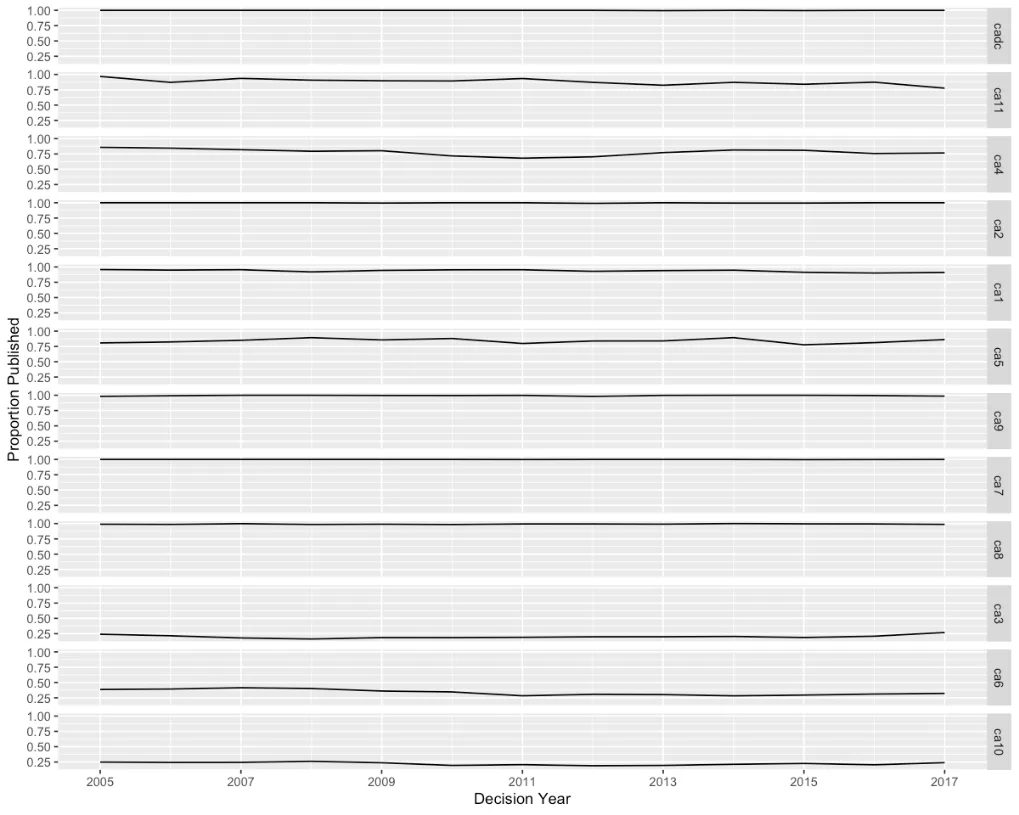
Table A.2: Binary Logistic Regression of Opinion Publication (Target Courts)
|
Gender (?) |
-0.257*** (0.018) |
|
Race (Black) |
-0.524*** (0.032) |
|
Race (Other) |
-0.080* (0.031) |
|
Party (Rep.) |
-0.270*** (0.020) |
|
T-14 School (1) |
0.251*** (0.019) |
|
Senior (1) |
-0.178*** (0.021) |
|
Chief (1) |
0.240*** (0.028) |
|
Visiting (1) |
-0.647*** (0.030) |
|
Presiding (1) |
0.125*** (0.015) |
|
Tenure |
0.005*** (0.001) |
|
Unanimous (1) |
-1.404*** (0.040) |
|
Court*Year |
X |
|
Topic |
X |
|
n |
52879 |
|
AIC |
53157 |
Notes: Robust standard errors clustered by judge in parentheses. Reference category for gender is male. Reference category for race is white. Dependent variable is opinion publication, where published = 1.
***p < 0.001; **p < 0.01; *p < 0.05; †p < 0.10.
Table A.3: OLS Linear Regression of Publication with Gender-Race Interactions (Target Courts)
|
Gender (?) |
-0.042*** (0.009) |
|
Race (Black) |
-0.084*** (0.016) |
|
Race (Other) |
-0.011 (0.013) |
|
Party (Rep.) |
-0.044*** (0.009) |
|
T-14 School (1) |
0.043*** (0.009) |
|
Senior (1) |
-0.028** (0.010) |
|
Chief (1) |
0.038** (0.013) |
|
Visiting (1) |
-0.102*** (0.012) |
|
Presiding (1) |
0.021** (0.007) |
|
Tenure |
0.001† (0.0005) |
|
Gender (?)*Race(Bl) |
0.0002 (0.025) |
|
Gender (?)*Race(Oth) |
-0.003 (0.104) |
|
Unanimous (1) |
-0.254*** (0.019) |
|
Court*Year |
X |
|
Topic |
X |
|
N |
52879 |
|
R2 |
0.304 |
Notes: Robust standard errors clustered by judge in parentheses. Reference category for gender is male. Reference category for race is white. Dependent variable is opinion publication, where published = 1.
***p < 0.001; **p < 0.01; *p < 0.05; †p < 0.10.
Table A.4: OLS Linear Regression of Opinion Type (Target Courts)
|
Gender (?) |
0.008 (0.006) |
|
Race (Black) |
0.014* (0.007) |
|
Race (Other) |
-0.005 (0.007) |
|
Party (Rep.) |
-0.029*** (0.004) |
|
T-14 School (1) |
-0.001 (0.004) |
|
Senior (1) |
0.010** (0.004) |
|
Chief (1) |
-0.005 (0.009) |
|
Visiting (1) |
-0.041*** (0.007) |
|
Tenure |
-0.001** (0.0002) |
|
Court*Year |
X |
|
Topic |
X |
|
n |
58648 |
|
R2 |
0.051 |
Notes: Robust standard errors clustered by judge in parentheses. Reference category for gender is male. Reference category for race is white. Dependent variable is whether the opinion is a non-majority/separate type (dissent or concurrence), where non-majority = 1. ***p < 0.001; **p < 0.01; *p < 0.05; †p < 0.10.
Table A.5: OLS Linear Regression of Opinion Publication for Unanimous Cases (Target Courts)
|
Gender (?) |
-0.039*** (0.009) |
|
Race (Black) |
-0.079*** (0.016) |
|
Race (Other) |
-0.012 (0.014) |
|
Party (Rep.) |
-0.039*** (0.010) |
|
T-14 School (1) |
0.037*** (0.008) |
|
Senior (1) |
-0.024* (0.010) |
|
Chief (1) |
0.037** (0.013) |
|
Visiting (1) |
-0.099*** (0.013) |
|
Presiding (1) |
0.023*** (0.007) |
|
Tenure |
0.001 (0.001) |
|
Court*Year |
X |
|
Topic |
X |
|
n |
48111 |
|
R2 |
0.299 |
Notes: Robust standard errors clustered by judge in parentheses. Reference category for gender is male. Reference category for race is white. Dependent variable is opinion publication, where published = 1. Non-unanimous cases excluded. ***p < 0.001;
**p < 0.01; *p < 0.05; †p < 0.10.
Table A.6: OLS Linear Regression of Opinion Publication by Court
|
3rd Cir |
4th Cir |
5th Cir |
6th Cir |
10th Cir |
11th Cir |
|
|
Gender (?) |
-0.043*** (0.013) |
0.014 (0.023) |
0.064*** (0.019) |
-0.122*** (0.016) |
0.007 (0.009) |
-0.031 (0.021) |
|
Race (Black) |
-0.047* (0.023) |
-0.196*** (0.039) |
0.081 (0.051) |
-0.203*** (0.020) |
-0.113*** (0.028) |
0.069* (0.028) |
|
Race (Other) |
0.019 (0.012) |
-0.177*** (0.052) |
0.056*** (0.015) |
0.077 (0.074) |
0.004 (0.018) |
0.101*** (0.028) |
|
Party (Rep.) |
-0.018 (0.012) |
-0.089*** (0.025) |
-0.0001 (0.022) |
-0.183*** (0.017) |
-0.015† (0.008) |
0.058*** (0.016) |
|
T-14 School (1) |
0.039*** (0.010) |
0.028 (0.019) |
-0.132*** (0.027) |
0.005 (0.009) |
0.107*** (0.028) |
0.093*** (0.024) |
|
Senior (1) |
-0.007 (0.014) |
-0.004 (0.036) |
0.087* (0.034) |
-0.050*** (0.015) |
-0.041** (0.015) |
0.005 (0.027) |
|
Chief (1) |
-0.032† (0.017) |
0.005 (0.018) |
-0.016 (0.033) |
0.030 (0.024) |
0.076*** (0.022) |
0.043† (0.025) |
|
Visiting (1) |
-0.057** (0.019) |
-0.332*** (0.055) |
-0.141*** (0.042) |
-0.125*** (0.016) |
0.035 (0.030) |
-0.181*** (0.036) |
|
Presiding (1) |
0.017* (0.008) |
0.027 (0.019) |
-0.002 (0.020) |
0.056*** (0.013) |
0.006 (0.011) |
0.019 (0.017) |
|
Tenure (yrs) |
0.001* (0.0005) |
0.008*** (0.002) |
0.001 (0.001) |
-0.001 (0.0005) |
-0.001 (0.001) |
-0.003* (0.001) |
|
Unani-mous (1) |
-0.454*** (0.027) |
-0.006 (0.015) |
-0.061** (0.021) |
-0.252*** (0.012) |
-0.484*** (0.019) |
-0.020† (0.011) |
|
Year |
X |
X |
X |
X |
X |
X |
|
Topic |
X |
X |
X |
X |
X |
X |
|
n |
12240 |
3252 |
5176 |
13334 |
15877 |
2998 |
|
R2 |
0.100 |
0.139 |
0.065 |
0.108 |
0.151 |
0.111 |
Notes: Robust standard errors clustered by judge in parentheses. Reference category for gender is male. Reference category for race is white.
***p < 0.001; **p < 0.01; *p < 0.05; †p < 0.10.
Table A.7: OLS Linear Regression of Opinion Publication by Topic (Target Courts)
|
Civil Rights |
Civil |
Admin |
Crim |
Prisoner |
Other |
|
|
Gender (?) |
-0.073*** (0.011) |
-0.040*** (0.011) |
-0.043** (0.015) |
-0.036** (0.011) |
-0.022† (0.012) |
-0.057* (0.026) |
|
Race (Black) |
-0.095*** (0.017) |
-0.109*** (0.014) |
-0.129*** (0.022) |
-0.067** (0.021) |
-0.040** (0.014) |
-0.025 (0.036) |
|
Race (Other) |
-0.016 (0.019) |
-0.006 (0.018) |
-0.053† (0.028) |
0.002 (0.016) |
0.008 (0.017) |
-0.019 (0.045) |
|
Party (Rep.) |
-0.081*** (0.013) |
-0.059*** (0.010) |
-0.059*** (0.017) |
-0.024* (0.012) |
-0.017† (0.009) |
-0.075** (0.026) |
|
T-14 School (1) |
0.043** (0.014) |
0.058*** (0.011) |
0.020 (0.013) |
0.050*** (0.011) |
0.022** (0.008) |
0.023 (0.029) |
|
Senior (1) |
-0.013 (0.016) |
-0.042** (0.016) |
-0.027 (0.027) |
-0.054*** (0.014) |
0.009 (0.017) |
0.055 (0.042) |
|
Chief (1) |
0.031 (0.020) |
0.043* (0.022) |
0.003 (0.032) |
0.013 (0.013) |
0.088*** (0.026) |
-0.037 (0.049) |
|
Visiting (1) |
-0.104*** (0.024) |
-0.119*** (0.018) |
-0.069** (0.022) |
-0.078*** (0.015) |
-0.147*** (0.026) |
0.001 (0.047) |
|
Presid-ing (1) |
0.031* (0.013) |
0.036*** (0.008) |
0.008 (0.015) |
0.015† (0.008) |
0.003 (0.008) |
0.079** (0.029) |
|
Tenure (yrs) |
0.0001 (0.001) |
0.001* (0.001) |
0.001 (0.001) |
0.001* (0.001) |
-0.0003 (0.001) |
-0.001 (0.002) |
|
Unani-mous (1) |
-0.254*** (0.020) |
-0.190*** (0.018) |
-0.230*** (0.036) |
-0.285*** (0.024) |
-0.260*** (0.025) |
-0.132** (0.041) |
|
Court* |
X |
X |
X |
X |
X |
X |
|
n |
8612 |
13445 |
4409 |
16681 |
8470 |
1262 |
|
R2 |
0.263 |
0.247 |
0.337 |
0.313 |
0.436 |
0.240 |
Notes: Robust standard errors clustered by judge in parentheses. Reference category for gender is male. Reference category for race is white.
***p < 0.001; **p < 0.01; *p < 0.05; †p < 0.10.
Table A.8: OLS Linear Regression of Opinion Publication by Time Slice (Target Courts)
|
2005–08 |
2009–12 |
2013–17 |
|
|
Gender (?) |
-0.054*** (0.009) |
-0.041** (0.012) |
-0.036** (0.013) |
|
Race (Black) |
-0.130*** (0.020) |
-0.088*** (0.017) |
-0.055** (0.017) |
|
Race (Other) |
0.016 (0.015) |
-0.018 (0.020) |
-0.037† (0.021) |
|
Party (Rep.) |
-0.054*** (0.010) |
-0.064*** (0.012) |
-0.018 (0.013) |
|
T-14 School (1) |
0.075*** (0.010) |
0.048*** (0.010) |
0.006 (0.010) |
|
Senior (1) |
-0.039** (0.013) |
-0.007 (0.018) |
-0.037* (0.017) |
|
Chief (1) |
0.016 (0.028) |
0.008 (0.016) |
0.064** (0.020) |
|
Visiting (1) |
-0.103*** (0.018) |
-0.083*** (0.020) |
-0.121*** (0.026) |
|
Presiding (1) |
0.022* (0.009) |
0.033*** (0.009) |
0.010 (0.011) |
|
Tenure (yrs) |
0.001 (0.001) |
-0.0001 (0.001) |
0.001† (0.001) |
|
Unanimous (1) |
-0.270*** (0.024) |
-0.273*** (0.024) |
-0.222*** (0.023) |
|
Court*Year |
X |
X |
X |
|
Topic |
X |
X |
X |
|
n |
18251 |
16971 |
17657 |
|
R2 |
0.303 |
0.305 |
0.309 |
Notes: Robust standard errors clustered by judge in parentheses. Reference category for gender is male. Reference category for race is white.
***p < 0.001; **p < 0.01; *p < 0.05; †p < 0.10.
B. Data Validation
I manually reviewed several random samples to test the data quality and help ensure that no systematic errors are present.
1. PageRank
I detected an anomaly in CAP’s PageRank data and confirmed, through personal correspondence with CAP, that there is an error in the computation of percentile scores from raw scores.235 Accordingly, I recomputed the percentile scores and used the updated data for my analyses. My percentile algorithm assigns a percentile score to each case based on what percentage of cases have a raw score equal to or lesser than that case’s raw score. The denominator of cases is the total number of cases in CAP’s PageRank dataset (and not the total number of cases in my dataset). Further, CAP excluded all cases with a PageRank raw score of zero from its PageRank dataset. Accordingly, I do not take those cases into account when assigning percentile scores.
The CAP documentation indicates that if a case is missing the PageRank fields (and absent from the PageRank dataset), it means that the case has no citations and that the PageRank raw score should accordingly be equal to zero.236 For the citation analyses, I assigned all cases that were missing a PageRank score a percentile score of zero. Note that this is mathematically imperfect and is meant as an approximation. We know that these cases would have a percentile score lower than all other cases in my dataset, but we do not know their true score, because we do not have the actual denominator of cases (all cases in the CAP database, including those with PageRank raw scores of zero).
There are 729 such cases in my dataset. I looked up a random sample of fifty of these cases on CAP’s searchable interface (by case citation)237 and found that six of the fifty cases do in fact have PageRank values. Because this is a relatively high error rate and also because of the issues with cases that have a PageRank raw score of zero outlined in the previous paragraphs, as a robustness check I ran the main citation analyses (Table 3, Models G and H; Table 4, Models A, B, and C; and Table 5, Model G) with the cases that are missing PageRank values (i.e., missing from CAP’s PageRank dataset) omitted. The results did not change in any notable ways that would affect my interpretations. The only changes involved some minor differences in p-values in Tables 4 and 5.
To get a sense of the validity of CAP’s citation data, I checked it against Westlaw’s citation data, as follows. I first broke the cases in my dataset into quantiles based on PageRank percentiles. This assigns each case a quantile (first, second, third, fourth, where first indicates that the case is in the bottom twenty-five percent of cases based on PageRank scores, and so on). I then created a random sample of one hundred cases from each of the first and fourth quartiles, and I looked up the number of case-based citations that Westlaw identified for each case. Note that even if CAP’s PageRank scores are perfectly accurate, we should not expect them to exactly track the citation counts on Westlaw. This is because, first, CAP’s PageRank scores take into account only citations from cases that are also in CAP’s database and that database is less comprehensive than Westlaw’s. Second, the PageRank scores take into account not only the number of citations to a case but also the importance of the cases that cite the case, whereas Westlaw’s data reports only the raw number of citing cases. Third, whereas I use CAP citation data from 2021, I conducted the checks against Westlaw in December 2023. For the cases in the first quartile of PageRank scores, the Westlaw citation values ranged from 0 to 219, with a median of 4, a mean of 18.4, and a standard deviation of 42.6. For the cases in the fourth quartile of PageRank scores, the Westlaw citation values ranged from 3 to 2483, with a median of 98.5, a mean of 208.2, and a standard deviation of 375.3. These results suggest a rough correspondence between CAP’s citation data and the number of citing cases as reported on Westlaw.
2. Unsigned Opinions
Second, I created a random sample of 312 opinions (two for each circuit-year pair) that are unsigned in my dataset, meaning no authoring judge was identified for the majority/lead opinion. I looked up each of these cases on CAP’s searchable interface (by case citation)238 and checked whether an author was given. In four of the cases there was in fact an author, for an accuracy rate in my dataset of 98.7%.
3. Separate Opinions
Third, I created a random sample of 312 opinions (two for each circuit-year pair) that are identified as non-majority/lead opinions in my dataset. I looked up each of these opinions on CAP’s searchable interface (by case citation)239 and checked whether the opinion was correctly identified as non-majority/lead. One was misidentified, for an accuracy rate of 99.7%.
4. Authoring Judge and Unanimity
Fourth, I created a random sample of 312 opinions (two for each circuit-year pair) in my main dataset. I looked up each of these opinions on Westlaw and checked whether my authoring judge matched the Westlaw data. The authors matched in all but one case, for an accuracy rate of 99.7% (assuming the Westlaw data is accurate). Note that if the authoring judge is misidentified for a case in my dataset, then all author attributes for that case are prone to error.
I also checked whether we had correctly identified the case as unanimous. All cases were correct in this respect. In addition, I manually checked the authoring judge attributes against the FJC’s judge biographical data for each of the attributes that required some data transformation on my part. For example, while judge gender and race were taken directly from the FJC data, the following attributes required some computation on my part: tenure, chief, senior, visiting, presiding, and T-14 law school.240 I detected errors in chief status in three cases and in presiding judge status in one case. The T-14 law school variable was incorrect in three cases, but I was able to identify the cause of this error and correct it.
5. Topics
Following Rachael Hinkle, I created topics based on the appeal type (APPTYPE) filed and the Nature of Suit (NOS) field from the FJC’s IDB. “APPTYPE identifies whether an appeal is administrative, civil, criminal, bankruptcy-related, or a matter of original jurisdiction.”241 NOS codes allow us “to further designate two additional issue areas: prisoner petitions and civil cases involving civil rights issues.”242 Cases without one of the specified NOS or APPTYPE codes were assigned a value of missing/not available (a total of six cases in my final dataset) and dropped from all analyses using the topic variable.
To test the resulting topics, I created a random sample of 312 opinions (two for each circuit-year pair) in my main dataset and checked the topic assigned to each case against Westlaw. I used Westlaw’s headnotes to attempt to identify the case topic and where necessary skimmed the opinion text to gain clarity on the topic. Recall that I assigned topics to the cases in my dataset using the FJC’s IDB, which provides the nature of suit and appeal type for each case. Topics in this classification scheme are mutually exclusive, which is unrealistic given that most cases span multiple topics. Accordingly, we should not expect the topics of the cases in my dataset to map in any precise way to the topics garnered from Westlaw. I aimed to assess whether the topic for a given case represented a plausible classification. In my first attempt at this assessment, I discovered some errors which led me to revise slightly my initial classification scheme. The initial scheme adopted Hinkle’s, which assigned some “prisoner petition” codes to the “civil rights” category. Because it seems more appropriate to place these codes in the “prisoner petitions” category, I made that revision. I also added three additional codes to the civil rights category, and two additional ones to prisoner petitions.243 After making these revisions, I created a new random sample and checked each case. The topics of all but seven cases seemed reasonable. Each of those seven are identified as civil cases. Six of these seemed like they should have been identified as administrative (as appeals from administrative proceedings) and one seemed that it should have been identified as a civil rights case. I manually looked up each of these problem cases by docket number on the IDB website using the interactive view function.244 The appeal type and nature of suit codes associated with the cases reflect the topics in my dataset, which indicates that the problem is not a matter of mismatched data but rather anomalies in the underlying IDB data.
Table A.9: NOS Codes Used to Create Case Topics245
|
NOS Code |
NOS Label |
Topic Coding |
|
463 |
Alien Detainee |
Prisoner Petitions |
|
510 |
Motions to Vacate Sentence |
Prisoner Petitions |
|
530 |
Habeas Corpus – General |
Prisoner Petitions |
|
535 |
Death Penalty |
Prisoner Petitions |
|
540 |
Mandamus & Other |
Prisoner Petitions |
|
550 |
Prisoner – Civil Rights |
Prisoner Petitions |
|
555 |
Prison Condition |
Prisoner Petitions |
|
560 |
Civil Detainee – Conditions of Confinement |
Prisoner Petitions |
|
440 |
Other Civil Rights |
Civil Rights |
|
441 |
Voting |
Civil Rights |
|
442 |
Employment |
Civil Rights |
|
443 |
Housing/Accommodations |
Civil Rights |
|
444 |
Welfare |
Civil Rights |
|
445 |
Americans with Disabilities – Employment |
Civil Rights |
|
446 |
Americans with Disabilities – Other |
Civil Rights |
|
448 |
Education |
Civil Rights |
- * Assistant Professor of Law, University of Wisconsin–Madison. For helpful comments and discussions, I’m grateful to Stephanie Didwania, Dmitry Orlov, Jon Petkun, Judith Resnik, Doug Rice, Matthew Sag, Alan Trammell, and Jason Yackee, as well as participants of the University of California Irvine’s Center for Empirical Research on the Legal Profession workshop, the Online Workshop on the Computational Analysis of Law, the Chicagoland Junior Scholars Conference, the Junior Federal Courts Workshop, and of faculty workshops at the University of Michigan Law School, William & Mary Law School, the University of Denver Sturm College of Law, Texas A&M University School of Law, and Wisconsin Law School. Thank you to Priyadarshi Amar, Saloni Bhogale, Leigha Hildur Vilen, Yukiko Suzuki, and Kou Wang for excellent research assistance. Support for this research was provided by the Office of the Vice Chancellor for Research and Graduate Education at the University of Wisconsin–Madison with funding from the Wisconsin Alumni Research Foundation. ↩︎
- See, e.g., 9th Cir. R. 36-3(a) (“Unpublished dispositions and orders of this Court are not precedent, except when relevant under the doctrine of law of the case or rules of claim preclusion or issue preclusion.”); see also Merritt E. McAlister, Missing Decisions, 169 U. Pa. L. Rev. 1101, 1114 n.65 (2021) (“In every circuit, decisions that are not designated for publication are not binding precedent.”). ↩︎
- See Rachel Brown et al., Is Unpublished Unequal? An Empirical Examination of the 87% Nonpublication Rate in Federal Appeals, 107 Cornell L. Rev. 1, 23 (2021) (reporting that, in each of the federal circuits, judges have “significant freedom when making publication decisions”); Rachael K. Hinkle, Publication and Strategy in the U.S. Courts of Appeals, 179 J. Institutional & Theoretical Econ. 121, 126 (2023) (“Each circuit may lay out specific parameters for this decision in their circuit rules, but there is still considerable discretion.”). ↩︎
- As other scholars have observed, “[t]he US Courts of Appeals, in particular, are crucial institutions to examine because they establish the bulk of federal precedent due to the relatively small docket of the Supreme Court, which effectively renders most federal appellate decisions the final word.” Laura P. Moyer, John Szmer, Susan Haire & Robert K. Christensen, ‘All Eyes Are on You’: Gender, Race, and Opinion Writing on the US Courts of Appeals, 55 Law & Soc’y Rev. 452, 464 (2021). ↩︎
- ABA, ABA Profile of the Legal Profession 2022, at 6 (2022), https://www
.americanbar.org/content/dam/aba/administrative/news/2022/07/profile-report-2022.pdf [https://perma
.cc/592B-TKUF] (collecting statistics in mid-2022). ↩︎ - Id. Regarding intersectional representation, twenty-nine percent of women judges are people of color. Id. at 11. Black women make up about four percent of all sitting federal judges. Id. at 2. ↩︎
- Russell Wheeler, Biden’s First-Year Judicial Appointments—Impact, Brookings (Jan. 27, 2022), https://www.brookings.edu/blog/fixgov/2022/01/27/bidens-first-year-judicial-appointments
-impact/ [https://perma.cc/BWP4-L4G7] (reporting that Biden has “nominated by any measure the most demographically diverse set of judicial candidates in history and by doing so has, in just one year, reduced slightly but noticeably the percentage of white males among active-status judges”); ABA, supra note 4, at 15–16 (reporting that, as of July 1, 2022, President Biden had appointed sixty-eight judges, seventy-seven percent of whom are women and sixty-eight percent of whom are people of color). ↩︎ - Jennifer Barnes Bowie, Donald R. Songer & John Szmer, The View from the Bench and Chambers 16 (2014) (“Historically, the federal appellate bench was almost entirely composed of white men.”). The first woman was appointed to the federal appellate bench in 1934 and the first person of color in 1949. Michael J. Gabrail, Hon. Florence Ellinwood Allen: U.S. Court of Appeals for the Sixth Circuit: A Judge of Many Firsts, Fed. Law., Aug. 2016, at 51; Judge William Hastie, 71, of Federal Court, Dies, N.Y. Times, Apr. 15, 1976, at 36. ↩︎
- See, e.g., Rosemary Hunter, More than Just a Different Face? Judicial Diversity and Decision-Making, 68 Current Legal Probs. 119, 127 (2015) (“[W]omen have been ‘let in’ to the judiciary on condition of conformity to the prevailing (masculine) ethos, and any hint of failure to conform would call into question their qualification to be a judge.” (footnote omitted)). These themes are not unique to the judicial or even legal profession; previous studies have documented gender- and race-based inequities in expectations, evaluations, and influence across a variety of professional contexts. See, e.g., Alice A. Tolbert Coombs & Roderick K. King, Workplace Discrimination: Experiences of Practicing Physicians, 97 J. Nat’l Med. Ass’n 467, 470 (2005) (presenting survey-based evidence of substantial gender discrimination against physicians in “the form of career advancement obstacles and disrespectful or punitive actions”); Kelly M. Hannum, Shannon M. Muhly, Pamela S. Shockley-Zalabak & Judith S. White, Women Leaders Within Higher Education in the United States: Supports, Barriers, and Experiences of Being a Senior Leader, 35 Advancing Women Leadership 65, 71 (2015) (finding that a majority of their study participants, who were all women in senior leadership roles in higher education, believe that men and women in their profession are subject to different expectations, that a substantial portion of participants feel they do not fit in or are not heard in their profession, and that a substantial portion of participants experience heightened scrutiny and criticism in their professional lives); Karen S. Lyness & Madeline E. Heilman, When Fit Is Fundamental: Performance Evaluations and Promotions of Upper-Level Female and Male Managers, 91 J. Applied Psych. 777, 777 (2006) (“[N]egative expectations resulting from perceptions of lack of fit detrimentally affect how women are regarded and how their work is evaluated when they are in traditionally male jobs.”); Monica Biernat, M.J. Tocci & Joan C. Williams, The Language of Performance Evaluations: Gender-Based Shifts in Content and Consistency of Judgment, 3 Soc. Psych. & Personality Sci. 186, 186 (2012) (discussing role incongruity and gender biases against women in “masculine” professions). ↩︎
- See Joan C. Williams & Veta T. Richardson, Project for Att’y Retention & Minority Corp. Couns. Ass’n, New Millennium, Same Glass Ceiling? The Impact of Law Firm Compensation Systems on Women 45 (2010), https://worklifelaw.org/publications
/SameGlassCeiling.pdf [https://perma.cc/RQA6-DLTZ] (“[D]ecisions made on the basis of subjective criteria are especially vulnerable to the influence of stereotypes and bias.”). ↩︎ - Rachael K. Hinkle, How Policy Influence Varies with Race and Gender in the US Courts of Appeals, Rsch. & Pol., July–Sept. 2021, at 1, 6 (2021). Maya Sen makes a similar point upon finding that Black federal district court judges are more likely to be reversed on appeal than their white counterparts. Maya Sen, Is Justice Really Blind? Race and Reversal in US Courts, 44 J. Legal Stud. S187, S221 (2015) (observing that the racial gap in reversal rates “calls into question whether the mere appointment of [individuals from underrepresented groups] is enough” to rectify racial inequality in the judiciary). ↩︎
- Further analyses, robustness tests, and data validation steps are detailed in the Appendix. ↩︎
- See supra note 1. ↩︎
- Norman R. Williams, The Failings of Originalism: The Federal Courts and the Power of Precedent, 37 U.C. Davis L. Rev. 761, 774 (2004). ↩︎
- Richard B. Cappalli, The Common Law’s Case Against Non-Precedential Opinions, 76 S. Cal. L. Rev. 755, 756 (2003); see also David R. Cleveland, Draining the Morass: Ending the Jurisprudentially Unsound Unpublication System, 92 Marq. L. Rev. 685, 687 (2009) (observing that because unpublished opinions are now both available beyond the parties and citable, the only legal difference between published and unpublished opinions is that the latter are not precedential); Marin K. Levy, The Mechanics of Federal Appeals: Uniformity and Case Management in the Circuit Courts, 61 Duke L.J. 315, 360 n.303 (2011) (noting that “the term ‘unpublished opinion’ has become something of a term of art” and “[d]espite the fact that these opinions are not published in the [main volume of the] Federal Reporter, they are almost always published on the Westlaw and Lexis databases”). Unpublished decisions from each of the courts of appeals appeared in the Federal Appendix (a West reporter) from 2001 to 2021, when it was discontinued; unpublished decisions are no longer published in an official reporter but are still included on Westlaw and Lexis. Andrew T. Solomon, Making Unpublished Opinions Precedential: A Recipe for Ethical Problems & Legal Malpractice?, 26 Miss. Coll. L. Rev. 185, 203 (2007) (observing that unpublished opinions are widely available in the Federal Appendix); Federal Appendix, Wikipedia, https://en.wikipedia.org/w/index.php?title=Federal_Appendix&oldid
=1080175058 [https://perma.cc/Z5BJ-29ED]. According to some accounts, “[b]y 2005, . . . the full-text of nearly every federal appellate opinion was published in either the Federal Appendix or the Federal Reporter.” Solomon, supra, at 207. Former Ninth Circuit Judge Kozinski stated that “all dispositive rulings, whether designated for inclusion in an official reporter or not, are widely available online through Westlaw and Lexis, as well as in hard copy in West’s Federal Appendix.” Unpublished Judicial Opinions: Hearing Before the Subcomm. on Cts., the Internet & Intell. Prop. of the H. Comm. on the Judiciary, 107th Cong. 30 (2002) (statement of J. Alex Kozinski), https://commdocs.house.gov
/committees/judiciary/hju80454.000/hju80454_0.HTM [https://perma.cc/CQJ4-Y6J2]. However, courts of appeals sometimes issue orders and memoranda that might not appear in the Federal Appendix, and that may or may not appear in legal research databases. See Robert Timothy Reagan et al., Fed. Jud. Ctr., Citing Unpublished Opinions in Federal Appeals 25 (2005) (noting that some courts of appeals issue short opinions that are not available on Westlaw and are not included in the Federal Appendix); Michael Kagan, Rebecca Gill & Fatma Marouf, Invisible Adjudication in the U.S. Courts of Appeals, 106 Geo. L.J. 683, 689 (2018) (finding that some unpublished decisions in immigration cases are not released by courts except to the litigants involved in the cases); McAlister, supra note 1, at 1105–06 (finding evidence of decisions, in particular First Circuit ones, that do not appear in databases or the Federal Appendix). Lexis includes some decisions that are not included in the Federal Reporter or Federal Appendix; based on a cursory review, these decisions seem typically to be very short, unsigned, and labelled as memos or orders. ↩︎ - Elizabeth Earle Beske, Rethinking the Nonprecedential Opinion, 65 UCLA L. Rev. 808, 816 (2018). ↩︎
- McAlister, supra note 1, at 1109 n.38 (“The publication designation identifies inclusion in the official West Federal Reporter.”). ↩︎
- See, e.g., Deborah Jones Merritt & James J. Brudney, Stalking Secret Law: What Predicts Publication in the United States Courts of Appeals, 54 Vand. L. Rev. 71, 95 n.78 (2001) (asserting that “[i]n theory, it would be interesting to explore the relationship between publication decisions and the attributes of the judge authoring each published and unpublished opinion” but suggesting that this is impossible because “most unpublished dispositions do not reveal their author”); Marin K. Levy, Kate Stith & José A. Cabranes, The Costs of Judging Judges by the Numbers, 28 Yale L. & Pol’y Rev. 313, 317 (2010) (“[U]npublished opinions are unsigned[].”); Donna S. Stroud, The Bottom of the Iceberg: Unpublished Opinions, 37 Campbell L. Rev. 333, 377 (2015) (suggesting that unpublished opinions are unsigned); Stephen L. Wasby, Unpublished Decisions in the Federal Courts of Appeals: Making the Decision to Publish, 3 J. App. Prac. & Process 325, 326 (2001) (stating that unpublished dispositions “are unsigned”). ↩︎
- See infra Section II.A. ↩︎
- William L. Reynolds & William M. Richman, The Non-Precedential Precedent—Limited Publication and No-Citation Rules in the United States Courts of Appeals, 78 Colum. L. Rev. 1167, 1169 n.17 (1978). As Donald Songer notes, “[i]t is not known how many decisions of the courts of appeals were not published before 1964, but apparently the number was relatively small.” Donald R. Songer, Criteria for Publication of Opinions in the U.S. Courts of Appeals: Formal Rules Versus Empirical Reality, 73 Judicature 307, 308 (1990). ↩︎
- See Reynolds & Richman, supra note 19, at 1168, 1170 (noting, in 1978, that “[i]n the last few years all of the federal courts of appeals have promulgated rules or adopted plans” that limit publication). ↩︎
- See Dean A. Morande, Publication Plans in the United States Courts of Appeals: The Unattainable Paradigm, 31 Fla. St. U. L. Rev. 751, 755 (2004) (“Selective publication plans favoring unpublished opinions were promoted in response to the exponentially expanding volume of cases before the courts.”). ↩︎
- See, e.g., Charles R. Wilson, How Opinions Are Developed in the United States Court of Appeals for the Eleventh Circuit, 32 Stetson L. Rev. 247, 256–57 (2003); Merritt E. McAlister, “Downright Indifference”: Examining Unpublished Decisions in the Federal Courts of Appeals, 118 Mich. L. Rev. 533, 535, 543 (2020) (documenting the rising caseload between the 1940s and 1990s and asserting that “federal courts have increasingly relied on the so-called ‘unpublished decision’ to combat a caseload volume ‘crisis’”). ↩︎
- See, e.g., Bowie et al., supra note 7, at 119 (“In general, in all circuits, unpublished opinions are those thought to be less important . . . .”); William L. Reynolds & William M. Richman, An Evaluation of Limited Publication in the United States Courts of Appeals: The Price of Reform, 48 U. Chi. L. Rev. 573, 606 (1981) (“The lower quality of unpublished opinions may be the most important of the costs of limited publication . . . .”); Kagan et al., supra note 14, at 717 (suggesting that judges might decide to produce an unpublished decision “simply because it removes the burden of producing a well-reasoned decision that will hold up as a precedent for the future”); William M. Richman & William L. Reynolds, Elitism, Expediency, and the New Certiorari: Requiem for the Learned Hand Tradition, 81 Cornell L. Rev. 273, 284 (1996) (“[U]npublished opinions are dreadful in quality.”); Patrick J. Schiltz, Much Ado About Little: Explaining the Sturm Und Drang Over the Citation of Unpublished Opinions, 62 Wash. & Lee L. Rev. 1429, 1485 (2005) (“Unpublished opinions are, for the most part, pretty useless as expositors of the law, which is why most judges find them unhelpful.” (footnote omitted)). ↩︎
- Reynolds & Richman, supra note 19, at 1202; see also Ben Grunwald, Strategic Publication, 92 Tul. L. Rev. 745, 756 (2018) (noting that critics contend “that the use of unpublished opinions encourages sloppy decision making because judges devote far less time to thinking and writing about them”); Wilson, supra note 22, at 255 (describing the common criticism “that unpublished opinions are careless and lack well-reasoned analysis”); Richard A. Posner, The Federal Courts: Challenge and Reform 169 (2d ed. 1996) (“Unpublished opinions are prepared less carefully because the judges put less time into them . . . .”). ↩︎
- Reynolds & Richman, supra note 19, at 1188. ↩︎
- Merritt & Brudney, supra note 17, at 72 n.2. ↩︎
- The question of what makes for a good or high-quality opinion is itself a contested one, which I take up in other work. See Nina Varsava, Professional Irresponsibility and Judicial Opinions, 59 Hous. L. Rev. 103 (2021). ↩︎
- Morande, supra note 21, at 752–53. ↩︎
- Id. at 752 n.2. ↩︎
- Fed. R. App. P. 32.1(a); Fed. R. App. P. 32.1 committee notes on rules—2006. ↩︎
- Fed. R. App. P. 32.1 committee notes on rules—2006; see also Beske, supra note 15, at 816 (“[T]he rule said nothing about what precedential effect, if any, unpublished opinions would have, leaving each court of appeals to develop its own rules.”); Brown et al., supra note 2, at 13 (“[T]here is no federal rule that lays out the appropriate criteria for nonpublication.”). ↩︎
- See, e.g., 4th Cir. Loc. R. 32.1 (“disfavor[ing]” citation to unpublished Fourth Circuit Court of Appeals decisions issued before 2007, with some narrow exceptions); 9th Cir. R. 36-3(c) (prohibiting citation to unpublished Ninth Circuit Court of Appeals decisions issued before 2007, with some narrow exceptions). ↩︎
- Jonathan P. Kastellec, Hierarchical and Collegial Politics on the U.S. Courts of Appeals, 73 J. Pol. 345, 352 (2011). ↩︎
- 4th Cir. Loc. R. 36(a). ↩︎
- See Brown et al., supra note 2, at 39 (“Inherent in the decision to publish is a normative decision that the subject of the opinion is important.”). ↩︎
- 5th Cir. R. 47.5.1. ↩︎
- 9th Cir. R. 36-2(d). ↩︎
- 1st Cir. Loc. R. 36(a). ↩︎
- 11th Cir. R. 36. Internal Operating Procs. 6 (“Opinions that the panel believes to have no precedential value are not published.”); see also 1st Cir. Loc. R. 36(c) (“[A] panel’s decision to issue an unpublished opinion means that the panel sees no precedential value in that opinion.”). ↩︎
- Morande, supra note 21, at 764. In some circuits, only “cases that have been formally briefed and [orally] argued” may result in a published decision. Clerk’s Off., U.S. Ct. of Appeals for the 4th Cir., Appellate Procedure Guide 65 (2021), https://www.ca4.uscourts.gov
/AppellateProcedureGuide/Decision_Post-Decision/APG-opinionandjudgment.htm [https://perma.cc
/QLR6-9HJM]. In circuits where that is not the case, some judges report that if they predict the court will issue a published decision in a case, then they will favor having oral argument. Bowie et al., supra note 7, at 39–40. Some circuits operate with a default presumption that panels will issue published decisions in all orally argued cases, but this presumption can be overcome if the panel ultimately determines that a case does not warrant a published decision. See Allison Orr Larsen & Neal Devins, Circuit Personalities, 108 Va. L. Rev. 1315, 1328–29 (2022) (reporting that in the Tenth, Fifth, and Seventh Circuits, there is a “strong presumption” that panels will issue published decisions in orally argued cases); see also Lauren K. Robel, The Myth of the Disposable Opinion: Unpublished Opinions and Government Litigants in the United States Courts of Appeals, 87 Mich. L. Rev. 940, 953 n.67 (1989). In at least some circuits, staff attorneys help decide whether a case will be orally argued and whether it will result in a published decision. See Reynolds & Richman, supra note 19, at 1202 n.174 (“Nearly all circuits use staff attorneys or staff law clerks . . . to help screen cases for full or summary appellate procedure. . . . The screening decision inevitably coincides to a great extent with the publication decision.”); Robel, supra, at 953–54 (reporting that judicial staff make recommendations on publication to judge panels). ↩︎ - Clerk’s Off., U.S. Ct. of Appeals for the 4th Cir., supra note 40, at 65–66. ↩︎
- 1st Cir. Loc. R. 36(b)(2)(B). ↩︎
- 5th Cir. R. 47.5.2. ↩︎
- 11th Cir. R. 36-2. ↩︎
- 6th Cir. Internal Operating Procs. 32.1(b)(2). ↩︎
- 5th Cir. R. 47.5.2. ↩︎
- David S. Law, Strategic Judicial Lawmaking: Ideology, Publication, and Asylum Law in the Ninth Circuit, 73 U. Cin. L. Rev. 817, 824 (2005) (footnote omitted); see also Patricia M. Wald, The Rhetoric of Results and the Results of Rhetoric: Judicial Writings, 62 U. Chi. L. Rev. 1371, 1374 (1995) (reporting that at the D.C. Circuit Court of Appeals, where she was a judge from 1979 to 1999, sometimes the assigned author alone decides whether the opinion will be published); Larsen & Devins, supra note 40, at 1329 (noting that most circuits seem to have “a norm towards deferring to the wishes of the authoring judge as to whether to publish or not”); Bowie et al., supra note 7, at 120 (“[T]he common rule of thumb that appears to have been adopted by most panels is that the judge assigned to write the opinion has the main responsibility to decide whether to designate the opinion for publication.”). Brown and co-authors report that, even though the Eighth Circuit’s internal rules specify that the judges on the panel “‘determine[] whether the opinion in the case is to be published or unpublished,’ 8th Cir. Internal Operating Procs. IV(B), . . . the court [informed the authors] that the publication decision is made by the judge authoring the opinion usually after consultation with others on the panel.” Brown et al., supra note 2, at 24 n.117. In contrast, the authors report that “[t]he Tenth Circuit explained to [them] that the panel decides whether to publish an opinion,” and “[t]he Seventh Circuit noted that although the panel ultimately decides whether to publish,” generally cases in which both sides have counsel are orally argued and lead to published decisions, whereas other cases do not get oral argument and do not result in published decisions. Id. ↩︎
- See Law, supra note 47, at 835; Wilson, supra note 22, at 251 (explaining that, at conference, “the senior member of the three-judge panel distributes the writing responsibilities to the members of the panel in an equitable fashion, and the panel reaches a tentative decision about each case, including . . . whether it should be published” (footnote omitted)); 11th Cir. R. 34, Internal Operating Procs. 15 (providing that, “[a]t the conclusion of each day’s arguments the panel usually has a conference on the appeals heard that day,” at which “a tentative determination is made as to the kind of opinion necessary”). Some state courts of appeals follow more specific protocols for deciding publication status. At the Colorado Court of Appeals, where cases are also decided by three-judge panels, the opinion is produced by one of the panelists (together with a staff attorney or judicial clerk), then the opinion is circulated to the whole court and each judge votes on publication status, which is decided by majority rule. K.K. DuVivier, Are Some Words Better Left Unpublished?: Precedent and the Role of Unpublished Decisions, 3 J. App. Prac. & Process 397, 412–13 (2001). ↩︎
- See Bowie et al., supra note 7, at 115–16. ↩︎
- Boyce F. Martin, Jr., In Defense of Unpublished Opinions, 60 Ohio St. L.J. 177, 192 (1999); see also Alex Kozinski & Stephen Reinhardt, Please Don’t Cite This! Why We Don’t Allow Citation to Unpublished Dispositions, NonPublication, https://www.nonpublication.com/don’t%20cite
%20this.htm [https://perma.cc/2Y62-XVBJ]. ↩︎ - Martin, supra note 50, at 192. ↩︎
- Posner, supra note 24, at 165; see also Reynolds & Richman, supra note 19, at 1192 (asserting that one should not “assume[] that an author is a reliable judge of the quality and importance of his own work product” and that judges should not “be authorized to determine which of their decisions should be long remembered” (quoting Justice John Paul Stevens, Remarks at Illinois State Bar Association’s Centennial Dinner, Springfield, Illinois (Jan. 22, 1977)). ↩︎
- Law, supra note 47, at 822; see also Songer, supra note 19, at 309 (describing publication rules as “broad, vague, and giv[ing] little detailed direction,” and explaining that “[b]ehind the normative debate over nonpublication are conflicting views as to whether or not the formal criteria governing publication provide an accurate description in fact of which cases are selected to be unpublished”); Reynolds & Richman, supra note 23, at 581 (“Another major problem with an early decision not to publish centers on the ability of a court to predict, early in the judicial process, that its opinion will not make law.”). ↩︎
- Ryan W. Copus, Statistical Precedent: Allocating Judicial Attention, 73 Vand. L. Rev. 605, 649, 653 (2020) (quoting Nat’l Classification Comm. v. United States, 765 F.2d 164, 173 n.2 (D.C. Cir. 1985) (separate statement of Wald., J.)). ↩︎
- Id. at 653 (“There is no particular reason to believe that judges are good at identifying the cases that are best for creating precedential value . . . .”); see also Songer, supra note 19, at 313 (“[T]here may be considerable variation among judges (even in the same circuit) in their operational definitions of what constitutes a decision that is worthy of publication.”). ↩︎
- Law, supra note 47, at 823. ↩︎
- Merritt & Brudney, supra note 17, at 119 (reporting that judges “seem to vary in their tendency to publish opinions [even] after controlling for other factors”); see also Songer, supra note 19, at 312–13 (finding that, in some circuits, individual judges participate in published decisions at differential rates); Copus, supra note 54, at 651–52 (same); Grunwald, supra note 24, at 766–69 (same). ↩︎
- Keith Carlson, Michael A. Livermore & Daniel N. Rockmore, The Problem of Data Bias in the Pool of Published U.S. Appellate Court Opinions, 17 J. Empirical Legal Stud. 224, 255–56 (2020). ↩︎
- Bowie et al., supra note 7, at 121. ↩︎
- See generally Elizabeth A. Tillman & Rachael K. Hinkle, Of Whites and Men: How Gender and Race Impact Authorship of Published and Unpublished Opinions in the US Courts of Appeals, Rsch. & Pol., Jan.–Mar. 2018, at 1. Tillman and Hinkle’s dataset differs substantially from mine, as they look at decisions from 2012 only, and include all the federal courts of appeals. Id. at 1. Looking at published decisions from 1971 to 2002, Bowie, Songer, and Szmer find that white judges authored more opinions than judges of color but find no gender difference. Bowie et al., supra note 7, at 80–84. ↩︎
- Tillman & Hinkle, supra note 60, at 4. ↩︎
- In another related study, looking at the demographic composition of federal appellate panels (and not the demographics of opinion authors), Hinkle finds that demographic diversity on judicial panels is associated with lower publication rates. Hinkle, supra note 10, at 1–2. ↩︎
- 4th Cir. Internal Operating Procs. 34.1; see also 11th Cir. R. 34, Internal Operating Procs. 2(b) (indicating that judges are randomly assigned to panels). ↩︎
- See, e.g., Songer, supra note 19, at 312 (assuming that, since cases are randomly assigned within circuits, on a given court each judge participates in an “equal number of cases which ‘objectively’ me[e]t the formal criteria for publication”); Adam B. Cox & Thomas J. Miles, Judging the Voting Rights Act, 108 Colum. L. Rev. 1, 17 (2008) (asserting and relying on the assumption that “within circuits, appellate judges are randomly assigned to panels”). ↩︎
- Edward K. Cheng, The Myth of the Generalist Judge, 61 Stan. L. Rev. 519, 523 (2008). ↩︎
- See, e.g., Adam S. Chilton & Marin K. Levy, Challenging the Randomness of Panel Assignment in the Federal Courts of Appeals, 101 Cornell L. Rev. 1, 3, 39–40 (2015) (through a quantitative study, finding evidence of nonrandomness in four of the twelve regional circuits tested); Matthew Hall, Randomness Reconsidered: Modeling Random Judicial Assignment in the U.S. Courts of Appeals, 7 J. Empirical Legal Stud. 574, 578 (2010) (through a qualitative study, finding evidence that judges are not randomly assigned to panels in three of the twelve regional circuits investigated); Marin K. Levy, Panel Assignment in the Federal Courts of Appeals, 103 Cornell L. Rev. 65, 81 (2017) (finding qualitative evidence to suggest that assignment is not “strictly random” in all five courts of appeals studied); J. Robert Brown, Jr. & Allison Herren Lee, Neutral Assignment of Judges at the Court of Appeals, 78 Tex. L. Rev. 1037, 1044–69 (2000) (observing that, although “[a]ll circuits purport to use a system of random assignment of judges and cases,” instances of “panel packing” have occurred, and discussing that phenomenon in the context of civil rights cases in the Fifth Circuit in the early 1960s). ↩︎
- Bowie et al., supra note 7, at 66, 86. More scholarly attention has gone to writing assignments at the U.S. Supreme Court. See generally, e.g., Saul Brenner, Strategic Choice and Opinion Assignment on the U.S. Supreme Court: A Reexamination, 35 W. Pol. Q. 204 (1982); Saul Brenner & Harold J. Spaeth, Issue Specialization in Majority Opinion Assignment on the Burger Court, 39 W. Pol. Q. 520 (1986); Saul Brenner, The Chief Justices’ Self Assignment of Majority Opinions in Salient Cases, 30 Soc. Sci. J. 143 (1993); Forrest Maltzman & Paul J. Wahlbeck, May It Please the Chief? Opinion Assignments in the Rehnquist Court, 40 Am. J. Pol. Sci. 421 (1996); Forrest Maltzman & Paul J. Wahlbeck, A Conditional Model of Opinion Assignment on the Supreme Court, 57 Pol. Rsch. Q. 551 (2004). ↩︎
- See, e.g., 5th Cir. R. 34, Internal Operating Procs. Oral Argument (“[T]he presiding judge assigns responsibility for opinion writing.”); 3d Cir. Internal Operating Procs. 3.2, 4.2 (providing that the presiding judge makes opinion assignments). The presiding judge is typically the chief judge if the chief is on the panel and otherwise the most senior active judge on the panel. For details, see infra note 84. There is some variation in assignment rules across the circuits. For example, in the Fourth Circuit, the chief judge is ultimately responsible for opinion assignments even if that judge is not on the panel. 4th Cir. Internal Operating Procs. 36.1 (“Opinion assignments are made by the Chief Judge on the basis of recommendations from the presiding judge of each panel on which the Chief Judge does not sit.”). For oral argument cases, writing assignments are typically made at the conference held after oral argument. See Bowie et al., supra note 7, at 63. ↩︎
- 11th Cir. R. 34-4, Internal Operating Procs. 15; see also 5th Cir. R. 34, Internal Operating Proc. Case Confs. & Designation of Writing Judge (providing that “[j]udges do not specialize” and “[a]ssignments are made to equalize the workload of the entire session”). ↩︎
- 9th Cir. App. Law. Representatives, The Appellate Lawyer Representatives’ Guide to Practice in the United States Court of Appeals for the Ninth Circuit 12 (May 2021 ed.) (“The writing assignment rotates among the three panel members.”). Further, the Ninth Circuit seems to be unique in that one panel member is assigned the responsibility to prepare a bench memo (or have a clerk do so) in advance of oral argument, and that judge typically also writes the opinion in the case. Id. at 12–13. ↩︎
- Cheng, supra note 65, at 527; see also Sean Farhang, Jonathan P. Kastellec & Gregory J. Wawro, The Politics of Opinion Assignment and Authorship on the US Court of Appeals: Evidence from Sexual Harassment Cases, 44 J. Legal Stud. S59, S60, S63 (2015) (finding evidence of “an institutional environment in which judges seek out opinions they wish to write,” and noting that “[p]rior research and the published writings of a number of courts of appeals judges suggest that . . . the wishes of potential writers are a material factor in determining writing assignments” and “[p]otential writers on a panel can either explicitly request or implicitly signal their preference for opportunities to author opinions in areas in which they particularly wish to write”). But see Bowie et al., supra note 7, at 67 (reporting that “some judges rely on volunteers to write the opinion, but [this] is not a common practice” and that some judges “consider[] whether any judge on the panel ha[s] a particular expertise related to the issues in the case” but expertise is not “regularly taken into account”). ↩︎
- Cheng, supra note 65, at 527–48; Burton M. Atkins, Opinion Assignments on the United States Courts of Appeals: The Question of Issue Specialization, 27 W. Pol. Q. 409, 409–10 (1974); Jonathan Remy Nash, Expertise and Opinion Assignment on the Courts of Appeals: A Preliminary Investigation, 66 Fla. L. Rev. 1599, 1607 (2015) (finding that judges with expertise in the Sentencing Guidelines were more likely to be assigned Guidelines cases). ↩︎
- See Sen, supra note 10, at S190 (observing that empirical studies of diversity on courts “have mostly focused on . . . whether women and minority judges decide cases differently than their white male counterparts”). For examples of such studies, see Pat K. Chew & Robert E. Kelley, Myth of the Color-Blind Judge: An Empirical Analysis of Racial Harassment Cases, 86 Wash. U. L. Rev. 1117, 1141 (2009) (finding “very different decision-making patterns for judges of different races”); Cox & Miles, supra note 64, at 53 (examining voting rights cases and finding that “[r]ace and partisanship affect a judge’s own voting behavior, as well as the voting behavior of fellow judges sitting on a panel”); Frank B. Cross, Decision Making in the U.S. Courts of Appeals 77 (2007) (finding that “women [are] more likely to cast liberal votes than men”); Theodore Eisenberg, Talia Fisher & Issi Rosen-Zvi, Does the Judge Matter? Exploiting Random Assignment on a Court of Last Resort to Assess Judge and Case Selection Effects, 9 J. Empirical Legal Stud. 246, 248 (2012) (studying the relationship between judge gender and outcomes in criminal cases on the Israel Supreme Court and finding that women are more likely to side with defendants); Sean Farhang & Gregory Wawro, Institutional Dynamics on the U.S. Court of Appeals: Minority Representation Under Panel Decision Making, 20 J.L. Econ. & Org. 299, 326 (2004) (“[R]acial minority judges . . . do not hold views different from white judges on employment discrimination claims, as measured by case outcome.”); Jonathan P. Kastellec, Racial Diversity and Judicial Influence on Appellate Courts, 57 Am. J. Pol. Sci. 167, 168 (2013) (finding a substantial relationship between judge race and voting in affirmative action cases); Jennifer L. Peresie, Note, Female Judges Matter: Gender and Collegial Decisionmaking in the Federal Appellate Courts, 114 Yale L.J. 1759, 1768–69, 1777 (2005) (finding that women judges are more likely than men to support plaintiffs in sexual harassment and discrimination cases); Gregory C. Sisk, Michael Heise & Andrew P. Morriss, Charting the Influences on the Judicial Mind: An Empirical Study of Judicial Reasoning, 73 N.Y.U. L. Rev. 1377, 1453 (1998) (finding no gender effect in decisions about the constitutionality of federal sentencing guidelines); James Stribopoulos & Moin A. Yahya, Does a Judge’s Party of Appointment or Gender Matter to Case Outcomes?: An Empirical Study of the Court of Appeal for Ontario, 45 Osgoode Hall L.J. 315, 317–18 (2007) (“empirically evaluat[ing] whether . . . characteristics such as the party that appointed a judge or a judge’s gender matter to case outcomes on appeal”); Thomas G. Walker & Deborah J. Barrow, The Diversification of the Federal Bench: Policy and Process Ramifications, 47 J. Pol. 596, 604–11 (1985) (finding gender differences in voting in some types of cases but no significant race differences). ↩︎
- Christina L. Boyd, Lee Epstein & Andrew D. Martin, Untangling the Causal Effects of Sex on Judging, 54 Am. J. Pol. Sci. 389, 392 (2010). ↩︎
- See Farhang & Wawro, supra note 73, at 303 (“While studies of the influence of race and gender on judicial behavior have not produced broadly consistent results, a number of the studies have found systematic differences in decision making by judges along racial and gender lines in the area of civil rights.”); Sen, supra note 10, at S190 (reporting that studies have generally found evidence of judge gender and race effects on case outcomes “in the context of substantively salient issues”). However, many studies examine only published decisions and their findings are accordingly limited to that domain. See, e.g., Cox & Miles, supra note 64, at 3; Cross, supra note 73, at 4; Farhang & Wawro, supra note 73, at 311; Kastellec, supra note 73, at 7; see also Carlson et al., supra note 58, at 225 (discussing this limitation in the literature). ↩︎
- See, e.g., Neil A. Lewis, Debate on Whether Female Judges Decide Differently Arises Anew, N.Y. Times (June 3, 2009), https://www.nytimes.com/2009/06/04/us/politics/04women.html [https://perma.cc/PHG4-6CW6]. ↩︎
- Charlie Savage, A Judge’s View of Judging Is on the Record, N.Y. Times (May 14, 2009), https://www.nytimes.com/2009/05/15/us/15judge.html [https://perma.cc/8LT3-V38C]. ↩︎
- But cf. Cross, supra note 73, at 92 (suggesting that demographic characteristics such as gender “matter relatively little,” since they have little effect on case outcomes). ↩︎
- Moyer et al., supra note 3, at 463 (citation omitted). ↩︎
- I exclude the Court of Appeals for the Federal Circuit since it is a specialized subject matter court and stands apart in that way from the twelve other circuits, which instead have circumscribed geographic jurisdiction but broad jurisdiction in terms of subject matter. This is a common practice in studies of the federal courts of appeals. See, e.g., Bowie et al., supra note 7, at 22 (excluding the Federal Circuit because of its “idiosyncratic nature”); Carlson et al., supra note 58, at 236 (“exclud[ing] the Federal Circuit on the grounds that its specialized docket makes it difficult to compare to other circuits”); Moyer et al., supra note 3, at 458 n.6 (omitting the Federal Circuit “due to the breadth of its geographic jurisdiction and its limited subject-matter jurisdiction”); see also Beth Zeitlin Shaw, Please Ignore This Case: An Empirical Study of Nonprecedential Opinions in the Federal Circuit, 12 Geo. Mason L. Rev. 1013, 1030 (2004) (discussing “differences in the nature of the Federal Circuit compared to other federal appellate courts”). ↩︎
- See supra note 14. Note that my initial dataset includes decisions from 2001 through 2018, but I filter out years 2001 through 2004 and 2018 before performing any analyses. ↩︎
- See supra Section I.A. My dataset includes only opinions that are included in the Federal Reporter (published) or the Federal Appendix (unpublished), and so my “unpublished” category is not comprehensive (since some unpublished decisions are not even included in the Appendix), but unpublished decisions of the type not included in the Federal Appendix seem typically to be unsigned and so we would not be able to test them for gender or race effects in any event. This applies to unpublished decisions before the Federal Appendix was discontinued in 2021. See supra note 14. ↩︎
- I first selected all and only those decisions that I was able to identify as three-judge-panel cases. Typical cases (and the vast majority of all merits decisions) are made by panels of three judges. Related studies likewise exclude non-three-judge-panel cases. See Hinkle, supra note 10, at 3. This meant excluding 1.4% of decisions. ↩︎
- Other studies of judge attributes and decision-making use similar sets of judge-level covariates. See, e.g., Farhang et al., supra note 71, at S60–61, S74–76 (including gender, tenure/experience, party of appointing president, ideology, seniority, and visiting status); Stephen J. Choi, Mitu Gulati & Eric A. Posner, What Do Federal District Judges Want?: An Analysis of Publications, Citations, and Reversals, 28 J.L. Econ. & Org. 518, 527–28 (2012) (including gender, race (white, Black, other), party of appointing president, top-three law school, chief judge status, and tenure/experience). I define top-fourteen school as one that was historically ranked among the top fourteen according to U.S. News and World Report, which the profession treats as the authority on school rankings (or at least did treat as the authority, until several schools decided to stop sending data to U.S. News in 2022). The following schools make up this group: Yale Law School, Harvard Law School, Stanford Law School, Columbia Law School, Chicago Law School, New York University School of Law, University of Pennsylvania Law School, University of Virginia Law School, University of California Berkeley Law School, Duke Law School, University of Michigan Ann Arbor Law School, Northwestern Pritzker School of Law, Cornell Law School, and Georgetown Law Center. See Maya Sen, How Judicial Qualification Ratings May Disadvantage Minority and Female Candidates, 2 J.L. & Cts. 33, 41 (2014) (likewise controlling for law school using a binary top-fourteen variable); Robert K. Christensen & John Szmer, Examining the Efficiency of the U.S. Courts of Appeals: Pathologies and Prescriptions, 32 Int’l Rev. L. & Econ. 30, 32 (2012) (using and justifying a similar law school measure). Presiding judge is defined as follows: if an active Supreme Court judge is on the panel, that judge is the presiding judge. Otherwise, if the chief judge of the decision court is on the panel, that judge is the presiding judge. Otherwise, the active judge (non-visiting, non-senior) with the longest tenure on the court is the presiding judge. If all judges on the panel are visiting or senior judges, then presiding judge takes a value of not applicable/missing, since we cannot determine the presiding judge. See 28 U.S.C. § 45(b) (“The chief judge shall have precedence and preside at any session of the court which he attends. Other circuit judges of the court in regular active service shall have precedence and preside according to the seniority of their commissions. . . . The circuit justice, however, . . . shall preside at any session which he attends.”). ↩︎
- Other studies take the same approach. See, e.g., Choi et al., supra note 84, at 527. ↩︎
- Many other studies of judicial decision-making do the same. See, e.g., Carlson et al., supra note 58, at 226, 228 (using party of appointing president to proxy for ideology and noting that judicial ideology is “typically estimated through a proxy variable such as the party of the appointing president”); Stephen B. Burbank & Sean Farhang, Politics, Identity, and Class Certification on the U.S. Courts of Appeals, 119 Mich. L. Rev. 231, 252 n.75 (2020) (“[W]e use party of the appointing president as a proxy for judges’ ideological preferences.”); Moyer et al., supra note 3, at 459 (using party of appointing president as “judges’ presumed ideology”); Joshua B. Fischman, Interpreting Circuit Court Voting Patterns: A Social Interactions Framework, 31 J.L. Econ. & Org. 808, 819 (2015) (same). ↩︎
- Caselaw Access Project, https://case.law [https://perma.cc/YV9U-DKAV]. Access to the full text version of the data (which I used) requires a registered researcher account, which is free to obtain. For details on case coverage, see About, Caselaw Access Project, https://case.law
/about/#what-data-do-we-have [https://perma.cc/HZ83-T6J6]. Personal email correspondence with Caselaw Access Project (CAP) confirmed that the database is meant to include all decisions reported in the Federal Reporter Third and Federal Appendix, but that Tables of case outcomes and some summary orders are not included. E-mails from CAP Rep. to Nina Varsava, Assistant Professor of L., Univ. of Wis.–Madison (Nov. 23, 2020, 3:23 PM, Dec. 6, 2021, 1:08 PM) (on file with author). I downloaded the June 4, 2020, version of the data by reporter on April 21, 2022. ↩︎ - Biographical Directory of Article III Federal Judges, 1789–Present, Fed. Jud. Ctr., https://www.fjc.gov/history/judges [https://perma.cc/EW47-TEDT]. This is a common data source for judge demographic and biographical information. See, e.g., Cox & Miles, supra note 64, at 10; Burbank & Farhang, supra note 86, at 252. I downloaded the judge data on September 29, 2021. ↩︎
- Integrated Database (IDB), Fed. Jud. Ctr., https://www.fjc.gov/research/idb [https://perma.cc/577Q-UZ5Y]. I downloaded the data on January 27, 2022. For details on the IDB data, see Maria-Veronica Ciocanel et al., JUSTFAIR: Judicial System Transparency Through Federal Archive Inferred Records, 15 PLOS ONE e0241381, at *11 (2020). ↩︎
- 2.4% of cases failed to find a match in the IDB; this seems to be because of data errors in the docket numbers and decision dates listed in the Caselaw and IDB data. I excluded such cases. ↩︎
- The NOS codes are determined by attorneys themselves; in the process of filing a case, the attorney is required to identify a single issue area that best characterizes the dispute. Christina L. Boyd & David A. Hoffman, The Use and Reliability of Federal Nature of Suit Codes, 2017 Mich. St. L. Rev. 997, 998–99. ↩︎
- Hinkle, supra note 10, at app. B, at 7–8. For details, see infra Appendix B. Note that the category “Administrative” refers to cases that were appealed from an administrative proceeding. ↩︎
- For a study of the relationship between judge attributes and case topics, see generally Michael A. Livermore, Nina Varsava, Keith Carlson & Daniel N. Rockmore, Gendered Judicial Opinions, 1 J.L. & Empirical Analysis 1 (2024). ↩︎
- For opinion summary statistics, see infra Appendix Table A.1. ↩︎
- Note that most of these judges (65.73%) are district court judges. Three hundred and twenty-eight are court of appeals judges (some of whom also appear in the data as district judges because they were elevated to appellate courts during the period of study). One of the judges appears twice in the party category as he was appointed to one court by a Republican president and to another by a Democrat. ↩︎
- The “Black” category includes judges identified as African American or African American/Hispanic in the FJC database. ↩︎
- The “other” category includes judges identified as Hispanic, Asian, Pacific Islander, Hispanic/white, or Pacific Islander/white in the FJC database. ↩︎
- Note that I dropped all decisions with unsigned majority/lead opinions (this includes cases labeled as per curiam, order, and memorandum), since I am interested in authoring judge characteristics. This could be seen as a limitation, since we would ideally like to know the authoring judge of all opinions, including unsigned ones (to the extent they have authoring judges). That information is not directly observable, however, and investigating the relationship between unsigned opinions and authoring judge characteristics would require a different empirical strategy. It is possible that judges of some groups are more likely to write or to otherwise oversee unsigned opinions than others; this might be worth investigating in future research. It is also worth noting that we shouldn’t assume that an opinion signed by a particular judge was necessarily written by that judge (and their clerks). Especially when it comes to an unpublished opinion, it might have been written or at least initially drafted by a staff attorney. Brown et al., supra note 2, at 77 (“Even in circuits without screening programs, judges sometimes rely on staff attorneys or Clerk’s Office attorneys to produce a first draft of unpublished opinions.”). When staff attorneys select a decision as not for publication and especially when they write the opinion, though, I assume that it is less likely to be signed by a judge. In the event that an opinion drafted by staff attorneys is signed, the judge who signs the opinion presumably exercises oversight over it and the signature is an expression of responsibility for it. ↩︎
- See infra Appendix Figure A.1 for a graph illustrating trends in publication of signed opinions over time. ↩︎
- Some of these circuits have internal court rules providing that unpublished decisions must be unsigned. See, e.g., 7th Cir. R. 32.1(b). ↩︎
- This criterion of inclusion (at least 10% unpublished decisions) is somewhat arbitrary. The Eleventh Circuit has the smallest proportion of unpublished decisions among the included courts at 11.9%. If we instead exclude this court from the main model (Table 2, Model G), neither the gender nor the race effect changes substantially. The First Circuit has the largest proportion of unpublished decisions among the excluded courts at 6.4%. If we instead include this court, again neither effect changes substantially. The main results appear to be robust to different criteria of inclusion. ↩︎
- See, e.g., Morgan L.W. Hazelton, Rachael K. Hinkle & Michael J. Nelson, The Impact of Relationships on the Use of Precedent, in The Elevator Effect: Contact and Collegiality in the American Judiciary 199, 199 (Oxford Univ. Press 2023) (“The number of subsequent citations is a classic way to quantify [the] significance [of a judicial opinion].”); William M. Landes & Richard A. Posner, Legal Change, Judicial Behavior, and the Diversity Jurisdiction, 9 J. Legal Stud. 367, 374 (1980) (“[T]he number of citations . . . in later opinions appear to provide reasonable proxies for the precedential value of an appellate decision.”); Ryan C. Black & James F. Spriggs II, An Empirical Analysis of the Length of U.S. Supreme Court Opinions, 45 Hous. L. Rev. 621, 669 (2008) (“The citation of precedent is one way of capturing the degree to which a given opinion is influencing legal development in the lower courts. The more often a case is cited, the higher the likelihood it is exerting an effect on the decisions of lower court judges and contributing to the development of law.”); John Szmer, Robert K. Christensen & Samuel Grubbs, What Influences the Influence of U.S. Courts of Appeals Decisions?, 49 Eur. J.L. & Econ. 55, 56 (2020) (“[W]e measure precedential influence in terms of citation rates.”). Note, however, that citation scores represent a far from perfect metric for assessing opinion quality or importance, since if gender or racial biases affect decisions about which opinions to cite, then opinions by women or people of color might be cited less just because of those biases and not for reasons of importance or value. And there may be other confounding factors as well. ↩︎
- For a description of the PageRank scores, see Data Specifications, Caselaw Access Project, https://case.law/docs/specs_and_reference/data_formats [https://perma.cc/QLW2-M9RH]. I downloaded the April 20, 2021, version of the PageRank data on December 7, 2021. ↩︎
- PageRank, Wikipedia, https://en.wikipedia.org/wiki/PageRank [https://perma.cc/L3CV
-5CQJ]. CAP provides data on both PageRank raw scores and percentiles, where “[t]he ‘raw’ score can be interpreted as the probability of encountering that case if you start at a random case and follow[] random citations.” Caselaw Access Project, supra note 103. I use PageRank percentile scores in my statistical models because, first, this measure dampens the effect of outliers. See Lawrence Page, Sergey Brin, Rajeev Motwani & Terry Winograd, Stanford Digit. Libr. Project, The PageRank Citation Ranking: Bringing Order to the Web 12 (1998), https://www.bibsonomy.org/bibtex/ca10cf0b0dd668c64b1f378ff0775849 [https://perma.cc/EZX4-C99P] (using PageRank percentile scores as a dependent variable and noting that converting PageRank raw scores to percentiles “has the effect of compressing large differences in PageRank at the top of the range”). And, second, diagnostic tests indicated that the residuals of the percentile scores have a much closer to normal distribution than those of the raw scores. Note that, because of a known error in CAP’s computation of percentile scores from the raw scores, I recalculated the percentile scores. My percentile algorithm assigns a percentile score to each case based on what percentage of cases in Caselaw’s PageRank dataset have a raw score equal to or lesser than that case’s raw score. See infra Appendix B.1 for further details on the PageRank data. ↩︎ - Note that the PageRank scores are based on citations to a case from other cases in the CAP database (and such citations only). ↩︎
- While some studies use binary logistic regression for binary outcome variables, the results of logistic regressions, especially coefficients but also odds ratios, are unintuitive to interpret and their magnitudes can be misleading. See, e.g., Lee Epstein & Andrew D. Martin, An Introduction to Empirical Legal Research 216 (2014) (“Unlike linear regression where we can directly interpret a coefficient—it’s how much we would expect a dependent variable to increase for a one-unit increase in the independent variable—we can’t do the same for logit models because they are non-linear.”). Econometricians have argued that linear models are preferable even when the outcome variable is categorical. See, e.g., Marc F. Bellemare, A Rant on Estimation with Binary Dependent Variables (Technical), Marc F. Bellemare (June 3, 2013), http://marcfbellemare.com/wordpress/8951 [https://perma.cc/P554-L4HL] (defending the use of linear models even when the dependent variable is binary); Jörn-Steffen Pischke, Probit Better than LPM?, Mostly Harmless Econometrics (July 9, 2012), http://www.mostlyharmlesseconometrics.com/2012/07/probit-better-than-lpm/ [https://perma
.cc/EWF9-FTNV] (same); Fischman, supra note 86, at 810–21, 814 n.9 (using linear models despite categorical outcome variables and arguing in favor of the linear probability model over logit or probit ones). I ran binary logistic regressions as a robustness check. The effects are statistically significant in the same direction in those models and appear to be larger in magnitude than in the linear ones. See infra app. tbl.A.2. The linear models would seem to give more conservative estimates than the logistic ones. ↩︎ - This helps account for the fact that the observations are at the case level and a single judge might be the majority opinion author of multiple cases, which violates the independence of observations assumption of regression analysis. I used the wild cluster bootstrap method for clustering standard errors, since the number of observations per judge varies substantially across judges (and some clusters are very small, with as few as one observation per judge). For an explanation of why this approach is appropriate when clusters are unbalanced in this way, see generally James G. MacKinnon & Matthew D. Webb, Wild Bootstrap Inference for Wildly Different Cluster Sizes, 32 J. Applied Econometrics 233 (2017). I implemented the clustered standard errors using the cluster.boot function from the multiwayvcov package in R. For details, see Cluster.Boot: Bootstrapped Multi-Way Standard Error Clustering, RDocumentation, https://www.rdocumentation.org/packages/multiwayvcov/versions/1.2.3/topics
/cluster.boot [https://perma.cc/K9JX-FNHW]. The raw data, complete Python scripts used to produce the dataset analyzed, and R scripts for all analyses presented here are on file with the author and available upon request. Due to digitization and data entry errors in each of the datasets that I relied on, as well as the fact that judge names do not always take the same form in decisions as they do in the FJC judge database, my final merged dataset inevitably contains some omissions and errors. I believe that these are random, however, and unlikely to systematically bias results. Data validation steps are described in the Appendix (Section B). ↩︎ - Since I am primarily interested in the publication effects of gender and race themselves, and not how those attributes interact with others, I focus my interpretation on Model G. I discuss Model H with the interaction effects below in this Section. Note that, absent any covariates, there are no statistically significant correlations between author gender and publication nor between author race and publication. But given major differences in publication rates across courts, and differences in gender and race composition across courts, it makes sense to control at least for circuit before drawing inferences. Otherwise, circuit effects would be likely to confound gender and race effects. When circuit is controlled for, the gender (woman) and race (Black) coefficients are negative and statistically significant. ↩︎
- See infra app. tbl.A.3. ↩︎
- See infra app. tbl.A.4. ↩︎
- See infra app. tbl.A.5. ↩︎
- See generally Tracey E. George, Mitu Gulati & Albert Yoon, Gender, Credentials, and M&A, 48 BYU L. Rev. 723 (2023). ↩︎
- Id. at 765–69. ↩︎
- Controlling for self-assignment is meant to account for the possibility that male-authored opinions are more likely than female-authored ones to be published just because presiding judges are more likely to be male and more likely to author published opinions. For a related study, see generally Tillman & Hinkle, supra note 60. ↩︎
- Note that the data reveals considerable variation in publication rates across individual judges, even within courts, and some courts have relatively few women judges or judges of color. Accordingly, it is possible that some individual judges with more extreme publication records are largely driving the judge-attribute effects. ↩︎
- Stephen Choi and Mitu Gulati likewise studied the relationship between gender and citations in federal appellate opinions. Stephen J. Choi & G. Mitu Gulati, Bias in Judicial Citations: A Window into the Behavior of Judges?, 37 J. Legal Stud. 87, 98, 118 (2008). They found no gender differences, but they looked at published opinions only. Further, their citation metric (number of external/outside-circuit citations) differs from mine, as does their time period of 1998 to 1999. See id. at 98. ↩︎
- See supra Section II.B.1. ↩︎
- See infra Section III.B.1. ↩︎
- I reserve judgment on the question of what the appropriate bar for publication looks like. Answering that question would require determining the optimal criteria for publication or ideal proportion of published to unpublished decisions, which are tasks that I do not take up here. Whatever the bar for publication is, though, it should apply equally to judges regardless of their gender and race. ↩︎
- See generally George et al., supra note 112. ↩︎
- See Deborah L. Rhode, Diversity and Gender Equity in Legal Practice, 82 U. Cin. L. Rev. 871, 878 (2014); Angela Melville, Evaluating Judicial Performance and Addressing Gender Bias, 4 Oñati Socio-Legal Series 880, 885 (2014) (suggesting that women judges may “need[] to do more than their male counterparts in order to justify their positions”); Moyer et al., supra note 3, at 452–53 (observing that scholars have “documented how the first black and Latinx judges to be appointed to the federal appellate bench felt pressure to exceed expectations”); Robert K. Christensen, John Szmer & Justin M. Stritch, Race and Gender Bias in Three Administrative Contexts: Impact on Work Assignments in State Supreme Courts, 22 J. Pub. Admin. Rsch. & Theory 625, 627 (2012) (suggesting that “status stereotypes often result in diminished expectations of competence for minority-classed groups,” including women and people of color). This seems to be a common theme across the legal profession. See, e.g., Bryna Bogoch, Courtroom Discourse and the Gendered Construction of Professional Identity, 24 Law & Soc. Inquiry 329, 367 (1999) (“[W]omen lawyers, unlike men, were addressed using a nondeferent and possibly demeaning form by judges, and . . . were interrupted more frequently than men . . . .”); Jordana R. Goodman, Ms. Attribution: How Authorship Credit Contributes to the Gender Gap, 25 Yale J.L. & Tech. 309, 328 (2023) (finding, in the patent law context, that women attorneys and agents are under-credited relative to men, and suggesting that “[w]omen—and especially women of color—are generally required to provide more evidence of competence than their male peers, which means they may need to have better work product for a longer period of time to be recognized as an author on the final document.”). See generally Meera E. Deo, Unequal Profession: Race and Gender in Legal Academia 111 (2019) (finding, through a qualitative study of legal academia, that nontraditional faculty—women and people of color, and especially women of color—confront a widespread presumption of incompetence in their professional lives). The phenomenon of presumed incompetence is not unique to the legal profession. See, e.g., Monica C. Schneider & Angela L. Bos, Measuring Stereotypes of Female Politicians, 35 Pol. Psych. 245, 259–60 (2014) (finding that “female politicians score significantly lower than [male ones] on leadership and competence, two characteristics central to being a successful politician,” but women politicians are “associated with several negative traits (e.g., uptight, dictatorial, ambitious)”); Silvia Knobloch-Westerwick, Carroll J. Glynn & Michael Huge, The Matilda Effect in Science Communication: An Experiment on Gender Bias in Publication Quality Perceptions and Collaboration Interest, 35 Sci. Commc’n 603, 616, 619 (2013) (finding, through a randomized experiment, that abstracts of academic papers received higher scientific quality ratings if they were represented as having male authors versus female ones). See generally Jeffrey Lazarus & Amy Steigerwalt, Gendered Vulnerability: How Women Work Harder to Stay in Office (2018) (arguing, through an empirical study of U.S. legislative activity, that women politicians are led to believe they must work harder than men to stay in office and that they respond by doing so). ↩︎
- See Ronit Dinovitzer, Nancy Reichman & Joyce Sperling, The Differential Valuation of Women’s Work: A New Look at the Gender Gap in Lawyers’ Incomes, 88 Soc. Forces 819, 847–50 (2009); see also Moyer et al., supra note 3, at 453. ↩︎
- Dinovitzer et al., supra note 122, at 847; see also Kjersten Nelson, Double-Bind on the Bench: Citizen Perceptions of Judge Gender and the Court, 11 Pol. & Gender 235, 246, 255 (2015) (using an experimental design, finding that under some circumstances female judges are perceived by the public as less knowledgeable than male ones). ↩︎
- Goodman, supra note 121, at 342, 344; see also Matthew B. Ross et al., Women Are Credited Less in Science than Men, 608 Nature 135, 135 (2022) (“Gender differences in observed scientific output are well-documented: women both publish and patent less than men. . . . Recent work has suggested that women are not less productive, but rather that their work is undervalued.” (footnote omitted)). In a recent study, Ross and coauthors find that women on scientific research teams “are accorded less credit than men”; “they are systematically less likely to be named as authors on articles and patents” and “have to do more than men to be included as an author.” Id. at 135, 139. ↩︎
- See, e.g., Rebecca D. Gill, Sylvia R. Lazos & Mallory M. Waters, Are Judicial Performance Evaluations Fair to Women and Minorities? A Cautionary Tale from Clark County, Nevada, 45 Law & Soc’y Rev. 731, 749 (2011) (“There remains a large, unexplained gap in the ratings of female and minority judges and their male and nonminority counterparts, all other measures of judicial quality being equal.”); Rebecca D. Gill, Implicit Bias in Judicial Performance Evaluations: We Must Do Better than This, 35 Just. Sys. J. 301, 308 (2014) (reporting that women judges score lower on performance evaluations than men and that the difference is “not mitigated by the inclusion of objective information about judicial performance,” and suggesting that the gender disparity is a product of implicit bias against women); Susan Brodie Haire, Rating the Ratings of the American Bar Association Standing Committee on Federal Judiciary, 22 Just. Sys. J. 1, 8 (2001) (finding that racial minorities and women “were much more likely to receive lower ratings, even after controlling for other indicators of judicial qualifications”); Sen, supra note 84, at 34 (finding that women and minority federal district court nominees receive lower qualification ratings from the ABA, even after matching on measures of qualification such as education and professional experience); see also Biernat et al., supra note 8, at 188–90 (suggesting that gender bias against women affects quantitative performance evaluations of attorneys at law firms). ↩︎
- Moyer et al., supra note 3, at 453. ↩︎
- Id. at 464. ↩︎
- Hunter, supra note 8, at 127; see, e.g., Bryna Bogoch, Lawyers in the Courtroom: Gender, Trials and Professional Performance in Israel, in Women in the World’s Legal Professions 247, 265 (Ulrike Schultz & Gisela Shaw eds., 2003) (suggesting, based on a qualitative study of gender and judicial behavior, that “[w]omen may . . . have a different style of judging, but ignore or contain it when dealing with other women because it is regarded as contrary to professional norms of behavior,” and “women judges may be wary of seeming to identify too strongly with women in order not to compromise their claims to professional neutrality”); Beatriz Kohen, What’s in a Label? Argentine Judges’ Reluctance to Call Themselves Feminists, in Gender and Judging 419 (Ulrike Schultz & Gisela Shaw eds., 2013) (finding that “Argentine judges . . . are very reluctant to label themselves as feminists,” and suggesting that because “women have entered the judiciary relatively recently, they feel insecure and vulnerable to suspicions of partiality,” which “adds to their tendency to feel threatened if they identify with feminism”). ↩︎
- Lewis, supra note 76. ↩︎
- See Michael P. Fix & Gbemende E. Johnson, Public Perceptions of Gender Bias in the Decisions of Female State Court Judges, 70 Vand. L. Rev. 1845, 1849–50 (2017) (finding evidence to suggest that people “view female judges as more likely to rely on ideology than law”); Amber Fricke & Angela Onwuachi-Willig, Do Female “Firsts” Still Matter? Why They Do for Female Judges of Color, 2012 Mich. St. L. Rev. 1529, 1545 (“[R]ace and gender-based requests for recusal reveal not only that some in society believe that white women, women of color, and men of color are not trusted to be neutral arbiters of justice (who can act with the integrity and impartiality that white men are assumed to possess) but also that the same individuals believe that the outlook of white women, women of color, and men of color on a case is predictable in a way that white men’s views are not.”); Rosalind Dixon, Female Justices, Feminism, and the Politics of Judicial Appointment: A Re-Examination, 21 Yale J.L. & Feminism 297, 337 (2010) (“[A] male justice who makes an argument similar to one espoused by a female justice may be more likely to be heard and taken seriously by the other justices, especially on questions where, if pro-feminist, a female justice is more likely than equivalent male justices to be perceived by as ‘biased.’”); see also Reg Graycar, Gender, Race, Bias and Perspective: OR, How Otherness Colours Your Judgment, 15 Int’l J. Legal Pro. 73, 82 (2008) (“[O]utsider perspectives are treated as specialised, emotionally-based, agenda-driven and political.”). ↩︎
- See, e.g., Melville, supra note 121, at 889 (“One of the strongest objections to the appointment of female judges is that they are selected on the basis of gender rather than merit. This leaves female judges vulnerable to the accusation that they lack the necessary skills to perform their role.”). ↩︎
- See Moyer et al., supra note 3, at 454. Studies in other contexts suggest that women tend to be more risk-averse than men. In politics, see Kristin Kanthak & Jonathan Woon, Women Don’t Run? Election Aversion and Candidate Entry, 59 Am. J. Pol. Sci. 595, 595 (2015) (“[W]omen are election averse, whereas men are not. Election aversion persists with variations in the electoral environment, disappearing only when campaigns are both costless and completely truthful.”). In the financial sector, see Paola Sapienza, Luigi Zingales & Dario Maestripieri, Gender Differences in Financial Risk Aversion and Career Choices Are Affected by Testosterone, 106 PNAS 15268, 15268 (2009) (“Women are generally more risk averse than men.”). ↩︎
- Tonja Jacobi & Dylan Schweers, Justice, Interrupted: The Effect of Gender, Ideology, and Seniority at Supreme Court Oral Arguments, 103 Va. L. Rev. 1379, 1383–84 (2017). ↩︎
- Id. ↩︎
- Id. at 1467; see also Dana Patton & Joseph L. Smith, Lawyer, Interrupted: Gender Bias in Oral Arguments at the US Supreme Court, 5 J.L. & Cts. 337, 349 (2017) (finding that women lawyers are interrupted more often and “endure longer speeches from the bench compared to their male counterparts”). ↩︎
- Schneider & Bos, supra note 121, at 261; see also Deborah Jordan Brooks, Testing the Double Standard for Candidate Emotionality: Voter Reactions to the Tears and Anger of Male and Female Politicians, 73 J. Pol. 597, 605 (2011) (finding, through a randomized controlled experiment, that “[f]emale candidates who get angry are seen as behaving less appropriately than male candidates who do so,” and that “[f]emale candidates who get angry are also seen as being more emotional . . . than male candidates who get angry”); Ross et al., supra note 124, at 140 (finding, in the context of scientific research, that when women speak up and demand proper recognition for their work, it can backfire). ↩︎
- Rhode, supra note 121, at 873; see also Goodman, supra note 121, at 342 (finding that women patent attorneys and agents receive less recognition for their work than men); Chaoqun Ni, Elise Smith, Haimiao Yuan, Vincent Larivière & Cassidy R. Sugimoto, The Gendered Nature of Authorship, Sci. Advances, Sept. 2021, eabe4639, https://www.science.org/doi/full/10.1126/sciadv.abe4639 [https://perma.cc/AV62-VSPC] (finding that women scientists in academia are more likely to feel that their contributions have not been fairly acknowledged and credited). ↩︎
- Sharyn Roach Anleu & Kathy Mack, Job Satisfaction in the Judiciary, 28 Work, Emp. & Soc’y 683, 695 (2014). Thirty-six percent of women judicial officers expressed dissatisfaction “with control over the amount of work compared with [twenty-three percent] of their male colleagues,” and twenty-six percent of women expressed dissatisfaction “with control over the manner of work, in contrast to only [eleven percent] of the men.” Id. ↩︎
- Stuart L. Lustig et al., Inside the Judges’ Chambers: Narrative Responses from the National Association of Immigration Judges Stress and Burnout Survey, 23 Geo. Immigr. L.J. 57, 59–60, 63 (2008); see also Gerald Lebovits, Judicial Wellness: The Ups and Downs of Sitting New York Judges, N.Y. St. Bar Ass’n J., June 2017, at 10, 13 (“Among new judges, women experience higher levels of stress than men; . . . [t]hey must deal with the same stresses male judges do while facing gender bias and warding off gender-based attacks.”). ↩︎
- Christensen et al., supra note 121, at 640–41. ↩︎
- Peter McCormick, Who Writes? Gender and Judgment Assignment on the Supreme Court of Canada, 51 Osgoode Hall L.J. 595, 607, 626 (2014) (using number of citations in other Supreme Court cases to measure decision importance). ↩︎
- See Dinovitzer et al., supra note 122, at 822–23 (“[W]omen and men are differentially slotted into . . . tasks offering different opportunities to advance.”); Seulki Rachel Jang, Tammy D. Allen & Joseph Regina, Office Housework, Burnout, and Promotion: Does Gender Matter?, 36 J. Bus. & Psych. 793, 793 (2020) (summarizing literature suggesting that “men tend to be assigned challenging in-role tasks that lead to positive performance evaluations and positive career success outcomes” and that women are disproportionately given “undervalued assignments”); Irene E. De Pater, Annelies E.M. Van Vianen & Myriam N. Bechtoldt, Gender Differences in Job Challenge: A Matter of Task Allocation, 17 Gender, Work & Org. 433, 449 (2010) (“[B]oth male . . . and female supervisors . . . are more inclined to assign challenging tasks to male [than female] subordinates.”); Biernat et al., supra note 8, at 187 (finding that “female subordinates . . . were assigned to less valued positions on a work team”); Joan C. Williams, Marina Multhaup, Su Li & Rachel Korn, ABA Comm’n on Women in the Prof. & Minority Corp. Couns. Ass’n, You Can’t Change What You Can’t See: Interrupting Racial & Gender Bias in the Legal Profession: Executive Summary 8 (2018), https://mcca.com/wp
-content/uploads/2018/09/You-Cant-Change-What-You-Cant-See-Executive-Summary.pdf [https://
perma.cc/7E8Q-4JDJ] (finding that women and people of color in the legal profession, compared to white men, have more limited access to “high-quality assignments” and “networking opportunities”); Joan C. Williams & Rachel Dempsey, What Works for Women at Work: Four Patterns Working Women Need to Know 68–70 (2014) (reporting that women in high status positions (in politics, business, and law) are asked and expected to do more low-status, uncompensated “office housework” than men); Ni et al., supra note 137, at 2 (finding that, in scientific research, “women are disproportionately associated with technical work and men with [the higher status and higher value tasks of] study design and writing”); Hive, State of the Workplace: Part 1: Gender 8 (2018), https://hive.com/state-of-the-workplace/gender-2018/ [https://perma.cc/769V-M823] (finding women workers are assigned, and complete, more work than men and suggesting that the additional work that women do is comprised of “non-promotable tasks” that do not “contribute to career advancement”). ↩︎ - Stephanie Russell-Kraft, Mistaken for the Court Reporter: Litigating as a Woman, Bloomberg L. (Aug. 16, 2017, 11:32 AM), https://news.bloomberglaw.com/business-and
-practice/mistaken-for-the-court-reporter-litigating-as-a-woman/ [https://perma.cc/DX8V-YYGM]. ↩︎ - Linda Greenhouse, Burnita S. Matthews Dies at 93; First Woman on U.S. Trial Courts, N.Y. Times, Apr. 28, 1988, at D27. ↩︎
- Collins T. Fitzpatrick, Seventh Circuit: Fairness in the Federal Courts, 32 U. Rich. L. Rev. 725, 725 (1998). The American Bar Association formally resolved to support studies of “the existence, if any, of racial, ethnic and gender bias in the federal judicial system and the extent to which bias may affect litigants, witnesses, attorneys and all those who work in the judicial branch.” Molly Treadway Johnson, Fed. Jud. Ctr., Studying the Role of Gender in the Federal Courts: A Research Guide 3 (1995). Some circuits, though, such as the Fourth, considered but ultimately declined to follow the Judicial Conference’s recommendation. Samuel W. Phillips, Fourth Circuit: The Judicial Council’s Review on the Need for a Gender Bias Study, 32 U. Rich. L. Rev. 721, 722 (1998). ↩︎
- Lynn Hecht Schafran, Will Inquiry Produce Action? Studying the Effects of Gender in the Federal Courts, 32 U. Rich. L. Rev. 615, 628–29 (1998); Joseph W. Hatchett, C.J. of the U.S. Ct. of Appeals for the 11th Cir., Executive Summary Presented to the Eleventh Circuit Judicial Council (Mar. 05, 1998), in Eleventh Circuit: “Executive Summary”—Report of the Eleventh Circuit Task Force on Gender Bias, 32 U. Rich. L. Rev. 751, 759 (1998); Jay C. Carlisle, Synopsis of the Report of the Second Circuit Task Force on Gender, Racial and Ethnic Fairness in the Courts, 19 Pace L. Rev. 431, 434 (1999); Comm’n on Gender & Comm’n on Race & Ethnicity, Report of the Third Circuit Task Force on Equal Treatment in the Courts (1997), reprinted in 42 Vill. L. Rev. 1355, 1387, 1419–20, 1425, 1486, 1551 (1997). ↩︎
- Vicki C. Jackson, What Judges Can Learn from Gender Bias Task Force Studies, 81 Judicature 15, 20 (1997). ↩︎
- Comm’n on Gender & Comm’n on Race & Ethnicity, supra note 146, at 1562. ↩︎
- 9th Cir. Gender Bias Task Force, The Effects of Gender in the Federal Courts: The Final Report of the Ninth Circuit Gender Bias Task Force (1993), reprinted in 67 S. Cal. L. Rev. 785, 786 (1994). ↩︎
- See supra Section I.A. ↩︎
- See Williams & Richardson, supra note 9, at 7 (“[D]ecisions made on the basis of subjective criteria are especially vulnerable to the influence of stereotypes and bias.”). ↩︎
- See Tillman & Hinkle, supra note 60, at 2 (suggesting that their findings can be explained by “an overall tendency of members of privileged demographic groups to disproportionately allocate less important work to their historically disadvantaged colleagues.”). This idea is consistent with empirical studies of opinion assignment at state supreme courts and the Canadian Supreme Court. See supra notes 140–41 and accompanying text. Studies of other professional contexts have found evidence of analogous kinds of gender disparity. See Biernat et al., supra note 8, at 187 (discussing some of these findings). ↩︎
- See supra notes 63–66 and accompanying text. ↩︎
- See supra notes 67–72 and accompanying text. ↩︎
- See Christopher F. Karpowitz & Tali Mendelberg, The Silent Sex: Gender, Deliberation, and Institutions 51, 53 (2014) (suggesting “that women influence less than men because they are less likely to have . . . a sense of entitlement to authority” and that “women tend to suffer adverse social consequences as women when they attempt to exert authority”). Even though judges technically receive writing assignments from superiors, they also likely have some influence over these assignments. See supra notes 71–72 and accompanying text. ↩︎
- Karpowitz & Mendelberg, supra note 155, at 53. Karpowitz and Mendelberg find that this holds true even, and in fact especially, for highly educated women. Id. at 328; see also Moyer et al., supra note 3, at 463 (pointing out that individuals “who have reached the elite ranks of their profession are not immune to self-doubt and feelings of impostorism”); Lazarus & Steigerwalt, supra note 121. ↩︎
- See supra notes 71–72 and accompanying text. ↩︎
- See supra Section III.A. ↩︎
- This idea is consistent with findings about author attribution and credit in scientific publication. See Ni et al., supra note 137, at 2 (“Women reported being less likely . . . to feel that they can openly and comfortably discuss authorship issues with members of their research teams[,] . . . [and] were more likely to observe hostility as a consequence of [authorship] disagreements . . . .”). ↩︎
- Merritt & Brudney, supra note 17, at 95, 101. Other studies looking at the relationship between individual panel members and decision publication status find that certain judges are more likely to sit on panels of published decisions than others. See Copus, supra note 54, at 651–52; Grunwald, supra note 24, at 769. ↩︎
- See supra Section III.A. ↩︎
- See Beske, supra note 15, at 817 (emphasizing that a published federal appellate decision “binds all subsequent panels and cannot be overruled by a subsequent panel, notwithstanding concern that it may misperceive the law or result in an unworkable standard”). ↩︎
- Reynolds & Richman, supra note 19, at 1203; see also Martin, supra note 50, at 180 (suggesting that unpublished opinions “allow . . . judge[s] to hide outside the public glare”); Patrick J. Schiltz, The Citation of Unpublished Opinions in the Federal Courts of Appeals, 74 Fordham L. Rev. 23, 35 (2005) (“[J]udges know that [published] opinions will bind future panels and lower courts . . . [and] that those opinions will be widely cited as reflecting the views of the judges who write or join them . . . .”). Unpublished decisions might also be less likely to be reviewed by appellate courts en banc or by the Supreme Court, just because of their publication status. Indeed, Supreme Court Justices have expressed concern that the federal courts of appeals take advantage of selective publication to shield certain decisions from review. See McAlister, supra note 22, at 569–70. In some cases, then, producing an unpublished opinion might be a subtle way of exercising power and subverting authority; perhaps judges sometimes hide novel or controversial decisions this way. See Hinkle, supra note 2, at 136–37 (finding evidence to suggest “that panels are more likely to leave an opinion unpublished when they are less likely to agree with the outcome of [en banc or Supreme Court] review” and “[t]he preferences of both the Supreme Court and the full circuit have substantially less impact on case outcomes when the opinion is not published compared to when it is,” and concluding that “ the lack of accountability [in unpublished decisions] creates an opportunity for panels to use nonpublication to shield a potentially vulnerable ruling from review and reversal.”). ↩︎
- See supra notes 121–27 and accompanying text; see also Sylvia Maxfield, Mary Shapiro, Vipin Gupta & Susan Hass, Gender and Risk: Women, Risk Taking and Risk Aversion, 25 Gender Mgmt.: Int’l J. 586, 594 (2010) (explaining how women in corporate positions may “want to manage their hyper-visibility, the phenomena of incurring intense scrutiny as a result of being in the minority”). ↩︎
- Drawing on literature about gender and risk perception, Tillman and Hinkle note that female judges might be more sensitive to risk than their male peers, in which case “White and male judges may perceive the risk of reversal to be lower and, consequently, request authorship assignments for published opinions more frequently.” Tillman & Hinkle, supra note 60, at 3. ↩︎
- Sarah Westergren, Gender Effects in the Court of Appeals Revisited: The Data Since 1994, 92 Geo. L.J. 689, 707 (2004). ↩︎
- Jingping Li & Yohanes E. Riyanto, Gender Differences in the Pursuit of Prestige in Charitable Giving: An Experiment, 178 J. Institutional & Theoretical Econ. 80, 80 (2022) (“Men donated more than women [to charity] when the star-donor threshold was high and when the donation was publicly acknowledged. Women’s average donations varied little with the threshold level or the publicity channel. Our result suggests that men conformed more to the image-seeker profile in their charitable giving than women.”). ↩︎
- See Bruce M. Selya, Pulling from the Ranks?: Remarks on the Proposed Use of an Objective Judicial Ranking System to Guide the Supreme Court Appointment Process, 32 Fla. St. U. L. Rev. 1281, 1290 (2005). ↩︎
- Beske, supra note 15, at 822 (noting that, among the body of unpublished federal appellate decisions, “it is beyond question that there are opinions that state new legal principles or seemingly draw controversial conclusions” and thus warrant publication). ↩︎
- See Grunwald, supra note 24, at 766 (finding that ideologically diverse panels are less likely to publish their decisions than ideologically homogenous ones and suggesting that strategic non-publication explains the difference); Morgan Hazelton, Rachael K. Hinkle & Jee Seon Jeon, Sound the Alarm? Judicial Decisions Regarding Publication and Dissent, 44 Am. Pol. Rsch. 649, 653 (2016) (“The publication decision opens the door to the potential for strategic bargaining over the outcome of an individual case and whether a generally binding legal rule will be announced.” (citation omitted)); Law, supra note 47, at 820 (“[J]udges may be prepared to acquiesce to decisions that run contrary to their own preferences . . . as long as the decision remains unpublished, but can be driven to dissent if the majority insists upon publication.”); McAlister, supra note 22, at 589 (suggesting that an unpublished opinion might play “an institutional role where judges find it difficult to reach agreement on a precedential outcome”); Reynolds & Richman, supra note 19, at 1201 n.168 (suggesting that some opinions may go unpublished because would-be dissenters agree not to “reveal division on an issue if the majority will refrain from creating a precedent”); Denise M. Keele, Robert W. Malmsheimer, Donald W. Floyd & Lianjun Zhang, An Analysis of Ideological Effects in Published Versus Unpublished Judicial Opinions, 6 J. Empirical Legal Stud. 213, 232, 235 (2009) (finding that both liberal and conservative court of appeals judges are more likely to vote along ideology lines in published cases than unpublished ones). The same kind of strategic bargaining might be involved in decisions about whether to report a decision at all, and some of the same explanations developed here for gender and race differences in publication might explain differences in decision reporting as well. See Nina Varsava, Michael A. Livermore, Keith Carlson & Daniel N. Rockmore, Judicial Dark Matter, 91 U. Chi. L. Rev. (forthcoming 2024), https://ssrn.com/abstract=4538555 [https://perma.cc/QV9H-CRJX] (exploring the relationship between decision reporting and the gender and racial composition of federal appellate panels). ↩︎
- Farhang et al., supra note 71, at S61 (noting that “nearly all opinions on the courts of appeals are both unanimous and unaccompanied by concurrences” and suggesting that this is indicative of “greater deference to opinion authors”). ↩︎
- See, e.g., Karpowitz & Mendelberg, supra note 155, at 65–68 (finding that women are less comfortable with conflict than men, prefer cooperation, and that they “desire to be part of a unified whole”); Ni et al., supra note 137, at 2 (finding, in a study of authorship in scientific articles, that women are “less likely . . . to feel that they can openly and comfortably discuss authorship issues with members of their research teams”); see also Westergren, supra note 166, at 707 (suggesting that women have a “greater tendency to avoid conflict”). ↩︎
- In a recent book on collegiality and judicial behavior, Hazelton et al. point out that dissents and concurrences can negatively affect the perceived legitimacy of the judiciary as well as collegiality among judges. See The Elevator Effect, supra note 102, at 51–52. And the authors point out that collegiality might affect judges differently depending on their race and gender, but they leave the topic for future research. Id. at 242; see also Farhang & Wawro, supra note 73, at 308 (explaining how, according to “the conventional legal model of decision making on a multijudge panel,” “sitting on an appellate panel is a collegial . . . decision-making process” where “judges take one another’s views seriously in the deliberative process,” which “tend[s] to cause judges on a heterogeneous panel . . . to moderate their views toward the center”); Kagan et al., supra note 14, at 717 (“[J]udges minimize the use of dissents and promote collegiality . . . on the bench.”); Kastellec, supra note 33, at 349 (“Dissents . . . may harm the legitimacy of a court.”); Larsen & Devins, supra note 40, at 1355–56, 1378 (explaining how, for at least some judges, the “commitment to collegiality” is “tied to the desire of judges . . . to demonstrate the professionalism of their court to the judges in other circuits,” and suggesting that unanimity fosters “collegiality and rule of law norms”). ↩︎
- See, e.g., Larsen & Devins, supra note 40, at 1321 (“Federal appeals judges should try to preserve the consensus-driven decision-making model that is the hallmark of their courts.”). ↩︎
- Yet another possible explanation for group-based publication disparities is that when judges write opinions in decisions that don’t meet publication criteria, some judges might be more likely than others to issue signed (as opposed to unsigned), unpublished opinions. Opinions that are unsigned and unpublished may take the form of per curiam opinions or “memoranda,” which may or may not make it into the Federal Appendix. Some judges might believe that litigants deserve a thorough, signed opinion even in cases that do not create precedent, whereas other judges might be more inclined to dispose of such cases in a more cursory fashion without issuing a signed opinion. However, because the authors of unsigned opinions aren’t reported and because some unsigned opinions might not even be available in the Federal Appendix or legal research databases, this theory is untestable, at least with the kinds of methods and data used here. ↩︎
- See Williams & Richardson, supra note 9, at 37, 41, 52; see also Swethaa Ballakrishnen, Priya Fielding-Singh & Devon Magliozzi, Intentional Invisibility: Professional Women and the Navigation of Workplace Constraints, 62 Socio. Persps. 23, 24 (2019) (describing the “double bind” that women encounter at work, where they are “penalized for assertiveness while professional advancement requires it”). ↩︎
- See Pauline T. Kim, Deliberation and Strategy on the United States Courts of Appeals: An Empirical Exploration of Panel Effects, 157 U. Pa. L. Rev. 1319, 1321 (2009) (quoting Harry T. Edwards, The Effects of Collegiality on Judicial Decision Making, 151 U. Pa. L. Rev. 1639, 1656 (2003)) (explaining how a court of appeals judge “describes the interactions among judges on an appellate panel as ‘a process of dialogue, persuasion, and revision’”). ↩︎
- Farhang & Wawro, supra note 73, at 301; see also Burbank & Farhang, supra note 86, at 233–34 (explaining the concept of substantive representation); Westergren, supra note 166, at 689, 706 (explaining how “women and minorities are said to bring different political perspectives to the act of judging, which result in decisions that embody substantively different policy outcomes than decisions of their white, male colleagues,” and arguing that “[w]omen must be appointed in numbers proportional to their share of the population”); Fix & Johnson, supra note 130, at 1848 (“[D]epending on the content of their jurisprudence, the inclusion of female judges can . . . promote the substantive representation of women’s interests . . . .”). ↩︎
- Farhang & Wawro, supra note 73, at 301 (“Advocates of racial and gender diversification of the judiciary have suggested that it will . . . strengthen . . . the judiciary’s legitimacy as a democratic institution.”); see also Alaina Purvis, Women in the Legal Profession: How Gender Barriers and Attrition Are Keeping Women Out of the Judiciary, 43 J. Legal Pro. 283, 284 (2019) (“Having equal representation in the judicial system ‘strengthens the rule of law and should be a goal across the Americas.’” (quoting Sital Kalantry, Women in Robes, Ams. Q. (July 24, 2012), https://www
.americasquarterly.org/women-in-robes [https://perma.cc/KQQ8-JSF2])). ↩︎ - See Melville, supra note 121, at 883 (“Feminist justifications for greater judicial diversity have tended to fall into two camps: the difference rationale; or a rationale based on equality and legitimacy.” (citations omitted)). ↩︎
- Farhang & Wawro, supra note 73, at 302. ↩︎
- Id. ↩︎
- Karpowitz & Mendelberg, supra note 155, at 16–17. Studies have likewise found that “larger numbers of women in the legislature do not consistently increase women’s influence, or the substantive representation of women’s distinctive priorities and perspectives.” Id. at 16; see also Hinkle, supra note 10, at 1 (“Women and people of color achieving positions of political power does not guarantee that they will be able to wield the same amount of power as similarly situated white men.”). ↩︎
- 9th Cir. Gender Bias Task Force, supra note 149, at 792. Studies of other professional contexts have likewise found that women’s responsibilities tend to be less critical and visible than men’s, “which may result in women having fewer promotion opportunities than men.” De Pater et al., supra note 142, at 447. ↩︎
- 9th Cir. Gender Bias Task Force, supra note 149, at 792. ↩︎
- See Penelope Pether, Sorcerers, Not Apprentices: How Judicial Clerks and Staff Attorneys Impoverish U.S. Law, 39 Ariz. St. L.J. 1, 53 (2007) (“[T]he work that produces unpublished opinions and the work of producing them are perceived as low status.” (citing Tony Mauro, Difference of Opinion; Should Judges Make More Rulings Available as Precedent? How an Obscure Proposal Is Dividing the Federal Bench, Legal Times (Apr. 12, 2004), http://www.nonpublication.com/mauro.htm [https://perma.cc/7ZPY-ZX3X])); see also supra notes 23–27. ↩︎
- See, e.g., Carl Tobias, The Federal Appeals Courts at Century’s End, 34 U.C. Davis L. Rev. 549, 558 (2000) (evaluating court performance based on percentage of published opinions); Carl Tobias, Fourth Circuit Publication Practices, 62 Wash. & Lee L. Rev. 1733, 1734 (2005) (same); Stefanie A. Lindquist, Bureaucratization and Balkanization: The Origins and Effects of Decision-Making Norms in the Federal Appellate Courts, 41 U. Rich. L. Rev. 659, 678 (2007) (same). ↩︎
- See, e.g., William M. Landes, Lawrence Lessig & Michael E. Solimine, Judicial Influence: A Citation Analysis of Federal Courts of Appeals Judges, 27 J. Legal Stud. 271, 271 (1998); Stephen J. Choi & G. Mitu Gulati, Choosing the Next Supreme Court Justice: An Empirical Ranking of Judge Performance, 78 S. Cal. L. Rev. 23, 31 (2004); Robert Anderson IV, Distinguishing Judges: An Empirical Ranking of Judicial Quality in the United States Court of Appeals, 76 Mo. L. Rev. 315, 333 (2011); Szmer et al., supra note 102, at 59. ↩︎
- See supra notes 52–59 and accompanying text. ↩︎
- Martin, supra note 50, at 189. ↩︎
- Theresa M. Beiner, Diversity on the Bench and the Quest for Justice for All, 33 Ohio N.U. L. Rev. 481, 491 (2007) (“The career tracks and socioeconomic statuses of even nontraditional appointees look strikingly similar and should be of some concern if a diversity of perspectives on the bench strengthens the perceived and actual fairness of the justice system.”). ↩︎
- Further, various previous studies examining similar kinds of relationships have found effects in the same ballpark in terms of magnitude. For example, Hinkle finds that “[i]deologically homogeneous panels with both race and gender diversity published 3.7% fewer of their opinions compared with unified homogeneous panels” (and other similar differences in publication based on panel compositions), Hinkle, supra note 10, at 5; Sen finds that Black district court judges have a two to three percentage points higher rate of reversal than white ones, Sen, supra note 10, at S200; Christensen, Szmer, and Stritch find (among various other effects of similar size) that in states that purport to assign opinion writing assignments randomly to judges, Black male judges are about 2% less likely and white female judges about 1.5% less likely to receive an opinion assignment than white male judges, Christensen et al., supra note 121, at 637; and Stephen Choi, Mitu Gulati, Mirya Holman, and Eric Posner find that published opinions written by female district court judges receive 0.02 more positive external citations per opinion than opinions by their male peers, Stephen J. Choi, Mitu Gulati, Mirya Holman & Eric A. Posner, Judging Women, 8 J. Empirical Legal Stud. 504, 524–25 (2011). ↩︎
- Jacobi & Schweers, supra note 133, at 1415, 1477 (“The effect of ideology in Supreme Court decisions has been demonstrated across a number of issue areas, including the death penalty, freedom of speech, search and seizure, federalism, intellectual property, and administrative law. The effect of ideology has also been demonstrated in the U.S. Courts of Appeal in areas as diverse as environmental regulation, administrative law, corporate law, campaign finance law, affirmative action, and discrimination law.” (footnotes omitted)). For examples of studies examining the relationship between judge ideology and decision-making, see Lee Epstein & Jeffrey A. Segal, Trumping the First Amendment?, 21 Wash. U. J.L. & Pol’y 81, 84 (2006) (finding ideology effects in free speech cases); Frank B. Cross & Emerson H. Tiller, The Three Faces of Federalism: An Empirical Assessment of Supreme Court Federalism Jurisprudence, 73 S. Cal. L. Rev. 741, 762 (2000) (finding ideology effects in federalism cases); Daniel R. Pinello, Linking Party to Judicial Ideology in American Courts: A Meta-Analysis, 20 Just. Sys. J. 219, 221 (1999) (discussing a number of empirical studies of judge ideology and decision-making). ↩︎
- See, e.g., Stephen Choi & Mitu Gulati, A Tournament of Judges?, 92 Calif. L. Rev. 299, 299 (2004) (proposing that the selection process for Supreme Court Justices should involve a ranking of federal courts of appeals judges based a series of criteria including citations to opinions). ↩︎
- See Knobloch-Westerwick et al., supra note 121, at 622 (noting that even small disparities in perceptions of the scientific quality of women’s and men’s research “will add up greatly across individual academic careers”); Goodman, supra note 121, at 353 (observing that a small advantage in “opportunities in a person’s early career can” lead to a substantial “cumulative advantage”). ↩︎
- See Levy, supra note 14, at 325–65 (documenting a variety of differences in judicial administration across the courts of appeals); Bowie et al., supra note 7, at 89 (“[I]n many . . . aspects of decision making on the courts of appeals, the circuits are different.”); Examining the Demographic Compositions of U.S. Circuit and District Courts, CAP 20 (Feb. 13, 2020), https://www
.americanprogress.org/article/examining-demographic-compositions-u-s-circuit-district-courts/#:~:text
=Eighty%2Dthree%20percent%20of%20sitting,there%20are%20two%20Hispanic%20judges. [https://
perma.cc/THE8-3A8R] (reporting on the gender and racial diversity of judges within each federal court of appeals). ↩︎ - See infra app. tbl.A.6 and supra note 115 and accompanying text. ↩︎
- See Tillman & Hinkle, supra note 60, at 6 (“[R]esearch indicates that unconscious biases such as those presumably driving disproportionate task assignment can be erased once brought to the attention of White male judges.”). ↩︎
- See supra notes 145–49 and accompanying text. ↩︎
- Hatchett, supra note 146, at 764. ↩︎
- U.S. Gov’t Accountability Off., GGD-96-71R, Circuit Bias Task Force Reports 3 (1996), https://www.gao.gov/assets/ggd-96-71r.pdf [https://perma.cc/5Z5H-ET6N].
- “[F]rustrated by the lack of information available through court administrative offices,” the 1990s task forces recommended similarly that courts keep records of information that might be indicative of gender and race inequities. Jeannette F. Swent, Gender Bias at the Heart of Justice: An Empirical Study of State Task Forces, 6 S. Cal. Rev. L. & Women’s Stud. 1, 76 (1996). ↩︎
- See, e.g., Williams et al., supra note 142, at 14 (recommending that law firms use metrics to help “pinpoint where bias exists and assess the effectiveness of [reform] measures”); Williams & Richardson, supra note 9, at 56, 60 (asserting that “[a] minimum first step is to introduce a formal metric, formally disseminated, that reports the breakdown of women and people of color in tiers of compensation” and the next “step is to implement regular monitoring and analysis of the impact of a given compensation system on out-groups, including women and people of color”); see also Brown et al., supra note 2, at 104–05 (arguing that “the judiciary should make information regarding aggregate trends in nonpublication practices publicly accessible,” but focusing on case characteristics (litigant and claim types) rather than judge characteristics). ↩︎
- See supra Section I.B. ↩︎
- Ross et al., supra note 124, at 136. ↩︎
- Id. ↩︎
- Id. at 136, 140. ↩︎
- See supra Section II.A. ↩︎
- See supra notes 34–40. ↩︎
- See Brown et al., supra note 2, at 9 (drawing attention to the “serious transparency problems attendant to current nonpublication practices” and in particular criticizing the judiciary for failing to “comprehensively self-monitor[] how non-publication affects certain types of parties and cases”). ↩︎
- Williams & Richardson, supra note 9, at 59. ↩︎
- Id. at 55–56; see also Ni et al., supra note 137, at 4, 6 (finding that women in academia are “more likely to rely on guidelines [regarding authorship] . . . and to express larger concerns . . . when there [a]re no guidelines”; and suggesting that non-transparent standards concerning authorship have enabled gender inequities to “increase unchecked,” that implicit norms can “disadvantage those who are not part of the dominant social groups,” and that “[t]ransparency in authorship, not unlike the effects of other forms of remuneration, is essential for achieving equity in scholarly communication” (citation omitted)). ↩︎
- See supra Section III.B.3. Studies find that the law firm norm of leaving “origination credit contests . . . to be negotiated privately between the contesting partners . . . ha[s] a highly negative effect on many women and attorneys of color.” Williams & Richardson, supra note 9, at 59. ↩︎
- Beske likewise proposes a new “framework for determining how and when an opinion ought to have precedential effect” and suggests that an opinion should be published if “it is not dictated by prior, well-reasoned, and specific precedent,” if the panel members disagree on the former matter, and “if an opinion takes familiar principles but imports them into a new context beyond the expected compass of the rule.” Beske, supra note 15, at 855–56. ↩︎
- See Brown et al., supra note 2, at 98 (proposing “minimum factors that might guide publication,” including whether the decision reverses the lower court). ↩︎
- See id. at 104 (suggesting that a requirement “that the panel provide an explanation for why that particular disposition need not be published could help address [the lack of transparency in publication decisions]”). ↩︎
- Williams & Richardson, supra note 9, at 60. ↩︎
- Morande, supra note 21, at 783. ↩︎
- Id. ↩︎
- Christensen et al., supra note 121, at 628 (“Twenty-two states use a procedural arrangement based on rotating the writing assignment, 13 states randomly assign the writing task, and 15 states use a procedural arrangement based on discretion.”). At some point in history, the Court of Appeals for the Sixth Circuit may have used a random method of opinion assignment, and some presiding judges in some circuits might already “rely at least in part on random distribution.” Nash, supra note 72, at 1608 n.28. ↩︎
- Christensen et al., supra note 121, at 641. ↩︎
- Id. ↩︎
- Id. at 641, 644. ↩︎
- Anthony D’Amato, The Limits of Legal Realism, 87 Yale L.J. 468, 504 (1978) (“[P]erhaps the most important, and least noticed, attempt to avoid individual bias in complex legal systems is what might be labeled the interchangeability and rotation of decision-makers.”). ↩︎
- See supra note 69 and accompanying text. ↩︎
- See Michael J. Hasday, 93 Notre Dame L. Rev. Online 17, 21 (2017) (explaining how the deliberate assignment of judges to case panels (which is done for example on the Canadian Supreme Court) enables “judicial gaming” such “that the Selector . . . deliberately choose[s] a panel to promote his or her policy views rather than the collective policy views of the entire [court]”). ↩︎
- Bowie et al., supra note 7, at 68 (reporting that their survey study revealed “agreement that a rough expectation of equality in quantity and importance of assignments was the norm”). ↩︎
- See supra notes 178–80 and accompanying text. ↩︎
- See supra note 73 and accompanying text. ↩︎
- See Bowie et al., supra note 7, at 25, 91 (observing that “the deliberations of the three-judge panel at the conference and during the opinion-writing process remain secret even after the final decision is announced” and “the opinion-writing process in the courts of appeals is conducted in secret”); Lawrence B. Solum, Communicative Content and Legal Content, 89 Notre Dame L. Rev. 479, 503 (2013) (highlighting “the secrecy that surrounds the [opinion] drafting process”). ↩︎
- Federal district courts also have a two-tier system of opinions, and “[a]lthough there are guidelines directing judges when to publish opinions,” “[j]udges appear to exercise significant discretion over [publication].” Choi et al., supra note 84, at 524. Many intermediate state appellate courts have a two-tier system too. See generally Lauren S. Wood, Comment, Out of Cite, Out of Mind: Navigating the Labyrinth that Is State Appellate Courts’ Unpublished Opinion Practices, 45 U. Balt. L. Rev. 561 (2016). Previous studies have found that the federal courts have “a much lower incidence of gender-biased behavior than the state courts,” so we might expect to find larger disparities in outcomes such as publication rates and citations in state courts. Schafran, supra note 146, at 628; see also Swent, supra note 202, at 34 (finding, in all states studied, “overwhelming evidence that state court systems [we]re seriously compromised by gender bias [against women]”). ↩︎
- All variables are binary except tenure and PageRank. The maximum value for tenure is 48.42 and the minimum is -0.92. Tenure is negative for just one case. Aside from this case, the minimum tenure is zero. The negative value for the one case appears to be due to a misidentified judge: the author of United States v. Henderson, 409 F.3d 1293 (11th Cir. 2005), is listed as “Barrett” in the CAP data but according to Westlaw the author is Rosemary Barkett, and the latter would make sense given the decision date. PageRank percentile ranges from 0.00 to 1.00. ↩︎
- Note that visiting judges are usually district court judges: 77.9% of the opinions in my dataset by visiting judges are by district judges. ↩︎
- E-mail from CAP Rep. to Nina Varsava, Assistant Professor of L., Univ. of Wis.–Madison (Nov. 21, 2023, 2:36 PM) (on file with author). ↩︎
- Data Specifications, supra note 103. ↩︎
- Search, Caselaw Access Project, https://case.law/search/#/ [https://perma.cc/BHZ7
-PHRP]. ↩︎ - Id. ↩︎
- Id. ↩︎
- Note that the chief judge dates are imprecise because the FJC data gives only the start and end years of the position. Biographical Directory of Article III Federal Judges, supra note 88. Accordingly, I assigned July 1 (the middle of the calendar year) as the start and end date. This will lead to some errors in the chief and presiding judge variables. ↩︎
- Hinkle, supra note 10, app. B.2, at 7. ↩︎
- Id. at 7–8. ↩︎
- I based these decisions on the information on appeal types and nature of suit codes provided in the Federal Judicial Center Integrated Data Base Appeals Documentation FY 2008 – Present, Fed. Jud. Ctr., https://www.fjc.gov/sites/default/files/idb/codebooks/Appeals%20Codebook%202008
%20Forward%20rev%2002102021.pdf [https://perma.cc/L6JE-ARG2], and the Civil Nature of Suit Code Descriptions, U.S. Cts. (Apr. 2021), https://www.uscourts.gov/sites/default/files
/js_044_code_descriptions.pdf [https://perma.cc/FHL8-LTHB]. ↩︎ - Integrated Database (IDB), supra note 89. ↩︎
- Adapted from Hinkle, supra note 10, at app. B.2, at 8. ↩︎