Patrick M. Corrigan1*
Abstract
Some have criticized mandatory securities regulation based on the claim that market competition alone adequately constrains exploitation of public investors in securities offerings. Other scholars support a mandatory regime. To date, empirical studies have been unable to resolve whether the securities laws actually provide meaningful protection to investors.
This Article identifies transactional innovation in public offering markets as a case study of how going-public transactions would work if issuers could choose to relax some of the investor protections provided under the securities laws. In recent years, private companies that wanted to go public had a meaningful choice between a traditional initial public offering and a merger with a special purpose acquisition corporation (SPAC). Most of the direct and indirect investor protections that ordinarily apply in the initial public offering context are relaxed in the SPAC context. The Article argues that outcomes in SPAC markets, where investors have systematically received a bad bargain, provide powerful market evidence consistent with the premises underlying the investor protection rationale of the federal securities laws: public investors cannot fend for themselves in new issues of equity securities and need mandatory protections to avoid systematically overpaying.
The design of the SPAC transactional structure is explained as a rational market response to a market in which public investors are vulnerable to systematically overvaluing new issues in the absence of mandatory investor protections. Regulators should address SPAC regulatory arbitrage by applying the public offering rules in the securities laws to all combinations between listed shell companies and private entities.
Introduction
The Securities Act of 1933 (the “Securities Act”) regulates offers and sales of securities to the public.2 The design of the Securities Act is to protect investors who cannot “fend for themselves” in public offerings of securities.3
Do the securities laws actually protect investors? Would investors be better off under a system in which issuers, constrained by market forces, could choose the rules that apply to their securities offerings? An influential set of “issuer choice” proposals have criticized mandatory investor protections based on the claim that market forces alone adequately constrain exploitation of public investors in primary offerings.4 Other legal scholars support a mandatory regime.5 Empirical studies have been unable to resolve whether the securities laws actually provide meaningful protection to investors.6
The thesis of this Article is that transactional innovation in going-public markets provides a case study of how going-public transactions would work if issuers could choose to relax some of the investor protections provided under the securities laws—an “issuer choice market experiment.”7 In recent years, issuers that wanted to offer stock to the public for the first time had a meaningful transactional choice between a traditional initial public offering (IPO) and completing a merger with a special purpose acquisition corporation (SPAC).8 Investors in both transactions face investment decisions with identical economic substance: whether to exchange a sum certain of money for shares of common stock in an unseasoned, newly public company.9 But the mandatory investor protections in the federal securities laws apply with full force in the IPO context but are mostly relaxed in the SPAC context. Put simply, if the mandatory investor protections in the securities laws actually provide meaningful protection to investors, then we would expect to observe SPAC investors systematically receiving bad deals.
Empirical observations from SPAC markets—by now well documented—support the importance of the investor protection rationale underlying the mandatory federal securities laws.10 Across hundreds of billions of dollars of SPAC transactions over the last several years, SPAC investors have systematically received dismal bargains.11 I argue that investment outcomes for SPAC investors constitute powerful market evidence for the claim that market forces alone are ineffective at constraining investor exploitation and misallocation of capital in new issues of equity securities. I also argue that the handsome returns observed in the parallel market for traditional IPOs—in which investors are ex ante similarly situated as SPAC investors—provide market evidence supporting the claim that the mandatory securities laws actually help to improve investor welfare relative to market outcomes.
This Article advances a burgeoning academic literature on SPACs by adopting an institutional perspective.12 To date, leading studies in the academic literature have explained the poor post-merger performance of SPAC investments and other problems in SPAC markets as about dilutive compensation arrangements and misaligned incentives arising from deficient contractual features.13 This Article instead looks to the institutional context to explain why SPAC transactions have produced investor protection concerns that are not present in IPOs.14 Driving the analysis is consideration of how the mandatory investor protections in the securities laws shape the bargaining environment and ex ante decisions by issuers, promoters, and public investors.
The Article explains transactional innovation in SPAC markets as a rational market response to both the nature of public investors and the regulatory scheme. Issuers contemplating a public offering of securities face a market structure in which some investors cannot fend for themselves.15 However, the market is regulated. Mandatory securities laws—intended to help investors avoid systematically overpaying for securities—set the bargaining environment. SPACs are meaningfully understood as vehicles that help issuers gain a bargaining advantage by enabling them to evade the investor protections that ordinarily apply in offerings of securities to public investors.16 A regulatory arbitrage design explanation of SPACs is consistent with the design of shell companies to avoid regulations in other contexts.17 This behavioral contract theory account explains why the same investor protection concerns identified in the SPAC context do not emerge in the IPO context even though IPO transactions utilize incentives and dilution mechanisms that are analogous to the ones used in SPACs.18
Analysis of SPAC markets provides a deeper understanding of how the securities laws work. Two categories of mechanisms operate in the IPO context but not in the SPAC context: direct and indirect investor protections. Direct investor protections include mandatory disclosure rules, restrictions on offers and sales before effectiveness of the registration statement, and heightened civil liability for issuers and other proper defendants.19 Indirect protections include the rules that empower investment bank underwriters to coordinate a price-setting process that involves sophisticated investors and constrains the incentives of underwriters to exploit investors.20
Consider a generic example of a private company announcing an IPO. Suppose that, upon announcement, the company distributes a glossy investment deck containing optimistic, forward-looking financial projections.21 Celebrities promote the company.22 Almost immediately thereafter, public investors commence trading in the issuer’s stock. The company’s stock price rockets upwards, increasing by multiples in a matter of days.23 Salesmanship jumps the gun on mandatory disclosure, as investors do not receive full disclosure until weeks or months after all this occurs. There is no third-party gatekeeper assuming any risk of civil liability for misstatements or actionable omissions in the company’s disclosures. Any securities regulation lawyer could tell you that the selling efforts and transaction structure described above would generally be prohibited in a traditional IPO.24 However, hundreds of companies went public in this manner in recent years through SPAC transactions.
The analysis generates an unconventional conclusion about how the securities laws work: mandatory disclosure alone is insufficient to protect investors in public offerings.25 Because SPAC investors receive substantially similar disclosures as IPO investors before making their key investment decision, mandatory disclosure alone cannot account for the observation that SPAC investors systematically overpay for new issues while IPO investors do not.26 The issuer choice market experiment suggests that other investor protection pillars are necessary to support mandatory disclosure rules, including regulation of underwriter conduct and regulation of the mode, manner, and timing of offers and sales.27
You might think that interpretations about the role of the securities laws by comparing outcomes across SPACs and IPOs are limited because private companies and investors are not randomly assigned across SPACs and IPOs. True, the issuer choice market experiment analyzed here does not identify the precise causal effect of the securities laws in partial equilibrium holding everything else constant. But this objection misses the point. The analysis is a general equilibrium test of issuer and investor choice. The claim is precisely that bargaining processes in SPAC markets, where the securities laws are relaxed, fail to constrain systematic investor exploitation by opportunistic issuers and promotors in direct contradiction of the logic supporting issuer choice proposals.28
To be clear, I argue that the presence or absence of mandatory investor protections under the securities laws shapes the ex ante bargaining environment and, in turn, market outcomes including the transactional structure and price-setting process employed and the mix of sophisticated and unsophisticated investors. For related reasons, I argue that the reputational constraints of underwriters are endogenous, at least in part, to the regulatory scheme. The claim is that the securities laws help to create an institutional context and bargaining environment in which the equilibrium outcome is that underwriters with thick reputational constraints engage repeat-player institutional investors to set the public offering price. In contrast, lax regulation in the SPAC context creates an institutional context and bargaining environment in which SPAC sponsors with weak reputational constraints run a process in which one-shot, unsophisticated investors lead the price-setting process.
A key insight is that issuers and promoters in SPAC markets—where they are less constrained by the mandatory investor protections in the public offering rules—have the incentives and the capacity to target unsophisticated investors.29 In contrast, the mandatory investor protections in the securities laws reduce the incentives and capacity of issuers and promoters to do so. While underwriters typically distribute the bulk of allocations in IPOs to large institutions, SPAC sponsors have reportedly spoken directly in terms of “cycling out” institutional investors and “cycling in” retail investors.30 This targeting function helps to explain why market forces do not self-correct investor exploitation problems in SPAC markets, even where the vast majority of investors in capital markets are rational and sophisticated.
This Article advances the academic literature on behavioral law and economics by providing empirical evidence supporting some of the behavioral assumptions about investors at the heart of the Supreme Court’s interpretation of the Securities Act of 1933 in its famous Ralston Purina decision.31 By working out the logic of contract design in public offering markets when investors cannot fend for themselves and by showing how legal rules underpin market outcomes in markets for new issues of equity securities, this work also contributes to a growing academic literature on catering to investor biases and on behavioral contract theory.32 The Article also contributes to a behavioral finance literature that has primarily studied how trading by “sentiment” investors affects secondary market trading.33 SPACs provide a case study that explains the observation of negative initial returns when issuers and promoters exploit sentiment investors in the primary market.34
The conclusions that can be drawn from the issuer choice market experiment are limited in important ways. The analysis does not compel a conclusion that the securities laws that apply to IPOs are the optimal bundle.35 If capital formation is prioritized over investor protection, the regulatory scheme that applies to SPACs might be normatively preferable to IPOs.36 A third securities law regime may be preferable.37 The conclusions do not necessarily extend to offerings by seasoned issuers.38 Even ignoring all the foregoing, the traditional IPO system produces its own concerning problems.39
The institutional analysis of SPACs undertaken in this Article yields important policy insights. The core problem identified is that public investors in SPAC markets cannot fend for themselves. The good news is that we already have a widely accepted institutional framework to deal with the problem of investor vulnerability: the Securities Act of 1933. This Article supports proposals to apply all the ordinary public offering rules—including Section 5 and Section 11—to all mergers between listed shell companies and private companies.40
Extending the public offering rules to SPACs will undoubtedly increase costs to companies going public by means of mergers with SPACs. Some will conclude that this outcome is undesirable because of the generally declining number of public companies and because the traditional IPO process has its own deficiencies, including high costs for issuing companies.41 It is true that compelling trade-offs exist. Nevertheless, given the long-standing statutory framework adopted by Congress, it is troubling that SPACs permit dispersed masses of public investors to speculate on the value of the stock of private companies before full disclosure and without other important public offering protections. Others may conclude that the proposal does not go far enough, arguing that federal law should prohibit entirely the use of shell companies as a vehicle for going-public transactions. I believe that leveling the regulatory playing field is a better option. Promoting competition among intermediaries in the market for going-public transactional services is desirable so long as public investors retain all the protections of the public offering rules.
Some critics of the proposal—even while lamenting past harm to investors in hundreds of billions of dollars of SPAC transactions—might claim that learning by market participants will eventually resolve the investor protection concerns raised by SPACs. History belies this optimistic account. SPACs are just the most recent, Reddit-fueled iteration of recurring investor protection concerns raised by the use of shell companies in securities transactions, including the infamous penny stock companies of the 1980s.42 Unless the SEC establishes a comprehensive regulatory solution to the use of shell companies, transactional innovation in shell-company-merger transactions should be expected to produce future instances of investor harm.
The Article also informs other timely investor protection policy issues. The evidence showing an inability of many investors to overcome severe information and incentive problems in SPAC markets suggests that the SEC should proceed with caution when implementing proposals to relax the definition of “accredited investor” or to otherwise expand the types of investors that are able to participate in nonpublic offerings.43 The SPAC market experience also counsels for vigorous enforcement of the securities laws that regulate transactions in unregistered offerings, including in the trading of digital assets and crypto assets that are unregistered securities.44
I. Why the Standard Contractual-Based Explanation of SPACs Is Incomplete
In recent years, SPACs have become a cause of concern in the academic literature because SPAC investors have received bad bargains, systematically overpaying for securities. To date, that literature has primarily framed the problems posed by SPACs as about problematic contractual features.45 This Part describes the contractual-based account and argues that it is incomplete. SPAC contracts are problematic only to the extent that SPAC investors misunderstand them, causing systematic overvaluation of SPAC targets.
A. Why SPACs Have Generated Concern: Investors Systematically Overpay for Securities
A SPAC is a shell company with no business operations formed solely for the purpose of identifying a private company target and effecting a business combination with the target. In the first step, the SPAC IPO, an individual or a group (called the SPAC sponsor) lists the SPAC on a securities exchange and raises money in a public offering of the SPAC’s securities (the SPAC IPO).46 In the second step, the SPAC sponsor negotiates and signs a business combination with a private target company. The surviving company is listed on a national securities exchange and assumes the obligations of a public company. In addition to these two steps, SPAC transactions involve a substantial amount of structuring. Because these additional details are not pivotal to the analysis in this Article, and other accounts provide excellent descriptions of them,47 I describe only the most basic features of SPAC deals.
There is now substantial empirical evidence supporting the claim that investors in companies that completed de-SPAC combinations systematically received bad bargains. Below, I summarize existing empirical studies that bear on the question of investment returns to SPAC investors and IPO investors. I rely on these studies to make an empirical conclusion: investors in SPACs have systematically overpaid for securities and have received investment returns that are systematically worse than IPO investors.48
A leading empirical study analyzed a strategy in which a hypothetical investor purchased the mean de-SPAC company’s shares on the first day of trading and held them for a year.49 They found that the equal-weight average returns of the company’s common stock are negative 11.3% in absolute terms and negative 30.7% adjusted for market returns.50 Over the same period, traditional IPOs generally experienced windfall returns with mean aftermarket returns equaling positive 41.6% on the first day alone in 2020.51 A different study by Renaissance Capital found that de-SPAC mergers had mean returns of negative 9.6% over the studied period.52 Similarly, the study by Professor Michael Klausner and co-authors showed that the mean return to twelve-month buy-and-hold SPAC investors in 2020 was negative 17.9% adjusted against market returns and negative 50.9% adjusted against an IPO index.53 In contrast, returns to initial IPO investors are systematically positive. On average, U.S. IPOs in 2020 yielded initial investors windfall gains of 41.6% on the very first day of trading.54
Another study has documented that negative returns to SPAC investors extend beyond just recent years. From 2003 to 2013, SPACs that combined with a target produced annual returns of negative 14.1% compared to returns of positive 5.9% for Russell 2000 index companies.55
B. The Standard Explanation: High Costs and Misaligned Incentives Drive Poor Investment Performance of SPAC Deals
A question of interest in the academic literature asks why SPAC investments perform so poorly. To date, the standard account on SPACs in the academic literature has framed investor protection problems in SPAC markets as about problematic compensation arrangements and dilution embedded in the SPAC’s capital structure.
Some accounts claim that the misaligned incentives of SPAC sponsors relative to investors are an important factor in the poor post-merger performance of SPAC investments.56 In a typical SPAC deal, the sponsor receives 20% of the SPAC’s pre-combination common stock in exchange for nominal consideration.57 This compensation is called the sponsor’s “promote.” The fixed nature of the SPAC sponsor’s promote compensation incentivizes underwriters to promote even “bad” deals on SPAC investors.
Other accounts explain the poor performance of SPAC investments as a function of the high costs associated with the dilution embedded in the SPAC’s capital structure.58 The biggest source of dilution is the sponsor’s 20% promote compensation. The warrants held by investors also create a dilutive overhang.59 Redemptions by SPAC shareholders exacerbate these sources of dilution. The purported problem with all this dilution is that it reduces the net cash per share that the SPAC can deliver to potential de-SPAC targets.60
A third and final critique of the SPAC transactional structure is that the vote for the de-SPAC combination is effectively a sham vote that creates “perverse” incentives for shareholders and also a “perilous” situation for shareholders that do not elect to redeem their shares.61 The purported problem is that holders of common stock in SPACs may still exercise their right to redeem their shares for $10 even after voting to approve a de-SPAC business combination.62 This is characterized as “empty voting” where the incentives to vote for or against the merger are decoupled from the economic substance of the merger.63
C. Why the Standard Account Is Incomplete: The Same Contractual Features Identified as Problematic in SPAC Deals Are Used in IPOs
However, the contractual features identified as problematic in the standard account of SPACs, on their own, are insufficient to raise the types of investor protection concerns attributed to them in the literature to date. Because of the redemption right, SPAC investors can always say no to highly dilutive deals or otherwise “bad” deals. SPAC contracts are only a problem if investors systematically misunderstand them. This Section establishes the point by showing that the exact same contractual features identified in the SPAC context also operate in the IPO context where they are not believed to be problematic and where investors do not systematically overpay for securities.
1. Intermediary Compensation
Like SPAC sponsors, the investment bank underwriters of IPOs receive a payoff conditional on the completion of a deal. IPO underwriters generally get paid 7% of IPO proceeds as fees if the deal is completed but only reimbursement for out-of-pocket costs if a deal is not completed.64
One of the purportedly problematic features identified about SPAC sponsor compensation is that it does not incentivize sponsors to admit failure when they are stuck with a “bad” deal for investors because SPAC sponsors receive a payoff regardless of how investors fare.65 However, the exact same can be said of underwriter compensation. The gross spread for underwriters does not incentivize underwriters to admit failure when a deal is bad for investors. Like SPAC sponsors, IPO underwriters get paid richly regardless of how well investors do. IPO underwriters, therefore, have analogous incentives as SPAC sponsors to push “bad” deals on IPO investors.
Another purportedly problematic feature of SPAC sponsor compensation is that it dissipates cash, narrowing the net cash per share that can be delivered from investors to the target company. However, the same can be said about the underwriter’s gross spread. The underwriter’s compensation is a transaction cost that dissipates the amount of cash that IPO investors can deliver to the IPO issuer. However, in the IPO context, investors manage to still come out ahead, on average, despite delivering 7% of the IPO proceeds to the underwriters.
Under the standard economic accounts with rational investors, the basis for viewing the sponsor’s 20% promote compensation pessimistically is not clear. A high fee to an intermediary does not inevitably mean that the deal is good or bad for investors so long as the deal creates enough surplus value to cover the transaction costs.66 Analogous compensation structures as the one criticized in the SPAC context are not only used for underwriters in IPOs but also show up in other market-based exchanges where they are believed to have efficiency explanations.67 Some prominent scholars have even lauded SPAC transactional structures, including sponsor compensation.68 Professors Frank Fagan and Saul Levmore argue that SPAC sponsors perform costly functions of discovery, management, and deal-making in an environment with severe information asymmetries.69 The promote compensates sponsors for the costs that they incur and incentivizes them to work hard to find a deal.
One might argue that there is a significant difference between SPAC sponsor compensation and IPO underwriter compensation because of the relative magnitudes of the compensation. SPAC sponsors receive at least 20% of the deal value while IPO underwriters only receive 7%. However, in this case, the purported problem would disappear if the SPAC sponsor’s compensation were simply reduced to a lower amount. Thus, the problem is not with the compensation arrangement per se but the value of the compensation. It may be true in certain cases that a 20% fee is somehow “excessive” compensation. But this would reflect poor valuation judgment by SPAC investors, not necessarily a problematic contractual structure. Put another way, the problem of excessive compensation is really a problem of overvaluation—either because of investor misunderstanding about the value of the compensation or because of investor overvaluation of the target’s value.
2. Ex-Post Dilution and Contingent Payoffs
One of the problematic contractual features identified in the SPAC context is that the warrants issued to investors create a dilutive overhang. If the stock price of the combined company increases after the de-SPAC merger, warrant holders will exercise their rights to purchase stock at advantageous prices, limiting the upside value to the original holders of common stock.70
However, IPO transactions also utilize an option mechanism that creates a dilutive overhang.71 The green shoe option gives underwriters the option to purchase an additional amount of shares equal to 15% of the shares initially offered to the public.72 If the issuer’s stock price trades above or even slightly below the initial offering price in the IPO, it is economical for underwriters to exercise the option and impose a large amount of ex post dilution on the issuer’s shareholders.73 Conditional on its exercise, the size of the IPO and the realized dilution of pre-IPO shareholders would be 15% greater than the base case where the green shoe option is not exercised at all.
But the dilutive overhang of warrants does not mechanically cause IPO investors to systematically overvalue IPO issuers. Just as in the SPAC context, IPO investors need to account for the warrants when they are valuing their interests in a de-SPAC combination to accurately value the various claims on the SPAC’s cash flows. The amount of potential dilution embedded in both IPOs and SPACs is disclosed to investors before they make their key investment decision.74
3. Reliance on a Vote by Investors
A final critique of the SPAC transactional structure is that the merger vote before a de-SPAC transaction is a sham vote.75 However, IPO investors do not make a vote as a group at all.76 In both cases, investors are unable to rely on a vote by a majority of investors to determine the soundness of the investment.77 True, investors in IPOs can presumably rely on the due diligence of underwriters and the constraint that the underwriter has to fill a book of demand for any given price. However, the same applies in the SPAC context. SPAC shareholders can presumably rely on the due diligence of SPAC sponsors and the constraint that the sponsor must raise enough cash from investors for the deal to move forward.
* * *
There are two implications to the analysis showing that IPOs and SPACs employ similar contractual features. First, the contractual deficiencies identified in the literature on SPACs are insufficient on their own to explain the investor protection concerns raised about SPACs. Second, contractual-based explanations for SPACs fail to explain the difference in investment returns across IPOs and SPACs. Like IPO investors, SPAC investors can always just say no to a “bad” deal by redeeming their shares of stock. Unlike IPO investors, however, it appears that SPAC investors fail to do so.
If contractual differences are not a complete explanation for why SPAC investors systematically receive bad deals while similarly situated IPO investors systematically receive good deals, what is a better explanation? Relatedly, what constraints in the IPO context curb the market forces that produce dilution and misaligned incentives in the SPAC context? The next Part turns to this question.
II. The Issuer Choice Market Experiment: A Behavioral Contract Theory and Regulatory Arbitrage Account of SPACs
This Article shifts the analytical focus from SPAC contracts to the legal and institutional framework that applies to SPAC transactions. The central theme of the analysis is that SPACs cannot be understood apart from the regulatory framework in which they operate.
This Part analyzes transactional innovation in SPAC markets as a market experiment that permits a test of the predictions underlying various theories about the effectiveness of the securities laws. As I discuss below, SPACs evade most of the investor protections in the securities laws. Outcomes in SPAC markets are consistent with the investor protection rationale of the securities laws: SPAC investors need mandatory investor protections in order to avoid systematically overpaying for securities.
The analysis produces a behavioral contract theory explanation for SPACs. Absent mandatory investor protections, public investors in SPAC markets predictably and systematically overpay for securities. High dilution costs, like poor investment returns, are a consequence of the defective bargaining process involving public investors who cannot fend for themselves.
A. The Doctrinal and Theoretical Background of the Issuer Choice Experiment
Do the securities laws actually protect investors? Would investors be better off under a system in which investors, subject to market forces, could choose the rules that apply to their securities offerings? These questions are some of the most seminal and important ones in the field of securities regulation.78 Empirical studies on the effectiveness of the securities laws have produced mixed results, limited by methodological challenges.79 This Section describes the two theories that drive the seminal debate on the desirability of the mandatory federal securities laws: the investor protection theory and the efficient contracting theory.
The investor protection theory motivates the mandatory protections in the federal securities laws. According to the U.S. Supreme Court, the core premise of the Securities Act of 1933 is that some investors cannot “fend for themselves” in public offerings.80 According to the Court, the design of the Securities Act “is to protect investors by promoting full disclosure of information thought necessary to informed investment decisions.”81 The potential harm to be avoided is that investors may overpay for securities absent the protections of the mandatory federal securities laws.82 The premise that investors cannot fend for themselves in public securities offerings is consistent with the assumptions underpinning modern behavioral finance and behavioral contract theories that show how market forces and intermediaries have incentives to cater to investor biases in order to exploit mistakes by investors.83
The efficient contracting critique of the securities laws challenges the doctrinal premise that public investors are unable to fend for themselves.84 Under this account, the prices investors pay are adjusted to rationally account for adverse selection problems (perhaps all the way to $0).85 Price discounts may arise from direct valuations by individual investors or through the operation of market forces, including through reputational intermediaries. Issuers anticipate rational discounting by investors, and they respond by offering constrained efficient transaction structures that minimize information frictions.86 Accordingly, the efficient contracting perspective predicts that the parties will strike the efficient bargain that maximizes the gains from trade available to both parties.
Starting from the premise that investors can fend for themselves (alone or with the help of intermediaries and competitive market forces), the normative conclusion of the efficient contracting perspective is inevitable: mandatory federal securities laws are unnecessary at best. Numerous eminent securities law scholars have argued for the desirability of regulatory competition and issuer choice relative to the existing system of mandatory federal securities regulation.87 Perhaps most famously, Professor Roberta Romano declared the mandatory system burdensome, ineffective, and mistaken.88 Professor Romano advocated for a system in which states could offer competing securities regulation regimes and issuing companies could choose the regime to which they would be subject.89 Purportedly, a system of issuer choice would create a beneficial regulatory race to the top and provide important regulatory diversity that would avoid one-size-fits-all regulatory problems.90 Professors Stephen J. Choi and Andrew T. Guzman have made a similar proposal advocating issuer choice.91
Notably, however, some prominent issuer choice proposals do not appear to apply directly to markets for new issues. Instead, they focus on the continuous disclosure requirements and civil liability provisions for public companies under the Securities Exchange Act of 1934.92 Thus, even the most prominent issuer choice proposals might admit the importance of applying the mandatory investor protections in the Securities Act, at least to new issues.
* * *
At bottom, the differences in the investor protection and efficient contracting theoretical frameworks hinge on an unsettled empirical question: Can public investors, as mediated by market forces and modern intermediaries with reputations, “fend for themselves” in public offerings without mandatory investor protections? If so, market forces will operate to produce efficient transaction structures without mandatory federal investor protections. If not, there may be room for the federal securities laws to improve investor welfare.
B. SPACs Created an Issuer Choice Market Experiment
For more than eighty-five years following the passage of the Securities Act of 1933, the traditional IPO held a virtual monopoly over going-public transactions. If an issuer wanted to go public, its only practical decision was to call its investment banker and ask them to underwrite an initial public offering, selling the company’s stock to public investors for the first time.93
In recent years, transactional innovation in SPAC markets gave issuers a meaningful choice when they wanted to go public.94 In the words of Gary Gensler, the chair of the Securities and Exchange Commission, “the SPAC target IPO is [functionally] being used as an alternative means to conduct an IPO.”95 While SPAC transactions have occurred since at least the 1990s, SPAC volume increased substantially only in recent years.96
SPACs are substitutes for IPOs from an issuer’s perspective, sometimes referred to as “backdoor IPOs.”97 In both a SPAC and an IPO, the company can raise money by issuing new shares of stock in exchange for cash from outside investors. In both cases, the company’s common stock will trade on an exchange, and the company will have public company obligations, such as periodic reporting obligations under the Securities Exchange Act of 1934.98 SPACs and IPOs also have identical economic substance from the perspective of investors. In both cases, investors decide whether to exchange a sum certain of money for common stock in an unseasoned, newly public company.
However, the securities laws are relaxed in the SPAC context. The specific rules that are relaxed are discussed below in Section III.C. For now, merely assume that the bundle of securities laws that apply in SPACs are less stringent than the bundle of securities laws that apply in IPOs.
The existence of a market where issuers had a meaningful choice about the bundle of securities laws that applied to their going-public transaction permits a test of the predictions bearing on the issuer choice debate. The efficient contracting theory and investor protection theory each make predictions about pricing outcomes in SPAC markets. If public investors can fend for themselves (alone or through the intermediation of market forces), then we should not observe SPAC investors systematically receiving a bad bargain. However, if public investors need the help of mandatory investor protections to help them avoid systematically overpaying for securities, then we would expect to observe SPAC investors receiving a bad bargain where they do not have the full protections of the securities laws.
The results of the issuer choice market experiment support the investor protection theory. The evidence on pricing outcomes was already discussed above in Section I.A. SPAC investors have systematically received bad bargains, generating substantial investor protection concerns from academics and regulators. Poor investment returns to SPAC investors cannot be attributable solely to broadly applicable negative market conditions given the fact that similarly situated investors in IPOs received significantly positive investment returns.99
In contrast, pricing outcomes are inconsistent with the efficient contracting theory. That theory predicts that investors, on average across SPAC deals, should at least be getting a positive return and one that is competitive with the returns that they could receive in other similar investment opportunities. However, SPAC investors appear to systematically overvalue SPAC targets.100
C. A Regulatory Arbitrage Explanation for SPAC Transaction Structures
This Section argues that SPACs are best understood in terms of and are best explained by the interaction of the regulatory scheme and the characteristics of public investors who cannot fend for themselves.101 A primary reason that SPACs are structured as reverse mergers is that this transactional form manages to evade essentially the entire scheme of investor protections that ordinarily apply to public distributions of securities. The shell, which serves no purpose other than as an alternate embodiment of a private company, receives preferable regulatory treatment compared to a private company. The analysis reveals the central role of mandatory investor protections in shaping an institutional environment and transactional structure that helps investors avoid systematically overpaying for securities.
This Section unpacks two categories of investor protection mechanisms that help constrain exploitation of investor vulnerability in the IPO context but that are not present in the SPAC context: direct investor protections, including disclosure and civil liability rules, and indirect investor protections, including the set of rules that empower IPO underwriters with thick reputational constraints to engage sophisticated institutional investors in a price discovery process.
1. Direct Investor Protections that Apply in IPOs but Not in SPACs
The first category of investor protection mechanisms in the securities laws that are avoided in the SPAC context are direct investor protections. These provisions provide direct legal rights or causes of action that can be utilized by individual investors. Ex ante direct protections include mandatory disclosures and restrictions on offers and sales of securities before effectiveness of the registration statement. Ex post direct protections include heightened civil liability causes of action for investors.
Table 1 lists key differences in direct investor protection across IPOs and SPACs.
Table 1: Summary of Direct Investor Protection Across SPACs and IPOs
|
Investor Protection |
IPO |
SPAC |
|
Restrictions on Offers Before Full Disclosure |
Section 5 |
Section 14 proxy rules (if applicable). |
|
Restrictions on Purchases / Sales Before Full Disclosure |
Section 5(a) |
N/A |
|
Mandatory Disclosure at Time of Investment Decision |
Form S-1 |
Form S-4 |
|
Trading in the Offered Securities |
Regulation M and insider trading rules. |
Insider trading rules. |
|
Civil Liability for Gatekeepers |
Section 11 for underwriters (with due diligence defense). |
Fiduciary duties for sponsors. |
|
Safe Harbor for Forward Looking Statements |
No PSLRA safe harbor. |
PSLRA safe harbor may apply. |
|
Ex Post Scienter for Issuer |
Strict (Section 11). |
Not strict (Section 10(b)). |
a. Regulation of the Information Environment and Selling Efforts of Promoters
The regulation of selling efforts and the information environment prior to the availability of the full disclosure documents is significantly different across the SPAC and IPO context.
In a traditional IPO, Section 5 of the Securities Act severely constrains the marketing and selling efforts of underwriters.102 First, Section 5 regulates offers of an issuer’s security. No “offers” are permitted prior to the filing of a registration statement with the SEC as to such security.103 The SEC interprets the term “offer” broadly to include communications that “condition the public mind or arouse public interest in the particular securities.”104 Moreover, most written or broadcasted “offers” are prohibited unless they meet disclosure conditions set forth in the SEC’s rules.105 Thus, the public offering rules not only compel mandatory disclosure of information thought to be useful. They also exclude certain types of information from investors other than the mandatory disclosures and other permitted offers. The public offering rules, thus, may be thought to have a similar rationale as the prejudice rule in evidence.106
Additionally, Section 5 prohibits sales of an issuer’s security in an IPO until a registration statement is in effect as to such a security.107 The motivation for the prohibition on sales under Section 5(a) is that full disclosure is necessary before investors can make informed investment decisions. An additional motivation is that a mandatory “cooling-off” period mitigates speculative fevers based on quick decisions and high-pressure sales tactics. Section 5(a), thus, has two effects. First, it protects investors that might have otherwise purchased in a speculative frenzy without full disclosure. Second, it prevents price signals motivated by speculative frenzies from informing investment decisions of other investors.
There are significant departures from all of the direct investor protections in Section 5 in the SPAC context relative to the IPO context.
First, the restrictions on offers and prospectuses are relaxed in the SPAC context. Promoters frequently announce the signing of a combination agreement by releasing a splashy investor presentation, holding an investor conference, and disseminating other promotional materials.108 In connection with these materials, sponsors might disseminate other information that is traditionally a matter of concern under the securities laws, such as implicit or explicit celebrity endorsements of the security.109
Second, the prohibition against binding sales before full disclosure does not apply to SPAC shares, permitting investors to make speculative purchases immediately upon announcement of an identified target or even before—far before the time that full disclosure is made in a proxy statement or otherwise.110
The existence of a trading market in the SPAC’s common stock permits price signals to influence the investment decisions of other investors. This is problematic for a few reasons. First, purchasing activity occurs before full disclosure about the issuer, so the price signal may reflect speculative frenzies rather than informed decision-making. Moreover, as Professors Holger Spamann and Hao Guo have argued, the redemption option embedded in SPAC common stock may confuse investors, creating a “SPAC trap.”111 The $10 price floor for SPAC common stock in exchange trading reflects the redemption value of the common stock, not necessarily valuation information about the prospects of a de-SPAC merger. Thus, when making a redemption decision, a SPAC investor may rely on the public trading price, as they do in other contexts, in believing that a stock price of around $10 per share indicates that the “smart money” believes the value of a de-SPAC combination is at least $10 per share. However, this view would be a mistake since the $10 floor on the SPAC’s common stock represents a redemption option rather than the intrinsic value of the proposed de-SPAC combination.
The anti-manipulation provisions in the Securities Exchange Act, as interpreted by the SEC, regulate purchases and sales of the issuer’s stock by underwriters and insiders in IPOs.112 According to the SEC, Regulation M, the SEC’s implementing regulation under Section 9(a) of the Securities Exchange Act, is intended to preclude manipulative conduct by persons with an interest in the outcome of an offering, consistent with the broader goal of the securities laws to prevent manipulation.113 Regulation M reflects a philosophy that broad, prophylactic prohibitions on trading by participants interested in a securities distribution are an important means of protecting the integrity of the offering process.114 Accordingly, underwriters and certain insiders are generally prohibited from engaging in open-market transactions that might peg, stabilize, or otherwise affect the market price of the offered securities in public offerings under Regulation M, subject to some important exceptions.115
However, Regulation M does not apply in the SPAC context. Regulation M does not prevent SPAC sponsors or affiliated entities from making open-market transactions that act as rocket fuel to catapult the price of the SPAC’s common stock or to stabilize its price at a desired level.116 To be sure, SPAC sponsors still have to comply with any applicable insider trading rules. However, SPAC sponsors may take the view that trading would be permitted after full disclosure is made to the market of all material facts, such as following the disclosure of an 8-K announcing a merger agreement or following the dissemination of the proxy materials before the redemption decision. Indeed, some SPAC prospectuses disclose the possibility of purchases by the SPAC’s sponsor in connection with the merger.117
In summary, the SPAC context gives issuers and intermediaries greater latitude to condition the market for a contemplated public offering than they have in IPOs. Prior to full disclosure in connection with a de-SPAC merger, the market is likely to contain puffery, optimistic projections, and a stock price that reflects speculative fever, momentum trading, and purchases by insiders. These information conditions pose risks to SPAC investors that are not faced by similarly situated IPO investors.
An important qualifier to the conclusion that the securities laws provide important protections is that mandatory disclosure—presumed by many to be the heart of the securities laws regime—is not sufficient by itself to protect public investors against systematic overpayment of securities.118 SPAC investors receive the full mandatory disclosures at the time that they make their meaningful investment decision—the redemption decision—and the disclosures SPAC investors receive are substantially similar to the disclosures received by IPO investors.119 So access to full disclosure at the time of the investment decision appears to be insufficient to prevent SPAC investors from receiving systematically negative returns as a class.
To the extent that mandatory disclosures are helpful, it is possible that the timing and framing of disclosures may also be important. While some commentators have lamented the “slow death of Section 5,”120 the issuer choice market experiment provides plausible evidence that Section 5 may still bite. Perhaps the importance of mandatory disclosures has been overemphasized while the role of restrictions on the information environment embodied by the gun jumping rules have been underemphasized. Alternatively, or complementarily, it may be that the role of underwriters in filtering disclosures is a critical complement to the mandatory disclosure rules.
This conclusion about mandatory disclosure informs a vast body of literature that exists on the topic of mandatory disclosure.121 Much of this debate on the merits of mandatory disclosure has taken place on rational choice terms, even though the information spillover rationales for mandatory disclosure identified in that literature have little application to IPOs where the protections of the securities laws apply most forcefully.122 The issuer choice experiment instead sheds light on the investor protection effects of mandatory disclosure rules.
A Case Study of the Information Environment in the SPAC Context
A case study of a particular SPAC, Foley Trasimene Acquisition Corp. (“Foley Trasimene”), illustrates how the information available to SPAC investors when they make investment choices differs from the standard IPO process.
Figure 1 below plots the stock price of Foley Trasimene starting immediately after its SPAC IPO and continuing through its de-SPAC combination. After its SPAC IPO, the common stock of Foley Trasimene traded near its redemption value of $10 per share.
On December 7, 2020, or forty days after its SPAC IPO, Foley Trasimene announced that it had signed a merger agreement with Paysafe Group Holdings, Limited (“Paysafe”).123 This date is marked by the solid line in Figure 1. The 8-K associated with the announcement included a splashy investor presentation deck with numerous forward-looking statements and the text of an investor call discussing the investor presentation.124 It also included personalized written announcements to Paysafe’s employees, partners, suppliers, and other constituents using optimistic words like “thrilled” and “momentous milestone.”125 However, Foley Trasimene did not release all or even most of the information required in a full or draft registration statement at that time.126 Most of these communications would generally be prohibited or restricted in the IPO context.
Upon this announcement, trading volume exploded, and the price of Foley Trasimene common stock began to rise, ultimately reaching close to $20 per share. All of these trades occurred before full disclosure, with many most likely trading on the basis of unreliable and speculative information. All of these trades would have been prohibited in the IPO context prior to full disclosure and effectiveness of the registration statement.
Investors may also have been trading in a market that was tainted by purchases from SPAC sponsors and other interested insiders. These trades, too, would have been prohibited in the IPO context.
Figure 1: Stock Price of Foley Trasimene Before Combination and Paysafe After Combination.
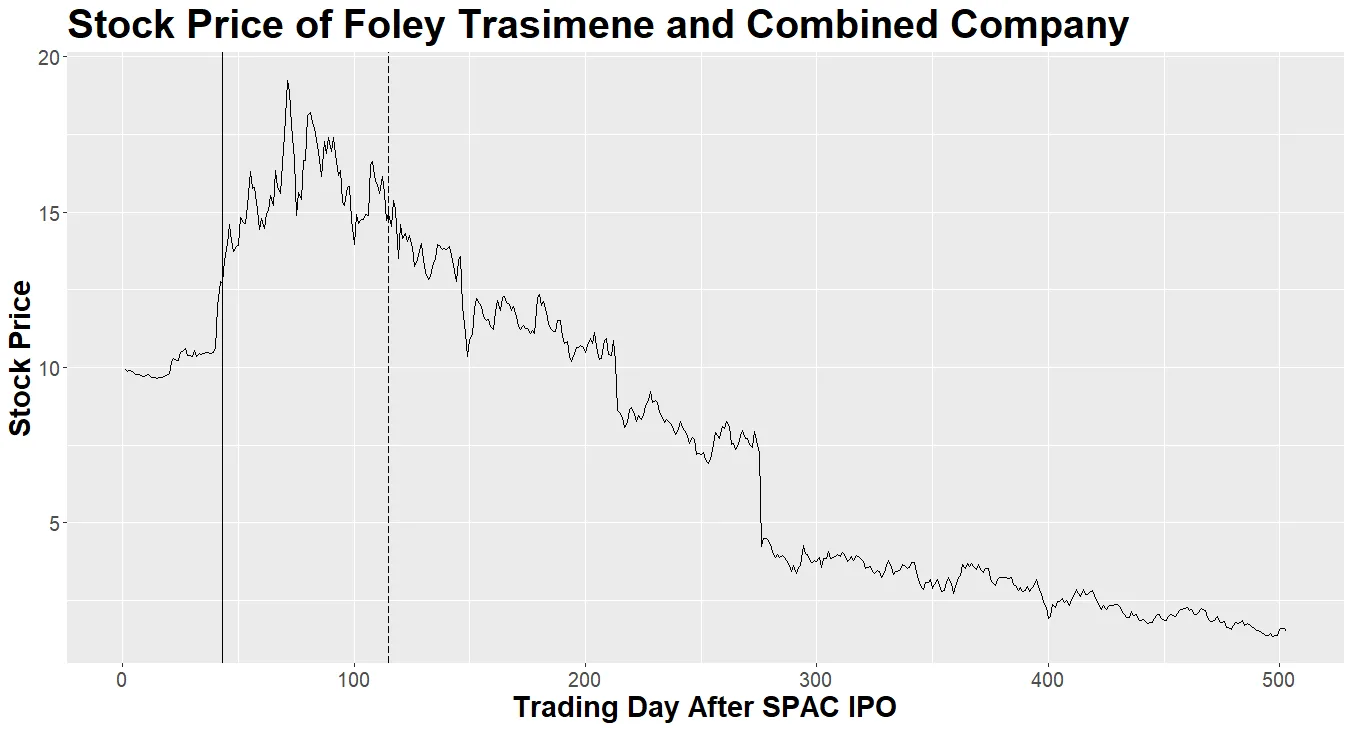
Numbers on the X-axis represent the number of trading days since Foley Trasimene’s IPO. The first day corresponds to October 9, 2020, and the last date corresponds to October 7, 2022. The solid line marks the date when the signing of a merger agreement with Paysafe was announced. The dotted line marks the date that SPAC investors approved the merger with Paysafe shortly after receiving full disclosure via a proxy statement. The data comes from CRSP’s Daily Stock File taken from the Wharton Research Data Services (WRDS).
Unrestricted trading in the SPAC’s stock before full disclosure should give securities law traditionalists concern. The very bedrock foundation of the Securities Act regime is that investors should not be permitted to speculate on the value of new securities issued by companies without the time and information necessary to make an informed investment decision—especially in the company’s first public offering of securities.
Investors did not receive full disclosure in the form of a definitive proxy statement until February 26, 2021, marked by the dotted line in Figure 1, more than a month after public investors had been purchasing SPAC common stock at prices exceeding $15 per share. Shortly thereafter, investors made their redemption decision, and many chose to hold on to their stock rather than receive the redemption price of approximately $10 per share. The merger with Paysafe Limited closed on March 30, 2021. The stock price of Foley Trasimene immediately began to decline following the merger from its trading price of around $15 per share. Individual investors who were savvy enough to sell out quickly could have still made a profit relative to the redemption value of $10 per share but only at the expense of other public investors who held the stock through the price declines. By August 2021, the combined company was trading below a redemption price of $10 per share. By June 2022, the combined company was trading below $3 per share, a 70% investment loss for buy-and-hold investors relative to the redemption value.
b. Civil Liability for Defects in Disclosures and Registration Materials
In an IPO, investors have powerful civil remedies that bolster the protective force of mandatory disclosures and restrictions on selling efforts. Under Section 12(a)(1), investors can seek rescission of securities transactions from a person who sold them a security in violation of the restrictions on offers and communications under Section 5 that are described above.127 Under Sections 11 and 12(a)(2), investors can seek damages if there are actionable misstatements or omissions in the registration statement or prospectus, respectively.128
However, SPAC investors generally could not seek a remedy under Sections 11 and 12 of the Securities Act in connection with de-SPAC transactions.129 These anti-fraud provisions generally apply only in the public offering context and are relatively plaintiff-friendly.130 Instead, investors will have to bring actions for fraud under Section 10(b) of the Exchange Act, which contains numerous limitations and hurdles for plaintiffs, including a requirement that the plaintiff establish that the fraud was committed with recklessness, knowledge, or intent.131
The Section 11 civil liability scheme employs investment bank underwriters as third-party gatekeepers. In an IPO, underwriters are liable for material misstatements and omissions in the issuer’s registration statement, subject to a due diligence defense and other defenses.132 This gives underwriters strong incentives to perform due diligence and verify that there are no intentional misstatements or omissions of information required by the securities laws.
However, the securities laws do not apply gatekeeping obligations on SPAC sponsors. It is possible that fiduciary duty litigation under state corporate law provides a similar function of casting SPAC sponsors as gatekeepers. SPAC sponsors are subject to the duty of candor inherent in corporate law fiduciary duties, to the extent that they are directors, controlling stockholders, or otherwise owe a fiduciary duty to SPAC shareholders. Fiduciary duty litigation against SPAC sponsors is novel and appears to have some bite.133 To the extent that SPAC sponsors anticipated this fiduciary duty litigation, they would have had incentives to perform due diligence and make the types of disclosures of all material information that would be helpful for SPAC shareholders in making their investment decision. In practice, the exposure of SPAC sponsors to civil liability is still unfolding and may have been uncertain to SPAC sponsors during the period studied. It is possible that some SPAC sponsors acted as if their exposure to potential civil liability was lower than in the IPO context and accordingly had fewer incentives to vet the information put forth by de-SPAC targets than underwriters do in the IPO context.
Another difference across SPACs and IPOs is the differential application of the safe harbor for forward-looking statements in IPOs relative to SPACs. Professor Amanda Rose has unpacked this differential treatment, including the debate over whether differential treatment applies at all or whether it is merely perceived.134 Studies have shown that SPAC targets disclose systematically optimistic financial projections.135 The increased use of forward-looking projections in the SPAC context and the subtle differences in framing when such projections are used relative to the IPO context may operate to affect investment decisions.
By imposing ex post liability risks on issuers and underwriters, the civil liability scheme in IPOs may subtly improve the quality and vetting of disclosures. Because this liability scheme is weaker in the SPAC context, SPAC investors are relatively more likely to receive disclosures with puffery, more optimistic forward-looking statements, and less factual integrity than in the IPO context.
2. Indirect Investor Protections that Apply in IPOs but Not in SPACs
The second possible category of investor protection mechanisms is indirect investor protections mediated by the role of underwriters in traditional IPOs.136 The securities laws buttress this indirect mechanism in two ways. First, the securities laws directly regulate the conduct of underwriters and restrict their ability to exploit investors. Second, the securities laws contain rules that restrict competition in the market for going-public transactional services and empower underwriters to involve sophisticated investors in a price discovery and price setting process.
a. Direct Regulation of the Conduct of Underwriters
Many of the complaints about SPAC sponsors today echo the complaints about the “abuses” and “excessive compensation” of investment bankers before the financial crash of 1929.137 In response, Congress created a regulatory scheme that regulates potentially problematic conduct of underwriters in public offerings of securities.138 According to the U.S. Supreme Court, Congress enacted the Securities Act and the Exchange Act, in part, “to promote honest practices in the securities markets.”139 If applied to SPACs, many of these regulations would directly address the concerns voiced about the conduct of SPAC sponsors. However, these conduct and contracting restrictions apply generally but do not apply to SPAC sponsors.
The securities laws flatly prohibit certain types of contractual arrangements into which underwriters and broker-dealers may enter. The Financial Industry Regulatory Authority (FINRA), the self-regulatory organization authorized under the Securities Exchange Act that primarily implements broker-dealer regulation, has repeatedly justified the restrictions on permissible contractual arrangements for underwriters on the grounds that “disclosure alone is not sufficient to prohibit unfair underwriting terms and arrangements that disadvantage issuers and investors.”140 Table 2 summarizes key differential regulatory requirements.
Table 2: Summary of Broker-Dealer Regulations Across SPACs and IPOs
|
Broker-Dealer Regulation |
IPO |
SPAC |
|
Regulatory Oversight |
Licensing requirements and “just and equitable” conduct standard. |
No oversight by a regulatory body. |
|
Regulatory Pre-Review of Intermediary Compensation for “Reasonableness” |
Pre-clearance of underwriting compensation by FINRA. |
No regulatory review of SPAC sponsor compensation. |
|
Cap on Ex Post Dilution |
Green shoe option greater than 15% is a per se “unreasonable” term (FINRA Rule 5110(g)(9)). |
No cap on ex post dilution. |
|
Reduced Prices |
Sales at reduced prices prohibited in fixed price offerings (FINRA Rule 5141). |
Sales at reduced prices may be made in contemporaneous PIPE offerings. |
Broadly, broker-dealers operate under the scrutiny of the SEC and FINRA. Underwriters have licensing requirements and are required to observe “high standards of commercial honor and just and equitable principles of trade” in the conduct of their business.141 The conduct of SPAC sponsors, in contrast, is not directly overseen by any regulatory body.
In IPOs, underwriters are prohibited from receiving an aggregate amount of “underwriting compensation” in connection with their participation in a public offering that is “unfair or unreasonable.”142 This rule directly limits the incentives of underwriters to exploit investors by capping the amount of compensation they can receive in connection with the offering.
However, regulatory limitations on compensation arrangements of SPAC sponsors do not exist. The absence of this investor protection is especially relevant because it is widely claimed that compensation arrangements are problematic in the SPAC context. Would the 20% promote by SPAC sponsors be deemed “unreasonable” or “unfair” if review under the FINRA corporate financing rule applied? FINRA has never published standards as to the types or amount of underwriting compensation that it considers to be unfair or unreasonable. The inquiry turns on whether reasonability and fairness exist given all the facts and circumstances.143 However, the prevailing view in the academic literature appears to be that SPAC sponsor compensation arrangements are not reasonable and fair. One knowledgeable commentator has stated his understanding that the FINRA corporate financing rule caps underwriter compensation at around 10% of the offering proceeds.144 Under this standard, the 20% SPAC sponsor promote would indeed be prohibited under the rule. At a minimum, SPAC sponsor compensation arrangements would undergo more scrutiny if sponsors had to justify them to an external regulatory body.
In the IPO context, the amount of ex post dilution that can occur through any “overallotment option” (green shoe option) received by an underwriter is capped at 15% of the amount of securities being offered.
However, no such prohibition applies to the SPAC warrants. Again, the absence of this contractual restriction is especially relevant because of claims that ex post dilution is problematic in the SPAC context. SPAC warrants frequently present potential dilution in excess of 15% of the outstanding SPAC common shares.
b. Empowering Underwriters to Involve Sophisticated Institutions in a Price Discovery and Price Setting Process
The securities laws also provide substantial indirect protection to investors by empowering underwriters in a traditional IPO to filter the price discovery and price setting process through sophisticated, institutional investors. The key analytical point is that the incentives of intermediaries and their reputational constraints in going-public markets are endogenous to the regulatory scheme.
One filtration mechanism employed in the traditional IPO process is the regulation of offers and prospectuses under Section 5. Restrictions on broad dissemination of written or broadcasted materials to the public make solicitations and selling efforts very costly. These restrictions incentivize underwriters and issuers to concentrate their efforts on soliciting the interest of bulk purchasers through direct meetings on roadshows or direct conversations between the investment bank’s selling arm and institutional investors.145 However, this filtration mechanism may be relatively less effective at filtering out retail investors from the price discovery process in recent years given the treatment of certain electronic roadshows as permissible free writing prospectuses, the broad permitted uses of “research reports” by securities analysts, and the increased dispersion of information among retail investors enabled by the internet.
In contrast, sales of SPAC common stock are not prohibited before full disclosure and the de-SPAC merger. Since the price of the SPAC’s common stock is set through trading by public investors on an exchange, SPAC sponsors need to invest relatively less in selling and distribution efforts.
A different, more powerful mechanism used in the IPO process to filter the price discovery process through sophisticated investors is the set of rules that elevate wholesale investment banks over retail investment banks in syndicate operations. Professor Paul Mahoney has persuasively argued that the limitations on selling efforts and syndicate selling efforts in the Securities Act reduced competition among investment banks.146 In particular, these restrictions privileged the role of wholesale investment bank dealers against competition from retail investment bank dealers.147 One of Congress’s concerns about selling efforts during the 1920s was that stock sellers were increasingly targeting retail investors through phone calls and door-to-door campaigns.148 The mandatory restrictions on selling efforts and syndicate transactions were intended in part to address this concern by giving managing underwriters more control over the price discovery and price setting process.149
Critically, the primary customers of wholesale investment banks that are privileged under the securities laws include large, sophisticated, institutional investors. Given their reputational constraints, wholesale investment bank underwriters have thick reputational incentives to avoid giving their customers systematically bad deals. Thus, by empowering underwriters to exercise influence over IPOs, the securities laws operate to involve the institutional customers of underwriters in a price discovery and price setting process.150
FINRA Rule 5141, the fixed-price rule, buttresses the ability of retail investors to rely on the price setting process that involves institutional investors. Rule 5141 prohibits underwriters from selling the offered securities at a lower price to select investors in a fixed price offering.151 The rule means that underwriters cannot charge retail investors a higher price than institutional investors in the IPO. By forcing all purchasers in the IPO to pay the same price, this rule makes it more likely that retail customers can rely on the price discovery process involving large, institutional customers.
However, the fixed-price prohibition does not apply to the transactions that lead up to a de-SPAC combination. By enabling price discrimination, SPACs make it relatively more difficult for retail investors to rely on pricing information produced by larger investors. Private offerings to sophisticated investors at discounted prices concurrently with a de-SPAC combination sometimes provide life support to SPAC deals, giving sponsors cash they need to complete a de-SPAC merger even when redemptions are high.152
Another powerful indirect mechanism of investor protection is the reputational constraint on underwriters that arises by operation of the regulatory hurdles imposed by the securities laws. At the heart of reputational models is the idea that the expectation of repeat relationships in the future can constrain opportunistic behavior in the present.153 If the securities laws suppress underwriter competition and produce relatively more repeat relationships between intermediaries and investors, then reputational constraints in securities offerings markets will be endogenous to the regulatory scheme.154
Empirical evidence already exists suggesting that the reputational mechanism of investor protection applies within SPAC transactions in the cross-section.155 Professors Michael Klausner and co-authors show that “high-quality” SPAC sponsors that are likely to be concerned about their reputation—those sponsors that are private equity funds with more than $1 billion in assets under management or that have a manager that is a former senior officer of a Fortune 500 company—are associated with better returns for SPAC investors than “low-quality” SPAC sponsors.156
It should not be surprising if reputational mechanisms also explain part of the difference in investment outcomes across SPACs and IPOs.
As evidence for the claim that IPO underwriters are subject to relatively stronger reputational constraints than SPAC sponsors, Tables 3 and 4 compare measures of repeat deal volume for both types of intermediaries. In general, greater market concentration and more repeat deal volume should be expected to be associated with greater reputational constraints, other things equal.
Table 3 presents a measure of lead underwriting market share for underwriting banks in IPOs: the aggregate percentage of total IPO proceeds over a given time period for IPOs in which each underwriting bank served as “lead managing underwriter”—the underwriter that negotiates the offering with the issuer, represents the other underwriters in the syndicate, and manages the selling efforts. The data is taken from the SDC Platinum Global New Issues database.157 The sample contains data on U.S. IPOs during two separate time periods a decade apart in time. The sample includes all U.S. IPOs between the years 2010 and 2012 and IPOs between the years 2020 and 2022.158 To calculate the measure of market share, I group IPOs by lead managing underwriter and then aggregate the total proceeds associated with each managing underwriter over specified time periods. The second column in Table 3 presents the percentage of total IPO proceeds associated with specified lead managing underwriters for the 2010–2012 period and the fourth column presents the percentage of total IPO proceeds associated with specified lead managing underwriters for 2020–2022 time period. For example, Morgan Stanley served as the lead managing underwriter in IPOs with $45 billion out of aggregate proceeds of $92 billion across all IPOs between 2010 and 2012, or 49% of total IPO proceeds. Morgan Stanley served as the lead managing underwriter in IPOs with $62 billion out of aggregate proceeds of $187 billion across all IPOs between 2020 and 2022, or 35% of total IPO proceeds.
Table 3: IPO Underwriting Market Share 2010–12 and 2020–22. Data from SDC Platinum Global New Issues Database.
|
Lead Manager |
Percentage of Total IPO Proceeds 2010–12 |
Lead Manager |
Percentage of Total IPO Proceeds 2020–22 |
|
Morgan Stanley |
49% |
Goldman Sachs & Co. |
35% |
|
Goldman Sachs & Co. |
14% |
Morgan Stanley |
34% |
|
Bank of America (Merrill Lynch) |
12% |
JPMorgan Chase & Co. |
16% |
|
JPMorgan Chase & Co. |
8% |
Bank of America (Merrill Lynch) |
5% |
|
Citigroup |
4% |
Barclays |
3% |
|
Barclays |
3% |
Citigroup |
2% |
|
Credit Suisse |
3% |
Credit Suisse |
2% |
|
Aggregate Total |
92% |
Aggregate Total |
94% |
Table 3 shows significant repeat deal volume for the largest IPO underwriters spanning more than a decade of time. The same underwriting banks that dominated the league tables in 2010–2012 also dominated the league tables a decade later. The order of the league tables is changed slightly, but the same seven investment banks show up in both time periods.
Table 3 also shows that the market for underwriting U.S. IPOs is heavily concentrated. In both time periods, only seven investment banks accounted for more than 92% of the combined market share as measured by the lead managing underwriter metric. Each investment bank in the table was the lead manager in IPOs underwriting at least $2 billion of securities across many transactions. Table 3 actually understates the concentration in the market owing to the fact that most underwritten IPOs are syndicated and involve many investment banks.159 While I group IPOs according to their lead manager in Table 3, most IPOs have multiple underwriters and dealers that form a selling group. Thus, if anything, the banks listed in Table 3 above participate in many more IPOs in addition to the ones attributed to them as “lead manager.”
In summary, the IPO underwriting market share data is consistent with strong reputational constraints for underwriters. The underwriting banks listed in Table 3 that have the most market share in U.S. IPOs are prestigious institutions with brands that are likely known by anyone reading this Article. The investment banks that dominate IPO underwriting markets expect to do billions of dollars of deals across hundreds of transactions on a regular basis. These banks also interact with the same group of institutional investors in seasoned equity offerings, debt offerings, and private placements. Given the frequency and large volume of IPO deals, investors are likely to have the incentives and the capacity to impose reputational sanctions on investment bankers that systematically give investors a bad deal.
In contrast to IPO underwriters, most SPAC sponsors appear to be closer to one-shot players with relatively weaker reputational constraints.
To compare completed de-SPAC deals with consummated IPOs, I compile a list of all completed mergers involving blank check companies from SDC Platinum’s Mergers & Acquisitions database in which the acquiror or target’s nation of exchange is the United States.160 The sample, covering 2010 through 2022, includes 622 mergers involving blank check companies.
To compile a proxy for repeat SPAC sponsors, I take advantage of the fact that most SPAC sponsors provide similar names to their affiliated SPAC vehicles. For example, six SPACs associated with Chamath Palihapitiya, a famous SPAC sponsor, each begin with the name “Social Capital,” utilizing a numbering system to distinguish between SPAC vehicles. Grouping SPACs sponsors by name is a sensible approach for identifying a proxy for reputational mechanisms since maintaining a consistent and identifiable name is key to reputational branding. Using this SPAC family approach, I identify SPAC families by looking to the names of the acquiror in each merger and count the number of times a SPAC family is involved in a transaction. I also used informal lists of SPAC sponsors to make sure that I did not miss any well-known SPAC sponsors.161
Table 4 presents the entire list of SPAC families associated with five or more consummated mergers in the aggregate over the period of 2010 through 2022.
Table 4: Count of Repeat De-SPAC Combinations for Sponsors Associated with Five or More Mergers Involving a Blank Check Company over the Period 2010 Through 2022. Data Taken from SDC Platinum Mergers & Acquisitions Database.
|
Sponsor |
De-SPAC Merger Count (2010–22)162 |
Year of First SPAC Combination in Sample |
|
The Gores Group (Alec Gores) |
9 |
2016 |
|
Eagle Equity Partners (Eric Rosenfeld) |
7 |
2012 |
|
Social Capital Hedosophia Holdings (Chamath Palihapitiya) |
5 |
2019 |
Table 4 shows that SPAC sponsors expect much lower repeat deal volume compared to IPO underwriters. Only three sponsors are associated with five or more mergers across thirteen years of de-SPAC combinations. Almost all of the 622 blank check company mergers in the dataset from 2010 through 2022 have been sponsored by SPACs with fewer than 5 total sponsorships according to the sponsorship proxy.
Table 4 also shows that the market for SPAC sponsors is much less concentrated than the market for underwriting IPOs. In the aggregate, the three most frequent SPAC families account for only 3% of merger volume involving blank check companies during the 2010 through 2022 period. In more than 50% of the mergers in the sample, the proxy for SPAC sponsorship is associated with only a single deal.
The data in Table 4 is consistent with relatively weaker reputational constraints for SPAC sponsors than for the investment banks listed in Table 3. Unlike the investment banks that underwrite IPOs, SPAC sponsors do not necessarily anticipate returning to the same investors for substantial amounts of future deal flow. Thus, SPAC sponsors have relatively fewer reputational incentives to refrain from exploiting investors when they believe they can obtain a good bargain.
In summary, I argue that the securities laws help create an institutional framework in IPOs where the price discovery and price setting process is primarily filtered through sophisticated investors and underwriters that generally have strong reputational incentives to give large institutional investors a fair bargain. In contrast, the relaxation of the securities laws in SPAC deals helps create an institutional framework in which sponsors have relatively lower reputational incentives to give investors a fair bargain and to refrain from exploiting investors. The market share data presented for IPO underwriters and SPAC sponsors is consistent with these claims.
Critically, my argument is that the reputational constraints for IPO underwriters are, at least in part, endogenous to the applicable regulatory scheme. In the IPO context, Section 11 imposes risk of civil and criminal penalties on low-quality underwriters that fail to accurately vet an issuer’s disclosures.163 This legal risk creates a regulatory hurdle that reduces competition in the market for going-public transactional services, which might explain why underwriters themselves have not aggressively lobbied to eliminate their liability under Section 11.164 The substantial fixed costs of new entry into underwriting markets contribute to a market structure in which underwriters are generally repeat players who do hundreds of deals with the same large investors, year after year.
III. Implications for Understanding of the Securities Laws and Reform Proposals of SPACs
A. Lessons on the Effectiveness of the Securities Laws
The recent rise in the use of SPACs can be interpreted as a market experiment testing what would happen if issuers were permitted to opt out of certain securities laws. Investors face functionally identical decisions in both SPACs and IPOs, but issuers can select the bundle of securities laws that apply to these investment decisions.
The issuer choice market experiment provides powerful market evidence supporting the doctrinal premise underlying the public offering rules that public investors cannot fend for themselves.165 Additionally, the issuer choice market experiment provides market evidence that, given the choice, issuers will choose rules and transaction structures that exploit these investors; that market forces are ineffective at constraining this exploitation; and that the full suite of the public offering rules of the securities laws work in the sense that they operate to avoid an equilibrium where public investors systematically overpay for securities. The results of this market experiment provide market evidence supporting the investor protection theory and weaken the rational choice underpinnings of the efficient capital markets theory.
The lesson from SPAC markets is that investors need mandatory protections to avoid systematically overpaying for securities in public offerings.166 The high dilution costs and the poor investment returns in the SPAC context relative to the IPO context are both best understood as a consequence of differences in direct investor protections and differences in gatekeeping incentives.
You might object to the conclusion about the importance of the securities laws by noting that the bundle of securities laws that apply to SPAC and IPO transactions is not the only thing that is different across SPACs and IPOs. There are numerous differences that one might conjecture exist and that might plausibly drive differential investor outcomes: SPAC transactions contain lower-quality issuers with riskier business prospects (issuer characteristics); SPAC transactions involve a greater share of unsophisticated, individual investors (investor characteristics); intermediaries are more inclined to commit fraud (intermediary characteristics); and the contractual structures and reputational constraints of the parties differ (contractual and reputational features).
This objection misses the mark. The analysis is not a partial equilibrium identification of the effect of the securities laws holding everything else constant. Rather, the analysis is a general equilibrium test of how market forces respond to issuer choice of securities laws. The mix of institutional and retail investors, issuer characteristics, and transaction structure, among other characteristics, is endogenous to the background regulatory scheme.
Issuer and investor characteristics are chosen by market participants conditional on expectations about the bargaining environment. Transaction structures and prices arise from arms-length bargains between investors and issuers based on their expectations. The respective bundles of mandatory securities laws that apply are a background feature of the bargaining environment. The expectations of market participants about the bargaining environment, in turn, affect the strategies of market participants. For example, one of the documented mechanisms used in the SPAC context is a strategy of “cycling out” yield investors like hedge funds and “cycling in” retail investors.167 But if the shadow of the securities laws prevents or mitigates exploitation of unsophisticated investors in IPOs, then the “cycling in” strategy employed in SPACs may never be pursued at all in IPOs. Put another way, differential characteristics between SPACs and IPOs on dimensions like issuer quality and the mix of investors in IPOs and SPACs should be interpreted as an outcome of the issuer choice market experiment.
At bottom, all of these potential alternative explanations for the poor performance of SPAC investors actually constitute a special case of the investor protection theory advanced in this Article: left to their own devices, in light of any particular problem you might identify (issuer characteristics, intermediaries with adversarial interests, etc.), investors cannot fend for themselves, and market forces exploit rather than correct this vulnerability. Behind these possible first-order concerns stands the concern that, left to their own devices, we just can’t trust SPAC investors to make good investment decisions.
B. Normative Implications
The analysis supports the conclusion that the public offering rules improve investor welfare in new issues markets relative to unaffected market outcomes. This is the primary normative conclusion of the analysis.
However, this normative conclusion is limited. First, the better regime between SPACs and IPOs is debatable. Investment losses in securities offerings on their face indicate value transfers rather than deadweight loss. A “good” deal for investors is a “bad” deal for the issuing company, and vice versa.
SPACs are problematic because they produce systematic overpricing of securities. Overpricing leads to a transfer of value from SPAC investors to companies, sponsors, and potentially investors in the SPAC, IPO, and PIPE transactions.168 Additionally, overpricing generates allocation inefficiency. The resources invested in SPACs could be better deployed elsewhere in society.
IPOs, however, have their own deficiencies.169 IPOs are systematically underpriced. On average, an IPO issuer’s stock price has closed almost 19% above the initial offering price over the last three decades.170 Combined with median fees to underwriters equal to around 7% of IPO proceeds, corporate issuers appear to leave almost a quarter on the table for every dollar of value they sell to capital markets investors in IPOs. Like in the case of SPAC overpricing, systematic IPO underpricing involves a transfer of value—this time from issuers to investors and underwriters. There is also allocation inefficiency again. While SPACs lock up too much capital in low-value firms, IPOs do not lock up enough capital in high-value firms.171 Presenting mean figures actually understates the allocation inefficiency because it disguises the volatility of initial returns. While the majority of IPOs are underpriced, more than a quarter of IPOs in the last few decades have been overpriced, with mean initial returns of almost negative 10% in this group.172 As in the SPAC context, retail investors tend to perform worse than institutional investors in overpriced IPOs.173
Measured against an allocation efficiency criterion—the ability of each transaction structure to match money and business projects until the returns to each are equal at the margins—it is not obvious whether SPACs or IPOs produce better outcomes. Overall, neither SPACs nor IPOs appear to price new issues very accurately. The record suggests that new issues markets contain severe information and incentive problems that make accurate pricing very difficult.
Nevertheless, the ability of SPACs to evade the investor protection provided by Congress through the Securities Act is troubling. Strong arguments can be made that the investor protection concerns raised by SPACs make an underwriter-driven process that produces mean IPO underpricing and high fees the lesser of evils.
Under an assumption that the IPO system is preferable to SPACs due to investor protection concerns, the issuer choice market experiment does not imply that the existing public offering rules are the optimal bundle. It is possible that a third bundle of rules could produce better investor protection than IPOs do or could produce the same investor protection at lower costs and with less allocation inefficiency.
Finally, the issuer choice market experiment does not bear on the question of whether the public offering rules produce meaningful investor protections for public offerings of listed securities where investors can rely on the indirect protection of efficient market prices.174 The interpretation is limited to the context of new issues of equity securities.
C. For SPAC Reform Proposals and Public Offering Regulation
The analysis supports proposals to level the regulatory playing field between SPACs and IPOs, particularly Harald Halbhuber’s proposal to apply the public offering rules in the SPAC context.175 Applying the public offering framework to SPACs would accomplish the end for which the securities laws aim: providing investors with the time and information necessary to make informed investment decisions and granting investors heightened civil liability remedies.176
Many of the existing reform proposals regarding SPACs are too narrow and skew too heavily toward the contracting failure explanation for SPAC investor performance. One set of proposals calls for increased disclosure of bad contractual features.177 Another set of proposals calls for regulating the voting mechanism in de-SPAC mergers.178 But if the problem is that investors cannot fend for themselves in public offerings, then static, contractual-based reforms to SPAC markets may not work and will leave investors vulnerable to future transactional innovations.179 The SEC’s recent rule proposal is an improvement on existing rules, but its approach of treating SPACs as a unique transaction type creates a rule that is both underprotective and overprotective.180
The problem with SPACs identified in this Article is the same one motivating the securities laws for almost a century: some public investors are unable to fend for themselves without mandatory investor protections.181 Fortunately, an off-the-shelf solution to this problem that has worked reasonably well already exists: applying the public offering rules in the federal securities laws. Generations of policymakers and capital markets lawyers have refined these rules and the policy solutions they represent through litigation, petitions, and rulemakings. Similar to the operation of common law, this regulatory updating process has sifted out many of the demonstrably bad investor protections and kept many of the successful ones.
The role of transactional innovation in the analysis of the issuer choice experiment counsels for comprehensive reforms to the use of shell companies in public offerings, not just to the particular version embodied by SPACs. This conclusion is supported by historical considerations.182 Congress once made a legislative finding that: “The present regulatory environment has permitted the ascendancy of the use of particular market practices, such as ‘reverse mergers’ with shell corporations and ‘blank check’ offerings, which are used to facilitate manipulation schemes and harm investors.”183
This finding echoes concerns about SPACs today, but the statute that contained this finding passed in 1990. SPACs are merely the most recent iteration of the shell companies from the 1980s, switching boiler room phone calls for Reddit message boards.
Accordingly, reform proposals should be written to apply broadly to all mergers between listed shell companies and private companies. If a comprehensive solution is not applied broadly to regulatory arbitrage by shell companies and only addresses the bespoke issues with today’s versions of SPACs, a risk will remain that transactional innovation will produce a new generation of shell companies that create new and unforeseen investor protection concerns. The SEC has already taken a disclosure-based approach to regulating SPACs, but this approach did not prevent transactional innovation from producing the recent round of SPAC mania.184
The securities laws already regulate shell company transactions, recognizing their investor protection concerns. For example, SEC Rule 419 restricts transfers of securities issued in offerings by certain “blank check companies” until a business combination occurs—effectively imposing the requirements of Section 5(a) of the Securities Act.185 As another example, listing rules impose a one-year “seasoning period” in U.S. over-the-counter markets for foreign companies that had completed a reverse merger, among other requirements, before the foreign company is permitted to list on an exchange.186
However, SPACs are structured to avoid these shell company regulations. Rule 419 applies to “blank check companies”—companies that issue “penny stock” and that have no specific business plan other than to merge with an unidentified company.187 Despite their status as “shell companies,” a SPAC is generally structured to avoid being considered a “penny stock” issuer by merely ensuring that a nominal amount of cash or cash equivalents ($5 million) is kept in escrow while it searches for a target.188 This exclusion for SPACs has never made logical sense and was a mistake from the beginning.
The SEC could simply change the definition of “blank check company” so that it encompasses all shell companies. This would be preferable to the current situation where shell companies help issuers evade the entire public offering framework. However, a better approach would involve leaving SPACs available as a viable transactional option, permitting SPAC sponsors to compete with investment bank underwriters while still applying the investor protections in the public offering rules to the SPAC context subject to all the investor protections of the securities laws.
The evidence from the issuer choice market experiment should also guide regulatory policies in areas where the public offering rules do not apply. First, regulators should aggressively police the registration requirement in the Securities Act. If there is evidence of significant investor harm in SPAC markets where mandatory disclosure provisions and certain other mandatory investor protections apply, investor harm is likely to be even more significant in unregistered offerings of securities. The failure of the SEC to aggressively police unregistered offerings of crypto assets stands out as a potential area of investor harm.
Second, regulators should carefully weigh the merits of expanding access to nonpublic offerings by lowering income or sophistication thresholds. Recently, SEC Commissioner Mark Uyeda has proposed expanding the types of investors that are able to participate in private offerings where the mandatory investor protections for public offerings do not apply.189 This follows a series of steps by the SEC under former Chairman Jay Clayton that also relaxed the restrictions on participation in nonpublic offerings.190 The so-called democratization of finance may be an important policy goal, but regulators should not lose sight of trade-offs and the policy goals underlying the Securities Act in the first place. The issuer choice market experiment suggests that many public investors need protection from themselves, and it may not be easy for commissioners to identify by rule where the line separates investors who can fend for themselves from those who cannot.
Conclusion
A seminal debate in the literature on securities regulation is what would happen if issuers could choose the securities laws that apply to them. The thrust of this Article is that we can look to SPAC markets for an answer. The issuer choice market experiment enabled by SPAC transactional innovation provides market evidence consistent with the doctrinal and policy underpinnings of the Securities Act that some public investors cannot fend for themselves; that, given the choice, some issuers will sell overpriced securities to these investors; and that market forces and intermediaries exploit, rather than correct, the mistakes of investors.
Ultimately, this Article constitutes a robust defense of the public offering rules in the Securities Act of 1933. The analysis makes it more difficult to sustain reform proposals rooted in law and economics theories premised on the idea that investors are rational and that public offering markets are efficient. Instead, the issuer choice market experiment in SPAC markets shows that the mandatory provisions of the Securities Act, aimed at ensuring that investors have the time and information they need to make informed investment decisions, are crucial to help public investors avoid systematically overpaying for securities.
These findings are cross-cutting and broadly applicable to current policy challenges faced by financial regulators. Markets for the sale of digital assets that are securities and markets for the securities of private companies have similar information problems as SPAC markets. The findings about SPACs in this Article are likely to apply in these other contexts. Public investors in these companies need protections to avoid systematically overpaying for these securities. Society benefits if these investor protections help channel capital more efficiently. The existing mandatory public offering rules in the federal securities laws are not necessarily the optimal securities regulation regime, but the lessons from SPACs suggest that they are a thoughtful regulatory regime that provides real protections to investors.
- * Associate Professor of Law, University of Notre Dame. For helpful comments, thanks to Ryan Bubb, Axel Buchner (discussant), Michael Dorff, Jill Fisch, Stavros Gadinis, Nicholas Georgakopoulos, Harald Halbhuber, Michael Klausner, Maria Maciá, Geeyoung Min, Patricia O’Hara, Michael Ohlrogge, Alexander Platt, Adam Pritchard, Bobby Reddy (discussant), Peter Robau, Roberta Romano, David Rosenfeld (discussant), Emily Strauss, James Tierney, Andrew Tuch, Julian Velasco, Emily Winston, and participants in the 2023 Annual Meeting of the American Law and Economics Association, the NYU—LawFin/SAFE-ESCP BS Law & Banking/Finance Conference, the National Business Law Scholars Conference, the University College of London and Notre Dame London Law and Finance Symposium, the Corporate and Securities Litigation Workshop, the Chicagoland Junior Scholars Conference, and the Annual Meeting of the Midwestern Law and Economics Association. Excellent research assistance was provided by Robert Kearney and Silvio Pantoja. ↩︎
- Securities Act of 1933, 15 U.S.C. §§ 77a–77mm. When I use the phrases “securities laws” or “securities regulation” throughout this Article, I generally refer solely to the rules that apply in public offerings of securities, including rules that regulate offers and sales, mandatory disclosures, civil liability, and the conduct of underwriters and dealers. ↩︎
- SEC v. Ralston Purina Co., 346 U.S. 119, 125 (1953) (stating that the design of the Securities Act is to protect investors who cannot “fend for themselves”). ↩︎
- See generally Roberta Romano, Empowering Investors: A Market Approach to Securities Regulation, 107 Yale L.J. 2359 (1998); Stephen J. Choi & Andrew T. Guzman, Portable Reciprocity: Rethinking the International Reach of Securities Regulation, 71 S. Cal. L. Rev. 903 (1998) [hereinafter Portable Reciprocity]; Stephen J. Choi & Andrew T. Guzman, The Dangerous Extraterritoriality of American Securities Law, 17 Nw. J. Int’l L. & Bus. 207 (1996); Alan R. Palmiter, Toward Disclosure Choice in Securities Offerings, 1999 Colum. Bus. L. Rev. 1; Paul G. Mahoney, The Exchange as Regulator, 83 Va. L. Rev. 1453 (1997). ↩︎
- See generally Merritt B. Fox, Securities Disclosure in a Globalizing Market: Who Should Regulate Whom, 95 Mich. L. Rev. 2498 (1997) (advocating for international jurisdictions to apply their own disclosure standards mandatorily); James D. Cox, Regulatory Duopoly in U.S. Securities Markets, 99 Colum. L. Rev. 1200, 1237 (1999) (finding enforcement deficiencies with issuer choice regimes); Merritt B. Fox, Retaining Mandatory Securities Disclosure: Why Issuer Choice Is Not Investor Empowerment, 85 Va. L. Rev. 1335, 1345–46 (1999) [hereinafter Retaining Mandatory Securities Disclosure] (criticizing issuer choice regimes on the ground that managers may choose suboptimal amounts of disclosure for reasons related to their own private welfare); Donald C. Langevoort, The SEC, Retail Investors, and the Institutionalization of the Securities Markets, 95 Va. L. Rev. 1025 (2009). ↩︎
- See J. Harold Mulherin, Measuring the Costs and Benefits of Regulation: Conceptual Issues in Securities Markets, 13 J. Corp. Fin. 421, 421–22 (2007) (discussing the conceptual difficulties in empirically evaluating the effects of securities laws); Allen Ferrell, Mandatory Disclosure and Stock Returns: Evidence from the Over-the-Counter Market, 36 J. Legal Stud. 213, 218 (2007) (finding that the variance of returns for securities that trade in over-the-counter markets decreased after Congress required their issuers to make new mandatory disclosures); George J. Benston, Required Disclosure and the Stock Market: An Evaluation of the Securities Exchange Act of 1934, 63 Am. Econ. Rev. 132, 149 (1973) (concluding that the disclosures mandates of the Securities Exchange Act of 1934 were of “no apparent value to investors”); Carol J. Simon, The Effect of the 1933 Securities Act on Investor Information and the Performance of New Issues, 79 Am. Econ. Rev. 295, 313 (1989) (finding that the dispersion of investors’ forecast errors was “significantly lower following the Securities Act”); George J. Stigler, Public Regulation of the Securities Markets, 37 J. Bus. 117, 122 (1964) (comparing investor returns before and after the passage of the Securities Act). ↩︎
- In an article using a similar methodology, Professor Elisabeth de Fontenay compared disclosures in markets for bonds, which are subject to mandatory securities laws, and in markets for leveraged loans, which are not subject to mandatory securities laws. Elisabeth de Fontenay, Do the Securities Laws Matter? The Rise of the Leveraged Loan Market, 39 J. Corp. L. 725, 726–27 (2014). The study concluded that the securities laws had little effect on the content or quality of disclosures. Id. at 759. In contrast, this Article tests the effectiveness of the investor protection function of the Securities Act. Unlike leveraged loan markets, SPAC markets contain the types of retail investors that the law deems most likely to need mandatory protections in public offerings. See infra text accompanying note 79 (discussing the definitions of “accredited investor” and “sophisticated investor” in the Security and Exchange Commission’s Regulation D). ↩︎
- In an IPO, a private company offers and sells its stock to the public for the first time through the selling and distribution efforts of an underwriter. A SPAC accomplishes the same end result for issuing companies through a two-step process. In the first step, the SPAC raises cash through an IPO of its securities in which the SPAC sells its securities to public investors and lists its securities on a national securities exchange like the New York Stock Exchange or the Nasdaq (the “SPAC IPO”). In the second step, the SPAC merges with a private operating company (the “de-SPAC” combination). Just before a de-SPAC combination, holders of SPAC common stock make their key investment decision: whether to redeem their share of stock for about $10 per share or to continue their investment in the post-combination entity. The redemption decision is the key investment decision faced by SPAC investors. See generally Charles J. Johnson, Jr., Joseph McLaughlin & Anna T. Pinedo, Corporate Finance and the Securities Laws § 3A.13 (6th ed. 2020) (describing the SPAC IPO and de-SPAC combination processes). ↩︎
- I use the term “SPAC investors” in this Article to refer to the investors who hold SPAC common stock through the de-SPAC combination. While there are other groups of SPAC investors (warrant holders, investors who sell before the de-SPAC combination, etc.), I use the simplified term “SPAC investors” to refer to a more narrowly defined group for expositional clarity. Transactional details about de-SPAC combinations and other SPAC investors are described infra Part I. I use the term “IPO investors” in this Article to mean the investors that receive initial allocations directly from the underwriters or selling group members and that pay the initial offering price in the IPO. ↩︎
- See infra Section I.A. ↩︎
- Id. ↩︎
- The recent legal academic literature on SPACs is large and growing. See generally, e.g., Michael Klausner, Michael Ohlrogge & Emily Ruan, A Sober Look at SPACs, 39 Yale J. on Regul. 228 (2022) [hereinafter A Sober Look at SPACs]; Usha Rodrigues & Mike Stegemoller, Exit, Voice, and Reputation: The Evolution of SPACs, 37 Del. J. Corp. L. 849 (2013) [hereinafter Evolution of SPACs]; Harald Halbhuber, Economic Substance in SPAC Regulation, 40 Yale J. on Regul. 44 (2022); Michael Klausner, Michael Ohlrogge & Harald Halbhuber, Net Cash Per Share: The Key to Disclosing SPAC Dilution, 40 Yale J. on Regul. 18 (2022) [hereinafter Net Cash Per Share]; Usha Rodrigues & Michael Stegemoller, Disclosure’s Limits, 40 Yale J. on Regul. 37 (2022) [hereinafter Disclosure’s Limits]; John C. Coates, SPAC Law and Myths, 78 Bus. Law. 371 (2023); Usha R. Rodrigues & Michael Stegemoller, Why SPACs: An Apologia, (U. Ga. Sch. L. Legal Stud. Rsch. Paper, Paper No. 2022-04, 2022) [hereinafter Apologia], https://papers.ssrn.com/sol3/papers.cfm?abstract_id=4072834 [https://
perma.cc/J8GF-Z7WT]; Usha R. Rodrigues & Michael Stegemoller, Redeeming SPACs 40–43 (U. Ga. Sch. L. Legal Stud. Rsch. Paper, Paper No. 2021-09, 2021) [hereinafter Redeeming SPACs], https://
papers.ssrn.com/sol3/papers.cfm?abstract_id=3906196 [https://perma.cc/V8AN-L6PR] (showing data suggesting that SPAC retail investors trade in a context of unusual illiquidity); Amanda M. Rose, SPAC Mergers, IPOs, and the PSLRA’s Safe Harbor: Unpacking Claims of Regulatory Arbitrage, 64 Wm. & Mary L. Rev. 1757 (2023); Michael Klausner & Michael Ohlrogge, Is SPAC Sponsor Compensation Evolving? A Sober Look at Earnouts (Stan. L. & Econ. Olin Working Paper, Paper No. 567, NYU L. & Econ. Rsch. Paper, Paper No. 22-10, 2022) [hereinafter Sober Look at Earnouts], https://papers.ssrn.com
/sol3/papers.cfm?abstract_id=4022611 [https://perma.cc/UT4H-JH89]; Andrew F. Tuch & Joel Seligman, The Further Erosion of Investor Protection: Expanded Exemptions, SPAC Mergers, and Direct Listings, 108 Iowa L. Rev. 303 (2022); Emily Strauss, Suing SPACs, 96 S. Cal. L. Rev. 553 (2023). ↩︎ - See infra Section I.B; notes 57–59 and accompanying text. But see Frank Fagan & Saul Levmore, SPACs, PIPEs, and Common Investors, 25 U. Pa. J. Bus. L. 103, 108 (2023) (“SPACs have evolved as a sensible way to link several steps in a process of business formation that can appeal to public investors.”). ↩︎
- In a complementary article, Professors Robert Jackson and John Morley provide an additional institutional analysis of issues posed by SPACs under the Investment Company Act of 1940, arguing that many SPACs have failed to register and comply with applicable regulations thereunder. Robert Jackson & John Morley, SPACs as Investment Funds (July 14, 2022) (unpublished manuscript) (on file with Wharton Initiative on Financial Policy and Regulation). The behavioral model of investors developed here is necessary to support some of the critiques that have been launched at SPAC contractual features. See infra Section I.C; notes 79–82 and accompanying text. ↩︎
- The leading concern is that investors are vulnerable to speculative frenzies in which they overvalue securities on the basis of unreliable information. This concern is embedded in the history and doctrine of the Securities Act of 1933. See, e.g., Felix Frankfurter, The Federal Securities Act: II, Fortune, Aug. 1933, at 53, 54 (“During the height of the greatest speculative carnival in the world’s history, billions of new securities were floated, of which a large part had no relation to the country’s need and which inevitably became worthless; worthless not merely for millions who had sought speculative gains, but for those other millions who sought to conserve the savings of a lifetime.”); see also supra note 2. ↩︎
- Halbhuber, supra note 11, at 53–61 (identifying gaps in the regulatory scheme because SPACs are not regulated as sales of stock for cash); Tuch & Seligman, supra note 11, at 306 (arguing that corporations have avoided the protections of Section 11 of the Securities Act by pursuing SPACs instead of traditional IPOs); Rose, supra note 11, at 1815–13 (discussing the likely availability of the safe harbor for forward-looking statements for SPACs but not for IPOs). The extent of certain aspects of this differential regulatory treatment is not settled. See Coates, supra note 11, at 392–93. However, even Coates argues that many market participants acted as if many securities laws applied differentially, which is the significant consideration for interpretation of market outcomes during the relevant time period. Id. ↩︎
- Enron used shell companies to evade accounting consolidation rules and mask its inevitable insolvency. See Steven L. Schwarcz, Enron and the Use and Abuse of Special Purpose Entities in Corporate Structures, 70 U. Cin. L. Rev. 1309, 1310 (2002). Venture capital firms use shell companies to obtain economic exposure to Chinese companies without violating prohibitions on foreign ownership under Chinese law. See, e.g., Samuel Farrell Ziegler, Note, China’s Variable Interest Entity Problem: How Americans Have Illegally Invested Billions in China and How to Fix It, 84 Geo. Wash. L. Rev. 539, 547 (2016). The “Texas two-step” strategy employed by Johnson & Johnson’s to transfer mass tort liabilities to a shell company was an attempt to evade a threshold requirement for obtaining the protection of bankruptcy laws. See In re LTL Mgmt., LLC, 64 F.4th 84, 109 (3d Cir. 2023) (denying bankruptcy protection to a shell company “‘formed,’ almost exclusively, ‘to manage and defend thousands of talc-related claims’” on grounds that bankruptcy was not filed in good faith). In other work, I have argued that many securitization vehicles, like the ones at the center of the 2007–09 financial crisis, were designed to evade regulation under the Investment Company Act and the banking laws. Patrick M. Corrigan, Shining a Light on Shadow Banks, 49 J. Corp. L. 1 (2023). ↩︎
- See infra Section I.C. ↩︎
- See infra Section II.C.1. ↩︎
- See infra Section II.C.2. ↩︎
- This Article returns to the merger between Lordstown Motors, an electrical vehicle company, and DiamondPeak Holdings Corp. SPAC in various places as an example. See DiamondPeak Holdings Corp., Current Report (Form 8-K) (Sept. 17, 2020), https://www.sec.gov/Archives/edgar/data/1759546
/000110465920106256/tm2029038-3_8k.htm [https://perma.cc/T4UU-ZB7Q]; DiamondPeak Holdings Corp., Exhibit 99.1 to Current Report (Form 8-K) (Sept. 17, 2020), https://www.sec.gov/Archives/edgar
/data/1759546/000110465920106256/tm2029038d3_ex99-1.htm [https://perma.cc/TW8W-XFAJ]. ↩︎ - See Amrith Ramkumar, The Celebrities from Serena Williams to A-Rod Fueling the SPAC Boom, Wall St. J. (Mar. 17, 2021, 5:32 AM), https://www.wsj.com/articles/the-celebrities-from-serena
-williams-to-a-rod-fueling-the-spac-boom-11615973578 [https://perma.cc/3EVW-SY4G]. ↩︎ - See Al Root, Lordstown Motors Trading Makes No Sense. Memes Trump Fundamentals., Barron’s (June 9, 2021, 4:40 PM), https://www.barrons.com/articles/lordstown-motors-trading-makes
-no-sense-memes-trump-fundamentals-51623271235 [https://perma.cc/6W2N-4SC8]. ↩︎ - See 15 U.S.C. § 77e(a) (2022) (prohibiting certain sales of securities unless a registration statement is in effect); see also infra Section III.C. ↩︎
- See infra Section II.C. ↩︎
- This claim supports the skepticism of some commentators about the effectiveness of new disclosure rules as a solution to investor protection concerns in SPAC markets. Disclosure’s Limits, supra note 11, at 42 (expressing concern that many public investors are unlikely to even read the disclosures, much less understand them). However, some commentators have argued that market-standard SPAC disclosures are inadequate because they hide the real amount of dilution associated with de-SPAC combinations and related transactions. See infra text accompanying note 73. To the extent that this claim has merit, my conclusions about the role of disclosure in SPAC markets should be qualified. ↩︎
- Donald C. Langevoort & Robert B. Thompson, IPOs and the Slow Death of Section 5, 102 Ky. L.J. 891, 891 (2013) (describing congressional and regulatory actions that have eroded the protections provided by Section 5 of the Securities Act). ↩︎
- See supra note 3. ↩︎
- Importantly, there is no assumption that all investors systematically fall prey to biases and errors in their judgment. See, e.g., Gregory Mitchell, Why Law and Economics’ Perfect Rationality Should Not Be Traded for Behavioral Law and Economics’ Equal Incompetence, 91 Geo. L.J. 67, 69 (2002) (criticizing behavioral law and economics studies that assume all market participants are equally incompetent). To be clear, the claim is that sophisticated market participants in SPAC markets have the incentives and the incentives to target the investors who are likely to systematically overpay for new issues of equity securities. ↩︎
- See Tuch & Seligman, supra note 11, at 343. In other work, I have argued that sophisticated issuers can obtain above-market pricing for their stock by pursuing a strategy of holding up their underwriter at the pricing negotiation. Patrick M. Corrigan, The Seller’s Curse and the Underwriter’s Pricing Pivot: A Behavioral Theory of IPO Pricing, 13 Va. L. & Bus. Rev. 335, 352 (2019). Transactional innovation in SPAC markets provides issuers with an additional avenue for obtaining an above-market price for their stock in going-public transactions. ↩︎
- SEC v. Ralston Purina Co., 346 U.S. 119, 125 (1953) (concluding that the design of the Securities Act of 1933 is to protect investors that cannot “fend for themselves”). ↩︎
- See generally, e.g., Claire Célérier & Boris Vallée, Catering to Investors Through Security Design: Headline Rate and Complexity, 132 Q.J. Econ. 1469 (2017); Petra Vokata, Engineering Lemons, 142 J. Fin. Econ. 737, 738 (2021) (finding that yield enhancement products sold to households offer negative returns); Xavier Gabaix & David Laibson, Shrouded Attributes, Consumer Myopia, and Information Suppression in Competitive Markets, 121 Q.J. Econ. 505 (2006); Oren Bar-Gill, Seduction by Contract: Law, Economics, and Psychology in Consumer Markets (2012). ↩︎
- See generally, e.g., Malcolm Baker & Jeffrey Wurgler, Investor Sentiment and the Cross-Section of Stock Returns, 61 J. Fin. 1645, 1677 (2006) (showing that proxies for investor sentiment are statistically related to certain categories of stock returns); Francesca Cornelli, David Goldreich & Alexander Ljungqvist, Investor Sentiment and Pre-IPO Markets, 61 J. Fin. 1187, 1214 (2006) (finding evidence that irrational behavior by sentiment investors contributes to relatively higher aftermarket prices following European IPOs). ↩︎
- See Alexander Ljungqvist, Vikram Nanda & Rajdeep Singh, Hot Markets, Investor Sentiment, and IPO Pricing, 79 J. Bus. 1667, 1668–69 (2006) (arguing that rational issuers should seek to capture as much as possible of the surplus under the demand curve of exuberant sentiment investors). ↩︎
- The analysis also does not resolve the question of whether the costs to issuers and capital formation outweigh the investor protection benefits of regulation. ↩︎
- See Fagan & Levmore, supra note 12, at 107–08. A third regime, perhaps direct listings, might provide a more desirable going-public transactional structure than both SPACs and IPOs do. However, very few market participants have chosen to complete Dutch auctions or direct listings. Issues related to direct listings and Dutch auctions are outside the scope of this Article. But see Tuch & Seligman, supra note 11, at 308 (expressing concerns about weak investor protection in the direct listing context as a result of the difficulty of applying Section 11 of the Securities Act to direct listings). ↩︎
- See, e.g., Stephen J. Choi & Adam C. Pritchard, All Stick and No Carrot? Reforming Public Offerings (NYU L. & Econ. Rsch. Paper, Paper No. 23-14, U. Mich. L. & Econ. Rsch. Paper, Paper No. 23-022, 2023), https://papers.ssrn.com/sol3/papers.cfm?abstract_id=4256951 [https://perma.cc/UY63-QF4L] (arguing for a new regime that focuses on the nature of the information environment for issuers at the time they go public). ↩︎
- See Holger Spamann, Indirect Investor Protection: The Investment Ecosystem and Its Legal Underpinnings, 14 J. Legal Analysis 16, 18 (2022) (arguing that investors already have substantial indirect investor protections in publicly traded stocks because of their ability to free ride on efficient market prices and the discipline produced by plaintiff’s lawyers and activist investors). ↩︎
- Among others, IPOs are vulnerable to systematic IPO underpricing and conflicts of interest. See, e.g., Corrigan, supra note 29, at 348–49 (describing IPO underpricing); Sean J. Griffith, Spinning and Underpricing: A Legal and Economic Analysis of the Preferential Allocation of Shares in Initial Public Offerings, 69 Brook. L. Rev. 583, 586–87 (2004) (describing preferential allocation of underpriced IPO shares by underwriters to favored customers). ↩︎
- See Halbhuber, supra note 11, at 47. To prevent future transactional innovation from raising the same investor protection issues as SPACs, the proposal should apply to all mergers between listed shell companies and private companies. See infra notes 181–87 and accompanying text. ↩︎
- See infra note 168 and accompanying text. ↩︎
- See, e.g., SEC v. Commonwealth Chem. Sec. Inc., 574 F.2d 90, 93, 99–100 (2d Cir. 1978) (describing a penny stock scheme in which promoters used affiliated funds to make purchases of the penny stock in order to drive up prices). SPACs are also another version of the reverse mergers by foreign companies that, more recently, created investor-protections concerns and that led to rule changes in 2011 making it more difficult for reverse merger companies to list. See Self-Regulatory Organizations, Exchange Act Release No. 34-65710 (Nov. 8, 2011) (approving a new rule that toughens the standard that companies going public through a reverse merger must meet to become listed on exchange). ↩︎
- See, e.g., Jessica Corso, SEC’s Uyeda Wants to Let Public in on Private Offerings, Law360 (Jan. 13, 2023, 10:02 PM), https://www.law360.com/articles/1565725/sec-s-uyeda-wants-to-let-public
-in-on-private-offerings [https://perma.cc/V59R-8L95]. ↩︎ - See Gary Gensler, Chair, SEC, Kennedy and Crypto (Sept. 8, 2022), https://www.sec.gov
/news/speech/gensler-sec-speaks-090822 [https://perma.cc/59QV-MBDA]. ↩︎ - See Lora Dimitrova, Perverse Incentives of Special Purpose Acquisition Companies, the “Poor Man’s Private Equity Funds,” 63 J. Acct. & Econ. 99, 118 (2017) (arguing that misaligned incentives for SPAC sponsors are a key driver of poor post-merger performance for de-SPAC companies); A Sober Look at SPACs, supra note 11, at 234, 247, 252, 298–99 (showing that dilutive contractual features are correlated with poor post-merger performance). ↩︎
- In the SPAC IPO, investors exchange $10 for a unit that includes one share of common stock and a warrant that permits the holder to purchase a fraction of a share of the SPAC’s common stock for $11.50. In connection with the SPAC IPO, the SPAC’s units are listed on an exchange. Thereafter, the units separate and the warrants trade independently of the common stock. See Johnson et al., supra note 7, § 3A.13(A). ↩︎
- See id. § 3A.13. ↩︎
- It is unclear the extent to which SPAC investors that hold through a de-SPAC combination sell in secondary markets or continue to hold their shares long-term. It is possible that some investors pursued a profitable strategy of “selling to a greater fool.” In this case, SPAC investors as a class perform poorly even if some subset of individual investors succeed in pursuing a profitable trading strategy. ↩︎
- See Minmo Gahng, Jay R. Ritter & Donghang Zhang, SPACs, Rev. Fin. Stud. (forthcoming) (manuscript at 24, 45), https://papers.ssrn.com/sol3/papers.cfm?abstract_id=3775847 [https://perma
.cc/2WNX-42NP]. Mean returns are less bad, negative 3%, when the returns are weighted by the amount of money that public SPAC investors leave in after redemptions. Id. (manuscript at 4). The mean is calculated using a period of January 2010 to December 2020. Id. ↩︎ - Id. ↩︎
- Jay R. Ritter, Initial Public Offerings: Updated Statistics, Univ. Fla.: Warrington Coll. Bus. 3 tbl.1 (Jan. 19, 2024), https://site.warrington.ufl.edu/ritter/files/IPO-Statistics.pdf [https://perma
.cc/A63K-4H8A]. The table reports mean first-day returns to initial IPO investors grouped by year. Between 2010 and 2020, the lowest mean first day return to investors was 9.4%. Id. ↩︎ - The analysis by Renaissance Capital that compared SPAC deals between 2015 and the third quarter of 2020 and traditional IPOs over the same period found that IPO investors received 58% greater returns than SPAC investors. See Updated: SPAC Returns Fall Short of Traditional IPO Returns on Average, Renaissance Cap. (Oct. 1, 2020), https://www.renaissancecapital.com/IPO-Center/News
/71816/Updated-SPAC-returns-fall-short-of-traditional-IPO-returns-on-average [https://perma.cc
/WPY7-FTMK]. A later analysis suggested that de-SPAC mergers in 2021 had yielded investors an average return of negative 43% by April 2022, returns that were worse than traditional IPOs around the same time. See Special Report: SPAC Merger Returns Crumble, Upending the 2022 SPAC Market, Renaissance Cap. (Apr. 20, 2022), https://www.renaissancecapital.com/IPO-Center/News
/92125/Special-Report-SPAC-merger-returns-crumble-upending-the-2022-SPAC-market [https://
perma.cc/JCC9-WQ3B]. According to another recent estimate, buy-and-hold investors in 2020 vintage SPACs had incurred mean market adjusted losses of 64% as of November 1, 2021. A Sober Look at SPACs, supra note 11, at 233. Numerous companies combined with SPACs are now on the brink of insolvency, and a wave of de-listings and restructuring might come soon. See Joanna Glasner, The Dollar Stock Club: Delisting Looms for These Poorly Performing SPACs, Crunchbase News (June 30, 2022), https://news.crunchbase.com/public/spac-merger-vc-backed-delisting-enjy-lotz-crxt/?utm_source=cb
_daily&utm_medium=email&utm_campaign=20220630&utm_content=intro&utm_term=content&utm_source=cb_daily&utm_medium=email&utm_campaign=20220630 [https://perma.cc/PMZ9-24HQ]; see also Bailey Lipschultz, Why More than 40% of Ex-SPACs Are Running Out of Cash, Bloomberg (Oct. 5, 2022, 9:28 AM), https://www.bloomberg.com/news/articles/2022-10-05/dozens-of-de-spacs-flag-severe-cash-problems-as-economy-weakens#xj4y7vzkg [https://perma.cc/47RR-GPJV]. ↩︎ - See A Sober Look at SPACs, supra note 11, at 256. ↩︎
- See Ritter, supra note 50, at 3 tbl.1. ↩︎
- See Paul Rose & Steven Davidoff Solomon, Where Have All the IPOs Gone? The Hard Life of the Small IPO, 6 Harv. Bus. L. Rev. 83, 123 (2016). ↩︎
- See Dimitrova, supra note 44, at 118; John S. Howe & Scott W. O’Brien, SPAC Performance, Ownership and Corporate Governance, 15 Advances Fin. Econ. 1, 3 (2012). ↩︎
- See A Sober Look at SPACs, supra note 11, at 236. ↩︎
- See A Sober Look at SPACs, supra note 11, at 233; Michael Klausner & Michael Ohlrogge, Was the SPAC Crash Predictable?, 40 Yale J. on Regul. 101, 105–06 (2023). ↩︎
- See A Sober Look at SPACs, supra note 11, at 232–33. In the initial SPAC IPO, investors typically invest $10 for a unit that contains a share of common stock and a warrant. The fraction of a share of common stock that the warrant permits the holder to purchase varies. The purchase price is usually set at $11.50 per share. In the Klausner et al. study looking at SPACs that completed an IPO between 2019 and 2020, the median number of shares purchasable per warrant was 0.5 and the mean was 0.63. Id. at 250 tbl.3. The warrant gives investors the right to purchase a fraction of a share of the post-combination company at a price of $11.50 per share. Id. at 248. ↩︎
- See A Sober Look at SPACs, supra note 11, at 246–47 (arguing that the promote effectively reduces the amount of cash available for a de-SPAC combination agreement from $10 per share of SPAC common stock to $8). ↩︎
- Redeeming SPACs, supra note 11, at 9, 44. ↩︎
- See id. at 3. ↩︎
- See id. (claiming that this empty voting problem poses “threats not only to SPAC shareholders themselves, but also to the markets as a whole”). ↩︎
- See Hsuan-Chi Chen & Jay R. Ritter, The Seven Percent Solution, 55 J. Fin. 1105, 1129 (2000). Technically, the underwriter profits from the spread on the purchase of securities from the issuer at a negotiated discount and the resale of those securities to the public. For simplicity, I refer to this gross spread as the underwriter’s fee compensation. ↩︎
- See A Sober Look at Earnouts, supra note 11, at 5 (“A bad deal for shareholders is still a good deal for a sponsor.”). ↩︎
- See Klausner & Ohlrogge, supra note 57, at 108 (“It is possible that a merger between a SPAC and a target creates surplus value—that a target sees value in combining with a SPAC beyond the net cash it will receive—in which case the target may agree to a deal that does not inflate its value commensurately with the inflation of the SPAC’s valuation of $10 per share. In that case, the merger may be profitable for both target and SPAC shareholders.”). ↩︎
- One notable example is that private equity fund managers are typically compensated around 20% of the total amount of funds invested as a result of a 2% annual management fee accruing for a period of ten years. See Victor Fleischer, Two and Twenty: Taxing Partnership Profits in Private Equity Funds, 83 N.Y.U. L. Rev. 1, 3 (2008); see also Ronald J. Gilson, Engineering a Venture Capital Market: Lessons from the American Experience, 55 Stan. L. Rev. 1067, 1089 (2003) (arguing that the compensation structure of fund managers is a critical tool for constraining the ability of fund managers to impose agency costs on investors by aligning the incentives of investors and fund managers to receive an investment return). ↩︎
- See, e.g., Fagan & Levmore, supra note 12, at 108, 113–14 (stating that “SPACs have evolved as a sensible way to link several steps in a process of business formation that can appeal to public investors” and describing the role of SPAC sponsors in this process). ↩︎
- Id. at 113–14. ↩︎
- See A Sober Look at SPACs, supra note 11, at 248. ↩︎
- The green shoe option grants underwriters a shorter exercise window than warrants issued by a SPAC. Most green shoe options must be exercised within thirty days while SPAC warrants are typically exercisable for five years. See Patrick M. Corrigan, Footloose with Green Shoes: Can Underwriters Profit from IPO Underpricing?, 38 Yale J. on Regul. 908, 918 (2021). ↩︎
- Id. It is possible for the green shoe option shares to come from existing shares held by shareholders, but it is more common for the source of green shoe option shares to be newly issued shares by the company. ↩︎
- Technically, it is economical to exercise the green shoe option if the issuer’s stock price trades above the initial offering price less the underwriting discounts because the underwriters purchase the green shoe option shares at the initial offering price less underwriting discounts. ↩︎
- The amount of dilution in SPAC deals is plausibly apparent to investors up front, at least directionally. The proxy statement sent to investors contains mandatory disclosures concerning specific information about underlying sources of dilution as well as disclosures about the general risk of dilution. Nevertheless, whether the specific form of disclosures made by SPAC investors in proxy statements and other mandatory disclosures is adequate is a matter of debate. Some have argued that the market standard disclosures in SPAC deals about dilution are inadequate. See Net Cash Per Share, supra note 11, at 33–35. If this claim has merit, it raises serious concerns about the ability of investors to digest complex disclosure information when making any type of investment decision, not only in the SPAC context. Cf. Disclosure’s Limits, supra note 11, at 38 (arguing that SPACs disclose dilution in tabular form and in risk factors and questioning whether investors would even read new disclosures).
In Delman v. GigAcquisitions3, LLC, the Delaware Court of Chancery declined a motion to dismiss by defendants in fiduciary duty litigation where a stockholder alleged inadequate disclosures about the amount of net cash available to the SPAC in the proposed merger and about the true business prospects of the target company. 288 A.3d 692, 700 (Del. Ch. 2023). The court found that a breach of fiduciary duties was reasonably conceivable even though the proxy statement that was delivered to investors disclosed information about the capital structure that investors could use to calculate dilution. Id. at 705–06. Moreover, the proxy statement disclosed a general risk of dilution caused by the merger and related transactions. Id. Some market participants have called the Delman decision “novel” and raised questions about whether the Delaware Supreme Court will follow it. Howard L. Ellin, Edward B. Micheletti, Gregg A. Noel, Richard C. Witzel, Jr. & Sarah Runnells Martin, In Novel SPAC Ruling, Court Questions Fundamental SPAC Structure Under Delaware Law, Skadden (Jan. 31, 2023), https://www.skadden
.com/insights/publications/2023/01/in-novel-spac-ruling-court-questions-fundamental [https://perma
.cc/884K-2FPD]. ↩︎ - See Redeeming SPACs, supra note 11, at 3 (“SPAC shareholders can vote for a business combination even while they are redeeming their shares. In effect, they can vote for an acquisition while walking out the door, paradoxically declining to take part in the very transaction they have approved.”). ↩︎
- One might argue that a sham “yes” vote is different than no vote at all to the extent that investors rely on the “yes” vote to inform their decision. However, the “yes” vote occurs after the redemption decision, so SPAC investors could not rely on this vote when making their investment decision even if voting “no” was a condition of redeeming. ↩︎
- You might think that IPO investors get the benefit of relying on the judgment of other sophisticated parties during the book-building process and that this process substitutes for a vote. If the underwriting banks are unable to build a book for the entire offering at the offer price, the deal will not happen or will get repriced downwards. But, of course, an identical feature operates in the SPAC context: SPAC investors also get to rely on the decisions of other investors failing to redeem their shares in a sufficient amount for the deal to get done. ↩︎
- See supra notes 4–5 and accompanying text (discussing the empirical literature on the effectiveness of the securities laws and the theoretical literature on issuer choice proposals). ↩︎
- See supra note 5. ↩︎
- SEC v. Ralston Purina Co., 346 U.S. 119, 125 (1953). Throughout, I use the concept of an inability of investors to fend for themselves to capaciously include any reason why investors could not fend for themselves, including but not limited to bounded rationality. Neither the Securities Act nor doctrinal interpretations precisely describe the nature of the posited inability of public investors to “fend for themselves.” Such investors might include the types of investors identified by the literature on behavioral law and economics. See generally Christine Jolls, Cass R. Sunstein & Richard Thaler, A Behavioral Approach to Law and Economics, 50 Stan. L. Rev. 1471 (1998); see also Nicholas Barberis & Richard Thaler, A Survey of Behavioral Finance (Nat’l Bureau of Econ. Rsch., Working Paper No. 9222, 2002); David Hirshleifer, Investor Psychology and Asset Pricing, 56 J. Fin. 1533 (2001). Indeed, as Professor Stephen J. Choi has observed, “[i]f we assume all investors are rational, then little justification exists for many of the public offering rules.” Stephen J. Choi, Behavioral Economics and the Regulation of Public Offerings, 10 Lewis & Clark L. Rev. 85, 88 (2006). More guidance exists concerning whom the law deems can fend for themselves. The class of persons who can fend for themselves, as interpreted by the SEC, includes at least certain large institutional investors, large investment companies, banks, insurance companies, certain wealthy individuals, and certain high-ranking officers of the issuing company, including directors and certain executive officers and heads of business or policy units. 17 C.F.R. § 230.501 (2011). The class of investors who can “fend for themselves” for purposes of Section 4(a)(2) is broader than the class of investors who are “accredited investors” as that term is used by the SEC primarily for the purposes of relying on the safe harbor for Section 4(a)(2) under Regulation D. However, the guidance on where the line between investors who can “fend for themselves” for purposes of Section 4(a)(2) and those who cannot is thin. Under certain conditions, these investors are able to participate in private offerings that are exempt from the public offering rules in the Securities Act. Securities Act of 1933, 15 U.S.C. § 77d(a)(2). ↩︎
- Ralston Purina Co., 346 U.S. at 124; see also S. Rep. No. 47, at 1 (1933) (claiming that the purpose of the Act included “providing protection against fraud and misrepresentation”); Brooklyn Manhattan Transit Corp., Exchange Act Release No. 15, 1935 WL 29822, at *11 (June 4, 1935) (claiming that the Securities Act was “designed to afford regulatory protection for investors in connection with the distribution of new security issues”). ↩︎
- Following the financial crash of 1929 and the subsequent Great Depression, Congress and society were grappling with a situation in which opportunistic promoters had used high-pressure sales tactics—and sometimes fraud and misconduct—to sell a staggering volume of overpriced new issues to public investors. According to one estimate, half of all securities issued in the 1920s were “undesirable or worthless.” National Affairs: Caveat Venditor, TIME (Apr. 10, 1933), https://content.time.com
/time/subscriber/article/0,33009,929518,00.html [https://perma.cc/L8FB-2VRC]; see also Statement of the Commission on the Problem of Regulating the ‘Pegging, Fixing and Stabilizing’ of Security Prices, Exchange Act Release No. 34-2446, 1940 WL 968, at *10 (Mar. 18, 1940) (“The damage to investors results ultimately from the over-pricing of securities issues.”). ↩︎ - The term “exploit” describes a situation in which one party takes strategic actions to profit from the mistakes of a counterparty. See Cass R. Sunstein, The Storrs Lectures: Behavioral Economics and Paternalism, 122 Yale L.J. 1826, 1832 (2013) (“In identifiable cases, those who do not exploit human errors will be seriously punished by market forces, simply because their competitors are doing so and profiting as a result.”); see also Ronald J. Gilson & Reinier Kraakman, The Mechanisms of Market Efficiency Twenty Years Later: The Hindsight Bias, 28 J. Corp. L. 715, 738 (2003). For the literature on behavioral law and economics and securities regulation, see generally, for example, Robert Prentice, Whither Securities Regulation? Some Behavioral Observations Regarding Proposals for Its Future, 51 Duke L.J. 1397, 1509–11 (2002) (arguing against deregulatory proposals using support from behavioral economics); Donald C. Langevoort, Taming the Animal Spirits of the Stock Markets: A Behavioral Approach to Securities Regulation, 97 Nw. U. L. Rev. 135, 139–43 (2002) (criticizing strong forms of the efficient market hypothesis and describing the importance of psychology to securities regulation); Stephen J. Choi & A.C. Pritchard, Behavioral Economics and the SEC, 56 Stan. L. Rev. 1 (2003); Choi, supra note 79, 107–22 (analyzing implicit behavioral assumptions in rules adopted by the SEC); James Fallows Tierney, Investment Games, 72 Duke L.J. 353, 415–23 (2022) (assessing the role of the gamification of stock commission apps on retail investor behavior); and Barbara Black, Behavioral Economics and Investor Protection: Reasonable Investors, Efficient Markets, 44 Loy. U. Chi. L.J. 1493 (2013). For the literature on catering to investor biases and behavioral contract theory, see also supra note 31. ↩︎
- See supra note 3. ↩︎
- A canonical example of the efficient contracting theory is George A. Akerlof, The Market for “Lemons”: Quality Uncertainty and the Market Mechanism, 84 Q.J. Econ. 488, 490–91 (1970). ↩︎
- See, e.g., S.J. Grossman & O.D. Hart, Disclosure Laws and Takeover Bids, 35 J. Fin. 323, 326 (1980) (arguing that firms will voluntarily disclose private information to signal their quality to investors and differentiate themselves from lower quality firms); see also Sanford J. Grossman, The Informational Role of Warranties and Private Disclosure About Product Quality, 24 J.L. & Econ. 461, 462 (1981). Similarly, issuers have incentives to provide governance structures that investors believe will mitigate expected agency costs. See, e.g., Lucian Arye Bebchuk, The Debate on Contractual Freedom in Corporate Law, 89 Colum. L. Rev. 1395, 1404 (1989) (“[T]he price investors will be willing to pay for stock in an initial offering will generally reflect the initial charter provisions, and the party designing the charter will take this into account.”). ↩︎
- See supra note 3 and accompanying text. ↩︎
- Romano, supra note 3, at 2361. ↩︎
- Id. at 2361–62. ↩︎
- Id. at 2389. ↩︎
- See Portable Reciprocity, supra note 3, at 907. ↩︎
- For example, the competitive federalism proposal by Professor Roberta Romano appears to assume the existence of large, institutional shareholders who set prices on which unsophisticated investors can rely, which does not inevitably apply in new issues markets. See, e.g., Romano, supra note 3, at 2366; see also Spamann, supra note 37, at 32–33 (stating that IPOs may not have informative prices because of a lack of secondary trading for the stock). ↩︎
- See Corrigan, supra note 29, at 338. ↩︎
- Alternatives to firm commitment IPOs exist, but they are rarely used in major commercial IPOs. Google famously priced its IPO using a Dutch auction mechanism, but very few issuers followed their example. See Ari Levy, Google Shares Took Off, but the Auction Didn’t, CNBC (Aug. 19, 2014, 10:37 AM), https://www.cnbc.com/2014/08/19/es-took-off-but-the-auction-didnt.html [https://perma.cc
/4ZKN-BNU7]. A relatively new transactional innovation pioneered by Spotify is the direct listing. See, e.g., Spotify’s Direct Listing – A Look Under the Hood, Cleary Gottlieb (Apr. 17, 2018), https://www.clearygottlieb.com/-/media/files/alert-memos-2018/spotifys-direct-listing–a-look-under
-the-hood.pdf [https://perma.cc/ER57-52K4]; see also Patrick Corrigan, The Seller’s Curse and IPO Pricing, CLS Blue Sky Blog (Oct. 9, 2019), https://clsbluesky.law.columbia.edu/2019/10/09/the
-sellers-curse-and-ipo-pricing/#comments [https://perma.cc/HN7M-4HTP] (conjecturing that market inefficiencies that create opportunities for value transfers in new issues remove the incentives of any party to choose a direct listing). ↩︎ - Press Release, SEC, SEC Proposes Rules to Enhance Disclosure and Investor Protection Relating to Special Purpose Acquisition Companies, Shell Companies, and Projections (Mar. 30, 2022), https://www.sec.gov/news/press-release/2022-56 [https://perma.cc/64GB-FCY7]. ↩︎
- IPOs of SPAC companies raised more than $75 billion in 2020, more than the preceding three decades combined. See Ritter, supra note 50, at 51 tbl.15b; see also Ernst & Young, 2021 EY Global IPO Trends Report 26 (2021), https://assets.ey.com/content/dam/ey-sites/ey-com/en_gl
/topics/ipo/ey-2021-global-ipo-trends-report-v2.pdf [https://perma.cc/LA5U-83AN] (stating that SPAC IPOs constituted about half of all U.S. IPO activity in 2020 and 2021). Globally, SPAC IPOs raised more than $170 billion in 2021. See John Guzman, Michael Immordino, Kaya Proudian, Joel L. Rubinstein & John Vetterli, Backed by SPACs, IPOs Hit New Heights in 2021, White & Case (Feb. 25, 2022), https://www.whitecase.com/publications/insight/backed-spacs-ipos-hit-new-heights-2021 [https://perma.cc/F9SH-MWWU]. In both of 2020 and 2021, SPACs constituted more than half of all going-public-transactions. Brian V. Breheny et al., SEC Proposes Significant Changes to Rules Affecting SPACs, Skadden (Apr. 21, 2022), https://www.skadden.com/insights/publications/2022/04/quarterly
-insights/sec-proposes-significant-changes-to-rules-affecting-spacs [https://perma.cc/S9RQ-C77A]. ↩︎ - Johnson et al., supra note 7, § 3A.13. ↩︎
- Securities Exchange Act of 1934, 15 U.S.C. §§ 78a–78qq. ↩︎
- See supra Section 1.A. ↩︎
- See supra Section 1.A. ↩︎
- The analysis is generally in accord with Halbhuber, supra note 11, 46–47 (arguing that SPACs are not, but should be, regulated as dispositions of stock for value). ↩︎
- See 15 U.S.C. § 77e. ↩︎
- See 15 U.S.C. § 77e(c). ↩︎
- In re Carl M. Loeb, Rhoades & Co., Exchange Act Release No. 34-5870, 1959 WL 59531, at *6 (Feb. 9, 1959). ↩︎
- 15 U.S.C. § 77e(b). This Section prohibits transmission of a “prospectus” unless it meets the requirements of Section 10 of the Securities Act. ↩︎
- This rule permits exclusion of evidence when the probative value of the evidence is substantially outweighed by the danger of unfair prejudice, confusion of the issues, or misleading the jury. Fed. R. Evid. 403. ↩︎
- 15 U.S.C. § 77e(a). ↩︎
- Such communications are regulated in IPOs by Section 5(b) of the Securities Act. See 15 U.S.C. § 77e(b). ↩︎
- See Ramkumar, supra note 21; see also A-Rod’s Slam Corp Joins the SPAC Phenomenon, Bloomberg (Feb. 24, 2021, 6:26 PM), https://www.bloomberg.com/news/videos/2021-02-25/a-rod-s
-slam-corp-joins-the-spac-phenomenon-video [https://perma.cc/D3RY-E3N9]. ↩︎ - See 15 U.S.C. § 77e(a). ↩︎
- Holger Spamann & Hao Guo, The SPAC Trap: How SPACs Disable Indirect Investor Protection, 40 Yale J. on Regul. 75, 77 (2022). ↩︎
- See Statement of the Commission on the Problem of Regulating the ‘Pegging, Fixing and Stabilizing’ of Security Prices, Exchange Act Release No. 34-2446, 1940 WL 968, at *1–2 (Mar. 18, 1940) (setting forth an early policy statement on manipulation of securities prices). ↩︎
- See Anti-Manipulation Rules Concerning Securities Offerings, 62 Fed. Reg. 520, 520 (Jan. 3, 1997) (to be codified at 17 C.F.R. pts. 200, 228–30, 240 & 242). The SEC promulgated Regulation M under Section 9(a) of the Exchange Act which prohibits certain manipulations of security prices. 15 U.S.C. § 78i(a) (2018); 17 C.F.R. §§ 242.100–.105 (2019). ↩︎
- See Anti-Manipulation Rules Concerning Securities Offerings, 62 Fed. Reg. at 521. ↩︎
- Rule 101 of Regulation M makes it unlawful for underwriters and other “distribution participants” to bid for, purchase, or attempt to induce another person to bid for or purchase a security that is the subject of a distribution during a restricted period around the time of the distribution, subject to exceptions. 17 C.F.R. § 242.101 (2019). ↩︎
- Even if Regulation M did apply in the SPAC context, SPAC sponsors could likely rely on the exception for purchases and sales on principal account. See 17 C.F.R. § 242.101(b)(9) (2019). I have criticized this exception in other work and those criticisms apply to the SPAC context. Corrigan, supra note 70, at 945; see also Deborah Lohse, GKN Securities Agrees to Settle NASD Claims of Overcharging, Wall St. J. (Aug. 15, 1997, 12:01 AM), https://www.wsj.com/articles/SB871595010556773000 [https://perma.cc/PN2A-DXKD] (discussing a sanction given to GKN Securities, a SPAC underwriter, for aftermarket manipulation of securities that it underwrote). ↩︎
- Halbhuber, supra note 11, at 59. ↩︎
- See Disclosure’s Limits, supra note 11, at 37–38. This conclusion itself should be qualified. Some have argued that disclosures about the amount of dilution embedded in the SPAC structure have not been adequately made because issuers did not provide calculations of the expected net cash per share that they could deliver to targets. See supra text accompanying note 73. ↩︎
- The required disclosures in SPACs and IPOs are substantially similar. See Johnson et al., supra note 7, § 3A.13[D]. In the IPO context, investors are aided in their investment decision by disclosures on Form S-1. In the SPAC context, investors are aided in their investment decision by disclosures on the proxy statement issued in connection with any shareholder vote, as well as Form S-4 or any supplementary disclosure documents if applicable. Id. ↩︎
- See Langevoort & Thompson, supra note 26, at 918. ↩︎
- See generally, e.g., Frank H. Easterbrook & Daniel R. Fischel, Mandatory Disclosure and the Protection of Investors, 70 Va. L. Rev. 669 (1984) [hereinafter Mandatory Disclosure and the Protection of Investors]; Merritt B. Fox, Randall Morck, Bernard Yeung & Artyom Durnev, Law, Share Price Accuracy, and Economic Performance: The New Evidence, 102 Mich. L. Rev. 331 (2003); Marcel Kahan, Securities Laws and the Social Costs of “Inaccurate” Stock Prices, 41 Duke L.J. 977, 1034–35 (1992); John C. Coffee, Jr., Market Failure and the Economic Case for a Mandatory Disclosure System, 70 Va. L. Rev. 717, 722 (1984) (arguing that managerial agency costs produce suboptimal disclosure); Nicholas L. Georgakopoulos, The Logic of Securities Law (2017); Allen Ferrell, The Case for Mandatory Disclosure in Securities Regulation Around the World, 2 Brook. J. Corp. Fin. & Com. L. 81, 82 (2007) (arguing that mandatory disclosure in countries with high levels of concentrated firm ownership can reduce the level of diversion of corporate assets by controlling shareholders and promote competition against established firms); Andrew A. Schwartz, Mandatory Disclosure in Primary Markets, 5 Utah L. Rev. 1069 (2019); Nicholas L. Georgakopoulos, Why Should Disclosure Rules Subsidize Informed Traders?, 16 Int’l Rev. L. & Econ. 417 (1996); Frank H. Easterbrook & Daniel R. Fischel, The Economic Structure of Corporate Law 17–21 (1991) (providing an antifraud rational for the securities laws); Joel Seligman, The Historical Need for a Mandatory Corporate Disclosure System, 9 J. Corp. L. 1, 9 (1983) (providing an optimal disclosure level rationale for the securities laws); Jack Hirshleifer, The Private and Social Value of Information and the Reward to Inventive Activity, 61 Am. Econ. Rev. 561, 565–66 (1971) (providing an information-cost justification for the securities laws). ↩︎
- See supra note 9 and accompanying text. These debates have largely centered around concerns that, left to their own devices, capital markets fail to produce the optimal amount of corporate information, as distinct from concerns that investors, left to their own devices, cannot fend for themselves. See sources cited supra note 120. ↩︎
- Foley Trasimene Acquisition Corp. II, Current Report (Form 8-K) (Dec. 7, 2020); Foley Trasimene Acquisition Corp. II, Exhibit 99.1 to Current Report (Form 8-K) (Dec. 7, 2020). ↩︎
- Foley Trasimene Acquisition Corp. II, Exhibit 99.2 to Current Report (Form 8-K) (Dec. 7, 2020). ↩︎
- Paysafe Ltd., Prospectus (Rule 425) (Dec. 7, 2020). ↩︎
- See Foley Trasimene Acquisition Corp. II, Exhibit 99.1 to Current Report (Form 8-K) (Dec. 7, 2020). ↩︎
- Securities Act of 1933, 15 U.S.C. § 77l(a)(1). ↩︎
- Securities Act of 1933, 15 U.S.C. §§ 77k(a), 77l(a)(2). ↩︎
- See, e.g., Strauss, supra note 11, at 595, 579–82 (stating that “Section 11 liability is virtually nonexistent in connection with SPACs” and presenting empirical evidence that most post-closing claims related to de-SPACs are brought under Section 10 or Section 14 of the Securities and Exchange Act); Tuch & Seligman, supra note 11, at 309 (“[G]enerally little risk of underwriter liability exists in SPAC mergers, significantly limiting the force of Section 11.”). ↩︎
- See, e.g., Tuch & Seligman, supra note 11, at 305 (“Section 11 imposes near-strict liability on corporate insiders . . . .” ). ↩︎
- Securities Exchange Act of 1934, 15 U.S.C. § 78j(b) (prohibiting certain manipulative or deceptive devices or contrivances in connection with certain purchases and sales of securities); Blue Chip Stamps v. Manor Drug Stores, 421 U.S. 723, 730 (1975) (affirming a private right of action under Section 10(b) of the Securities Exchange Act of 1934); Ernst & Ernst v. Hochfelder, 425 U.S. 185 (1976) (finding that scienter is a necessary element of a Section 10(b) claim). ↩︎
- Securities Act of 1933, 15 U.S.C. §§ 77k(a)(5), (b) (making underwriters potentially liable under Section 11 and describing defenses available to Section 11 defendants that are not the issuer). ↩︎
- See, e.g., In re Multiplan Corp. S’holders Litig., 268 A.3d 784, 792 (Del. Ch. 2022). ↩︎
- Professor Amanda M. Rose finds that there is a divergent application of the safe harbor across IPOs and SPACs. Rose, supra note 11, at 1763 (“When SPACs share their target’s growth projections with investors, those projections may enjoy the protection of the [Private Security Litigation Reform Act of 1995]’s safe harbor [from liability under the federal securities laws for certain forward looking statements], whereas any projections shared by a company doing a traditional IPO would fall within an exclusion from the safe harbor.”). ↩︎
- See Elizabeth Blankespoor, Bradley E. Hendricks, Gregory S. Miller & Douglas R. Stockbridge Jr., A Hard Look at SPAC Projections, 68 Mgmt. Sci. 4742, 4742 (2022) (finding that only 35% of firms that complete a de-SPAC merger meet or beat the projections they made in offering materials); see also Linda Elizabeth DeAngelo, Managerial Competition, Information Costs, and Corporate Governance: The Use of Accounting Performance Measures in Proxy Contests, 10 J. Acct. & Econ. 3, 4 (1988). ↩︎
- I use the term “indirect investor protections” in the same sense used by Spamann, supra note 37, at 17–19 (describing “indirect investor protections” as protections that arise as a byproduct of competition and self-interested activities of sophisticated third parties). ↩︎
- The Pecora Report claimed that investment bankers received “excessive compensation,” including through the use of options to purchase the issuer’s stock at a windfall price. S. Rep. No. 1455, at 114 (1934). The Pecora Report also charged investment bankers with being “derelict in the performance of [their] fundamental duty,” id. at 17, “to protect the investor from unsound or unfair issues,” including by issuing warrants that enabled investors to purchase shares of the issuer at a fixed price. Id. at 116–17; see also Homer Cherrington, The Investor and the Securities Act 1 (Frank Freidel ed., 1973) (claiming that, before the crash of 1929, “promoters, officers, directors and principal shareholders of many corporations had been faithless in the discharge of their fiduciary responsibilities”). According to President Roosevelt, “[t]he public in the past has sustained severe losses through practices neither ethical nor honest on the part of many persons and corporations selling securities.” National Affairs, supra note 81. ↩︎
- There is a broad prohibition on persons acting as a broker or a dealer in securities unless registered with the SEC or expressly exempted from registration. 15 U.S.C. § 77o. ↩︎
- Cyan, Inc. v. Beaver Cnty. Emps. Ret. Fund, 583 U.S. 416, 420 (2018). ↩︎
- Letter from Jeanette Wingler, Assoc. Gen. Couns., Fin. Indus. Regul. Auth., to Vanessa Countryman, Sec’y, SEC 2 (July 11, 2019), https://www.finra.org/sites/default/files/rule_filing_file/sr
-finra-2019-012-response-to-comments.pdf [https://perma.cc/JR9X-QRC8]. ↩︎ - Fin. Indus. Regul. Auth. Rules r. 2010 (Fin. Indus. Regul. Auth. 2008). Section 15(b)(1) of the Securities Exchange Act gives the SEC the authority to revoke registration of a broker-dealer based on evidence of misconduct or false statements to the SEC—a death sentence for their ability to engage in the business of buying and selling securities or effecting transactions of securities as an agent for others. 15 U.S.C. § 78o(b)(1). Similarly, broker-dealers, but not SPAC sponsors, operate in the shadow of FINRA’s standards of commercial honor and principles of trade. ↩︎
- Fin. Indus. Regul. Auth. Rules r. 5110(a)(1)(A) (Fin. Indus. Regul. Auth. 2020). The IPO cannot occur until the underwriter receives a “No Objections Letter” from FINRA, a self-regulatory organization authorized under the Securities Exchange Act. Id. at r. 5110(a)(1)(C). Securities Act Rule 461(b)(6) provides that the SEC may refuse to accelerate the effective date of a registration statement when FINRA has not approved of the fairness of the underwriting arrangements. 17 C.F.R. § 230.461 (2016). ↩︎
- See Fin. Indus. Regul. Auth. Rules r. 5110(g) (Fin. Indus. Regul. Auth. 2020). A prior version of FINRA Rule 5110 stated that the maximum amount of compensation permitted would vary directly with the amount of risk to be assumed by the participating member and inversely with the dollar amount of the offering proceeds. Notice of Filing of a Proposed Rule Change to Amend FINRA Rule 5110, Exchange Act Release No. 34-85715 (Apr. 25, 2019). ↩︎
- See Halbhuber, supra note 11, at 56. ↩︎
- However, these restrictions may be relatively less effective at filtering out retail investors from the price discovery process in recent years for two reasons. First, the internet has made it possible for small investors to informally share information. Second, the provision in the JOBS Act of 2012 that permits unrestricted “research reports” by securities analysts may engage retail investors more robustly. Jumpstart Our Business Startups Act, Pub. L. No. 112-106, 126 Stat. 306, 310–11 (2012). The effects of these changes on public offering processes are still unfolding. ↩︎
- Paul G. Mahoney, The Political Economy of the Securities Act of 1933, 30 J. Legal Stud. 1, 3 (2001). ↩︎
- Id. at 2. ↩︎
- Id. at 13–20. ↩︎
- Id. at 20–26. ↩︎
- Romano, supra note 3, at 2378 (“Institutional investors’ pricing determinations better protect unsophisticated investors than any of the SEC’s mandated disclosure requirements . . . .”). ↩︎
- Fin. Indus. Regul. Auth. Rules r. 5141 (Fin. Indus. Regul. Auth. 2011) (prohibiting member broker-dealers from offering a reduced price below the stated public offering price in fixed price offerings like IPOs). ↩︎
- See Gahng et al., supra note 48, at 27 (finding that PIPE investors receive transfers from sponsors in many cases that reduce their effective purchase price of shares or units below their nominal price of $10). ↩︎
- See, e.g., Richard Carter & Steven Manaster, Initial Public Offerings and Underwriter Reputation, 45 J. Fin. 1045, 1051–53 (1990). In a related line of literature, legal scholars have argued that underwriters, accountants, and law firms, among others, sometimes act as gatekeepers that detect and deter wrongdoing by third parties. See, e.g., John C. Coffee Jr., Gatekeepers: The Professions and Corporate Governance (2006) (a seminal work on this topic); Frank Partnoy, Barbarians at the Gatekeepers?: A Proposal for a Modified Strict Liability Regime, 79 Wash. U. L.Q. 491, 491 (2001). ↩︎
- The regulatory scheme may also shape competition among intermediaries by creating regulatory hurdles. See Mandatory Disclosure and the Protection of Investors, supra note 120, at 671 (“The [securities laws] help existing investment banks and auditing firms obtain an advantage because they acquire expertise and because rivals cannot compete by offering differentiated products.”); Partnoy, supra note 152, at 524, 541–42. ↩︎
- See Evolution of SPACs, supra note 11, at 853 (arguing that reputational constraints are weak in the SPAC context). ↩︎
- The authors calculate that the median “costs” of a SPAC with a low-quality sponsor is 80% of pre-merger equity compared to 30% for high-quality sponsors. A Sober Look at SPACs, supra note 11, at 252 tbl.5. ↩︎
- I identify the lead manager for each IPO by looking to the first underwriting bank listed in the “Lead Managers Short Name” variable. ↩︎
- Consistent with the financial economics literature, I delete offerings that are not IPOs; with security types that are not common stock, such as units and limited partnership interests; offerings by real estate investment trusts; offerings by closed-end funds; offerings of American Depositary Receipts; and penny stock offerings (IPOs with an offering price of less than $5 per share). ↩︎
- See John William Hatfield, Scott Duke Kominers, Richard Lowery & Jordan M. Barry, Collusion in Markets with Syndication, 128 J. Pol. Econ. 3779 (2020) (discussing the effects of market concentration in syndicated markets, including IPO markets). ↩︎
- To construct the sample of 622 mergers, I first included all mergers in the dataset for which the “Blank Check Company (SPAC) Flag” is true from 2010 through 2022. I then dropped observations that do not have an effective date in the dataset. Spot checking indicated that these combinations were announced but never occurred because they were withdrawn by the parties or otherwise not consummated. ↩︎
- One list, for example, is Othmane Zizi, How Much the Biggest SPAC Sponsors Lost in January’s Rout, Bus. of Bus. (Feb. 4, 2022, 3:32 PM), https://www.businessofbusiness.com
/articles/how-much-the-biggest-spac-portfolios-lost-in-januarys-market-rout/ [https://perma.cc/H7BC-EJU8]. ↩︎ - Among other notable SPAC sponsors, each of Churchill Capital and dMY Technology Group were associated with four de-SPAC combinations in the sample; Crescendo Partners was associated with three de-SPAC combinations in the sample; and Bill Foley was associated with two de-SPAC combinations. ↩︎
- Ronald J. Gilson & Reiner H. Kraakman, The Mechanisms of Market Efficiency, 70 Va. L. Rev. 549, 605 n.164 (1984). ↩︎
- Partnoy, supra note 152, at 519–20. ↩︎
- The assumption that some investors cannot fend for themselves in SPAC markets already influences scholarship on SPACs, though the preferred word for such investors appears to be “unsophisticated” or “retail” investors. See, e.g., Mira Ganor, The Case for Non-Binary, Contingent, Shareholder Action, 23 U. Pa. J. Bus. L. 390, 391 (2021) (claiming that “[u]nsophisticated retail investors” may not understand the significance of a “yes” vote in the SPAC context); Bobby V. Reddy, Warning the UK on Special Purpose Acquisition Companies (SPACs): Great for Wall Street but a Nightmare on Main Street, 22 J. Corp. L. Stud. 1, 32 (2022) (arguing that retail investors are the most likely losers in the SPAC context); Rose, supra note 11, at 1767, 1821 (describing the role of “unsophisticated investors” in SPACs and of “unreasonable investors vulnerable to placing undue reliance on management forecasts”). ↩︎
- Statement, John Coates, Acting Dir., Div. Corp. Fin., SEC, SPACs, IPOs and Liability Risk Under the Securities Laws (Apr. 8, 2021), https://www.sec.gov/news/public-statement/spacs-ipos-liability-risk-under-securities-laws [https://perma.cc/3VBL-89G5] (contending that environments of high information asymmetries are the ones where the investor “protections of . . . federal securities law[] are typically most needed”). ↩︎
- See Tuch & Seligman, supra note 11, at 343. ↩︎
- See, e.g., A Sober Look at SPACs, supra note 11, at 238. Consideration of externalities provides another layer to the welfare analysis. SPACs may produce more public companies than is privately optimal, but this may push the equilibrium toward social optimality if there are information spillovers or other positive externalities produced by public companies. See Steven Davidoff Solomon, In Defense of SPACs, N.Y. Times (June 12, 2021), https://www.nytimes.com/2021/06/12/business
/dealbook/SPACs-defense.html [https://perma.cc/F4A8-M5ET]. ↩︎ - See, e.g., Sean J. Griffith, Spinning and Underpricing: A Legal and Economic Analysis of the Preferential Allocation of Shares in Initial Public Offerings, 69 Brook. L. Rev. 583, 598 (2004) (describing a practice where underwriters receive side payments from “spinning” underpriced stock to institutional investors); Tim Jenkinson, Howard Jones & Felix Suntheim, Quid Pro Quo? What Factors Influence IPO Allocations to Investors?, 73 J. Fin. 2303, 2303–05 (2018) (describing broking revenues as a potential quid pro quo payment from institutional investors to underwriters for IPO allocations); M. Nimalendran, Jay R. Ritter & Donghang Zhang, Do Today’s Trades Affect Tomorrow’s IPO Allocations?, 84 J. Fin. Econ. 87, 88 (2007) (describing share trade commissions as a potential quid pro quo payment from institutional investors to underwriters for IPO allocations); Corrigan, supra note 29, 341–42 (arguing that underwriters and institutional investors exploit issuers who fail to anticipate their transactional vulnerability to IPO underpricing). ↩︎
- See Ritter, supra note 50, at 3 tbl.1. ↩︎
- This claim, and the following ones, measures the allocation efficiency of a security in reference to the price of the security in secondary markets shortly after the offering. ↩︎
- See Michelle Lowry, Micah S. Officer & G. William Schwert, The Variability of IPO Initial Returns, 65 J. Fin. 425, 426, 455 (2010) (finding that almost one-third of U.S. IPOs between 1965 and 2005 had negative ten-day returns after the IPO). ↩︎
- See Reena Aggarwal, Nagpurnanand R. Prabhala & Manju Puri, Institutional Allocation in Initial Public Offerings: Empirical Evidence, 57 J. Fin. 1421, 1429 (2002) (finding that retail investors receive a relatively greater share of allocations in poorly performing IPOs); Lawrence M. Benveniste, Sina M. Erdal & William J. Wilhelm Jr., Who Benefits from Secondary Market Price Stabilization of IOPs [sic]?, 22 J. Banking & Fin. 741, 744 (1998) (stating that the empirical evidence presented is consistent with the threat of penalty bids being used to constrain retail selling activity). ↩︎
- See Spamann, supra note 37, at 17. ↩︎
- See Gary Gensler, Chair, SEC, Remarks Before the Healthy Markets Association Conference (Dec. 9, 2021), https://www.sec.gov/news/speech/gensler-healthy-markets-association-conference
-120921 [https://perma.cc/8XQ9-RHR3] (arguing to treat SPACs like IPOs because of their similarity); Halbhuber, supra note 11, at 45–47; Tuch & Seligman, supra note 11, at 309 (arguing that the benefits of imposing gatekeeper liability under Section 11 are at least as persuasive in the SPAC context as in the IPO context); Rose, supra note 11, at 1766 (arguing that the application of the safe harbor for forward-looking statements should apply uniformly across SPACs and IPOs). ↩︎ - Professor Amanda M. Rose has argued that extending regulation in response to regulatory arbitrage should occur only after a determination that extending the regulation would advance the aim the regulation was designed to implement. See Rose, supra note 11, at 1765–66. ↩︎
- See A Sober Look at SPACs, supra note 11, at 234; Net Cash Per Share, supra note 11, at 19 (providing details for a proposal about enhanced disclosures regarding the expected cash per share delivered to the target by the SPAC in connection with a de-SPAC combination). ↩︎
- See Redeeming SPACs, supra note 11, at 5–6. ↩︎
- For accounts that are skeptical of the claim that proposals to adopt new disclosures for SPAC investors will provide sufficient protections, see Disclosure’s Limits, supra note 11, at 38 (arguing that SPACs disclose dilution in tabular form and in risk factors and questioning whether investors would even read new disclosures); Spamann & Guo, supra note 110, at 85 (“In general, the information presented in SEC filings is much too complex and plentiful for unsophisticated investors, particularly retail investors, to absorb.”). ↩︎
- As an example of an overprotective provision, the SEC’s rule ropes in investment banks who have neither the incentives nor the capacity to act as gatekeepers in de-SPAC transactions by deeming underwriters in the SPAC IPO to be underwriters in the de-SPAC combination. ↩︎
- See, e.g., Disclosure’s Limits, supra note 11, at 42 (arguing that disclosure-based reforms will be of limited utility in protecting investors). ↩︎
- Throughout, I generally use the phrase “shell company” to mean an issuer with no operations and assets consisting only of cash and cash equivalents, consistent with that term’s meaning in the SEC’s Rule 405. See 17 C.F.R. § 230.405 (2022). ↩︎
- Securities Enforcement Remedies and Penny Stock Reform Act of 1990, Pub. L. No. 101-429, 104 Stat. 931, 951. ↩︎
- See, e.g., Corporation Finance Reviewed 6K Issuers Over Past Year, Deputy Director Announces, 37 Sec. Reg. & L. Rept. (BL) 1881 (Nov. 14, 2005) (quoting SEC Deputy Director Shelley Parratt: “Our role is not to say that people cannot do [SPAC] deals. Our role is full disclosure.”). ↩︎
- 17 C.F.R. § 230.419(b)(3)(i)–(ii), (e)(3)(i)–(ii) (2022); Blank Check Offerings, 57 Fed. Reg. 18037, 18040 (Apr. 28, 1992) (to be codified at 17 C.F.R. pts. 230, 240). ↩︎
- Press Release, SEC, SEC Approves New Rules to Toughen Listing Standards for Reverse Merger Companies (Nov. 9, 2011) (on file with author). In connection with that approval, SEC Chairman Mary L. Schapiro stated, “Placing heightened requirements on reverse merger companies before they can become listed on an exchange will provide greater protections for investors.” Id. ↩︎
- See 17 C.F.R. § 230.419(a)(2) (2022) (defining “blank check company”). ↩︎
- See 17 C.F.R. § 240.3a51–1 (2022) (defining “penny stock”). ↩︎
- See, e.g., Corso, supra note 42. ↩︎
- See, e.g., Facilitating Capital Formation and Expanding Investment Opportunities by Improving Access to Capital in Private Markets, 86 Fed. Reg. 3496 (Jan. 14, 2021) (to be codified at 17 C.F.R. pts. 227, 229–30, 239–40, 249, 270 & 274) (reforming rules related to private offerings). ↩︎